Building Wealth From Scratch: 5 Steps for 2026
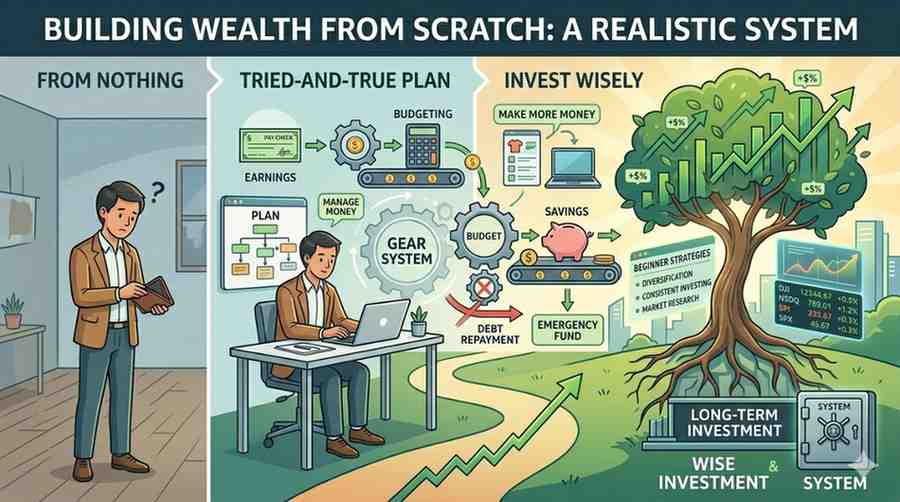
Started with zero at 28. Learn how to build wealth from nothing with simple steps, real math, and no gimmicks.
Disclaimer: I'm not a financial advisor. I'm just someone who went from $0 at 28 to a net worth I never thought possible. This is what worked for me and hundreds of others. Your results may vary. Do your own research.
Let me tell you something that might make you uncomfortable.
I was 28 years old with absolutely nothing. Not $100 in savings. Not a retirement account. Not even a clear idea of where my next $500 was coming from. I had a degree, a job that paid okay, and a bank account that hit exactly $43.00 two weeks before every payday.
I wasn't stupid. I wasn't lazy. I was just flying blind. Nobody had ever sat me down and explained how money actually works. My parents did their best, but they were just as lost as I was.
Fast forward ten years. I'm financially free. Not "I can buy a private jet" free. But "I don't wake up in cold sweats about money" free. I can take a month off work without panic. I can help my family when they need it. I can invest in things that actually matter to me.
You know what the difference was? It wasn't a massive inheritance. It wasn't a lucky stock pick. It was a system. A simple, repeatable, almost boring system that anyone can follow. And that's exactly what I'm going to share with you today.
Here's the truth that most financial gurus won't tell you: wealth building is not complicated. It's just not easy. There's a massive difference. Complexity is not your barrier. Consistency is.
The Biggest Lie About Money You've Been Told
Before we dive into the system, let's kill one myth dead. The biggest lie in personal finance is that you need to earn a lot to become wealthy.
I've met people making $300,000 a year who live paycheck to paycheck. I've also met people making $50,000 who are quietly building real wealth. Income is not the differentiator. Behavior is.
Think about this for a second. The average lottery winner goes broke within three to five years. Three out of four professional athletes file for bankruptcy within two years of retirement. These people had millions. Millions! And they still ended up broke. Why? Because they lacked the system.
Money without a system is like water without a container. It leaks. It evaporates. It disappears. You can pour more and more in, but if there are holes, it will never fill up. The system is the container. And most people don't have one.
What You'll Get From This Guide
I'm going to walk you through exactly what I did. Not theory. Not wishful thinking. The actual steps that took me from broke to financially free. By the time you finish reading, you'll understand:
- Why most people stay broke even when they earn more money
- The 5-step system that actually builds wealth from scratch
- How to start investing with as little as $10 (yes, seriously, $10)
- The difference between saving, investing, and trading (and which one you should actually care about)
- How to increase your income without working yourself into the ground
- Exactly what progress looks like and when you'll start seeing results
No fluff. No motivational speeches. No "manifest your wealth" nonsense. Just a proven system that works if you actually work it.
The 5-Step Wealth-Building System That Changed My Life
Here's the system I've used for years. I've refined it, tested it, and watched it work for dozens of others. It has five steps, and they build on each other. Skip one, and the whole thing falls apart. Do them in order, and you'll see progress.
Step 1: Get Brutally Honest About Your Numbers
Most people cannot tell you exactly how much they spent last month. They have a vague idea. A rough feeling. A "somewhere around there" number. That's not good enough.
The first step in this system is to get brutally honest about your current situation. Not the situation you wish you had. The one you actually have. And I mean brutal. You need to know exactly what comes in and exactly what goes out. Every single dollar.
Here's why this matters: you can't fix what you don't measure. I had a client named Marcus who thought he was spending about $200 a month on dining out. When we actually tracked it, he was spending $680. He was off by almost $500. That's $6,000 a year that was just... disappearing.
Marcus wasn't a bad person. He wasn't even irresponsible. He just had zero visibility. Once we surfaced that number, he could make an intentional decision about whether to keep spending that way or redirect the money toward his goals. He chose to redirect $300 of it to his savings account. That's $3,600 a year he started keeping instead of spending.
You need to know your numbers. Not to punish yourself. To empower yourself. Knowledge gives you the power to choose. Ignorance just makes you a passenger in your own financial life.
Step 2: Build a Budget That Actually Fits Your Real Life
I hate what most budgeting advice has become. It's all about cutting coffee, canceling Netflix, and feeling guilty about every little pleasure. That's not a budget. That's a punishment. And nobody sticks with a punishment for very long.
A good budget is not about restriction. It's about intention. It's about looking at your money and saying, "Here's what matters to me, and here's how I'm going to fund it."
There's no one-size-fits-all budget. Some people do better with the structure of zero-based budgeting. Others prefer the simplicity of the 50/30/20 rule. Still others, especially those with irregular income, need the flexibility of a more dynamic system. The key is to pick something and start.
I've written extensively about different budgeting methods on this site. If you're not sure where to start, here are a few options:
- The 50/30/20 Rule – Perfect for beginners with stable income. Simple, easy, and effective. You allocate 50% to needs, 30% to wants, and 20% to savings and debt.
- Zero-Based Budgeting – For people who want complete control and are willing to put in a bit more effort. Every single dollar gets a job.
- The Four Walls Budget – Focus on essentials first. Food, utilities, shelter, and transportation. Ideal for tight financial situations.
- 50 Smart Budgeting Hacks – Quick wins that don't require a complete lifestyle overhaul. Small changes that add up.
My personal recommendation? Start with zero-based budgeting for one month. It's the most effective way to understand where your money goes. If it feels too rigid, switch to the 50/30/20 rule. The key is to track for at least 30 days. You can't optimize what you don't understand.
Step 3: Build a Tiny Emergency Fund First
This is where most wealth-building advice goes wrong. They tell you to save three to six months of expenses immediately. That's great advice if you already have money. But if you're starting from zero, it's overwhelming and demoralizing.
Here's a more realistic approach: start with $500. That's it. Just $500 in a separate savings account that you don't touch unless it's a real emergency. Flat tire? You're covered. Urgent dentist visit? You're covered. Unexpected job loss? $500 gives you some breathing room while you figure things out.
I've seen people spend months trying to save three months of expenses and failing. Then they get discouraged and give up entirely. Starting with a smaller goal creates momentum. And momentum is the secret sauce of wealth building.
Once you hit $500, go for $1,000. Then one month of expenses. Then two. Build incrementally. Celebrate each milestone. This is how you make progress without burning out.
Step 4: Start Investing With Whatever You Have Right Now
This is where most people freeze. They think they need thousands of dollars to invest. They think they need to understand the stock market perfectly. They think they need to be sophisticated and knowledgeable.
You don't need any of that. You can start investing with $10. Yes, ten dollars. Here's why that's not crazy: the habit of investing is more important than the amount you invest. If you can invest $10 consistently every week, you'll eventually invest $100, then $500, then $1,000. The habit scales. The amount doesn't matter nearly as much.
Let me show you this with real numbers.
| Monthly Investment | Annual Return | After 10 Years | After 20 Years |
|---|---|---|---|
| $50 | 7% | $8,700 | $26,000 |
| $100 | 7% | $17,400 | $52,000 |
| $200 | 7% | $34,800 | $104,000 |
| $500 | 7% | $87,000 | $260,000 |
That's not magic. That's compound interest. It rewards consistency over perfection. It rewards patience over speed.
If you're new to investing, I recommend starting with low-cost index funds or ETFs. They're boring, but they work. You don't need to pick individual stocks. You don't need to time the market. You just need to consistently put money in and let time do its thing.
For crypto, be cautious. I like Bitcoin and Ethereum for the long term, but I also understand they can drop 50% in a month. Only put in what you can afford to lose. And never invest money you need for rent or food. That's not investing. That's gambling.
If you want to go deeper, here are some guides I've written that will help:
- How Regular People Get Rich in the Stock Market – The simple approach that works for most people.
- Is It Worth Buying $10 of Stock? – Yes, and here's why.
- The Stock Market Truth – Cut through the noise and focus on what matters.
Step 5: Create Multiple Income Streams (Without Burning Out)
Here's something nobody tells you: the safest way to build wealth is not to have a single high-paying job. It's to have multiple sources of income. Not because you need to work three jobs. Because you need to reduce your risk.
Imagine you have a $70,000 job. That's your main income. Now imagine you also have a side hustle that brings in $500 a month. It could be freelance writing, tutoring, selling digital products, or even a small online store. That's $6,000 a year in extra income.
Now imagine you lose your job. That $6,000 isn't going to replace your entire income, but it gives you breathing room. It buys you time. And time is the most important asset when you're between jobs.
The best part? That $6,000, if invested at 7%, grows to over $80,000 in 20 years. That's $80,000 you wouldn't have had if you'd stayed dependent on a single income stream.
I'm not suggesting you burn out trying to build multiple income streams overnight. Start with one. Something small. Something you enjoy or are good at. Test it. Refine it. Scale it. Then consider adding another.
If you're looking for ideas, I've put together a detailed guide on 10 Free Ways to Start Earning Passive Income. These are methods that have worked for real people, not theoretical concepts.
A Word on Trading: Please Don't Confuse It With Investing
I need to pause here and address something important. Trading is not investing. And I'm going to say this bluntly: most beginners should not trade.
Investing is buying and holding assets for years or decades. It's boring. It's slow. It's based on the fundamental principle that economies grow over time. Trading is buying and selling assets in days, hours, or even minutes. It's exciting. It's fast. It's based on predicting short-term price movements.
Here's the problem: 70% to 90% of retail traders lose money. Yes, you read that correctly. Nine out of ten people who try to trade lose their money. The reasons are simple: emotion, lack of strategy, and poor risk management.
If you want to trade, fine. But do it properly. Never risk more than 1% to 2% of your account on a single trade. Always use stop losses. And never, ever trade money you can't afford to lose. I've seen people wipe out months of savings in a single day because they got emotional and didn't follow these rules.
If trading genuinely interests you, I've written some guides for beginners:
- Trading for Beginners With $500 – How to start without blowing up your account.
- How to Build a Smarter Crypto Portfolio – Practical advice for the crypto curious.
- Forex Trading Real Talk – The honest truth about the largest financial market.
The Loop: How All Five Steps Work Together
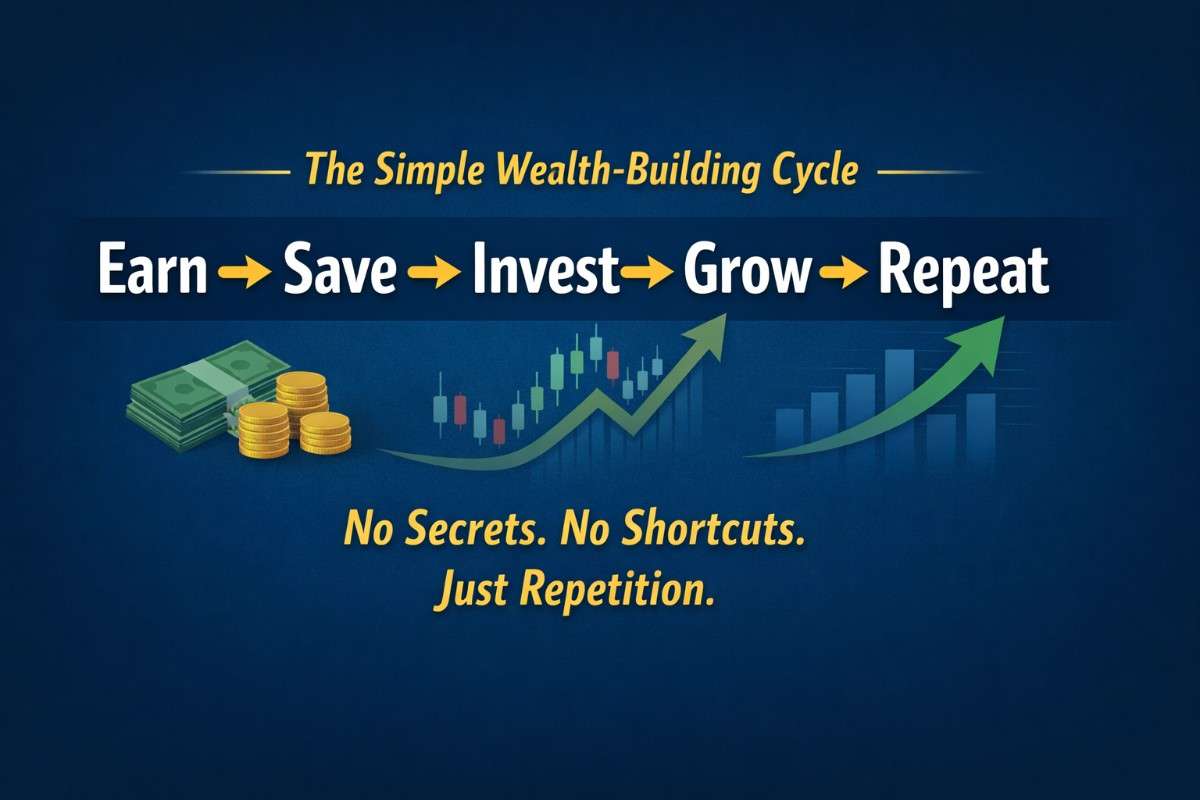
Here's the beautiful thing about this system: the steps reinforce each other. When you budget, you find money to save. When you save, you have money to invest. When you invest, your money grows. When your money grows, you have more to invest. And when you increase your income, you accelerate the whole thing.
It's a loop. And like any loop, it gets stronger the more you run it.
What Real Progress Actually Looks Like
Let me give you a realistic timeline. Not the fantasy you see on Instagram. The real one that actually happens.
Month 1-3: You're just starting. You're tracking expenses. You're building the habit of saving. You might save $200. That's a win. Most people don't even do this much.
Month 4-6: Your budget is working. You've built a small emergency fund of $500 to $1,000. You're starting to think about investing. Maybe you put $50 into an index fund. You're ahead of 80% of people.
Year 1: You've saved $2,000 to $3,000. You have an emergency fund. You're investing consistently. Your net worth is growing, even if it's small. You feel more in control than you ever have.
Year 3: Your savings and investments are starting to compound. You've got $10,000 to $15,000. That's real money. It's a down payment on a car or a significant emergency buffer.
Year 5: Compound interest is doing its thing. Your investments are growing faster than you can save. You've got $25,000 to $30,000. You look back and realize the person who started five years ago was different. You're not the same person.
Year 10: This is where it gets interesting. If you've been investing $200 a month at 7%, you'd have over $35,000. If you've been investing $500 a month, you'd have over $85,000. The numbers start to feel meaningful. And the loop gets stronger every year.
The gap between year 5 and year 10 is where most people give up. They've been consistent for half a decade, and they haven't seen life-changing results yet. But that's exactly the wrong moment to quit. Because that's when the compounding really starts to accelerate.
The Mistakes That Will Kill Your Wealth (I Made Most of These)
I've made most of these mistakes. I've watched others make the rest. Here are the ones you absolutely must avoid:
- Not having a system: This is the biggest one. Without a system, you're just guessing. And guessing doesn't work.
- Chasing get-rich-quick schemes: They don't work. They never work. They just take your money. If it sounds too good to be true, it is.
- Stopping the loop: The worst thing you can do is start, stop, start again, stop again. Consistency is everything. Starting and stopping is worse than never starting at all.
- Ignoring your numbers: If you don't know where your money is going, you can't control where it goes. It's that simple.
- Investing without understanding: Don't put money into anything you don't understand. Period. If you can't explain it to a 10-year-old, don't invest in it.
- Letting lifestyle inflation steal your progress: Every raise, promotion, and bonus is an opportunity to accelerate your wealth. Most people use it to upgrade their lifestyle instead. Don't be most people.
The Psychological Shift That Changes Everything
I saved the most important part for last. Wealth building is not just a financial exercise. It's a psychological one. The numbers are simple. The math is straightforward. But the mindset? That's where most people fail.
Here's what I've learned: wealth is not about the number in your bank account. It's about the relationship you have with money. It's about feeling in control. It's about knowing that you can handle financial surprises. It's about not waking up at 3 AM worrying about bills.
The shift happens slowly. You don't wake up rich one day. But you do wake up one day and realize that money is no longer a source of constant stress in your life. You realize you have options. You realize you're not trapped.
That is the real definition of financial freedom. Not infinite money. But enough money that it stops being a weight on your soul.
I can't tell you how long that will take for you. But I can tell you this: if you follow the system, you'll get there. Maybe in two years. Maybe in five. Maybe in ten. The timeline depends on your starting point and your consistency. But the destination is certain if you keep going.
Before You Go: One Final Thought
Most people will read this guide and do nothing. They'll nod along, feel inspired, and then go back to their normal routine. They'll wait for a better time. They'll wait for more money. They'll wait for the perfect moment.
The perfect moment doesn't exist. The only moment that matters is now.
You can start today with $5. You can start today with a single budget spreadsheet. You can start today by tracking one week of expenses. The starting point doesn't matter. What matters is that you start.
I was 28, broke, and completely lost. If someone had told me then that I'd be financially free in my 30s, I wouldn't have believed them. But here I am. Not because I'm special. Because I had a system and I stuck with it.
If I can do it, you can too. The question is: will you?
Recommended Reading
- 50 Smart Budgeting Hacks – Quick wins that save money without suffering.
- Zero-Based Budgeting: The Complete Guide – Take total control of every dollar.
- The Four Walls Budget – A survival-focused approach for tough times.
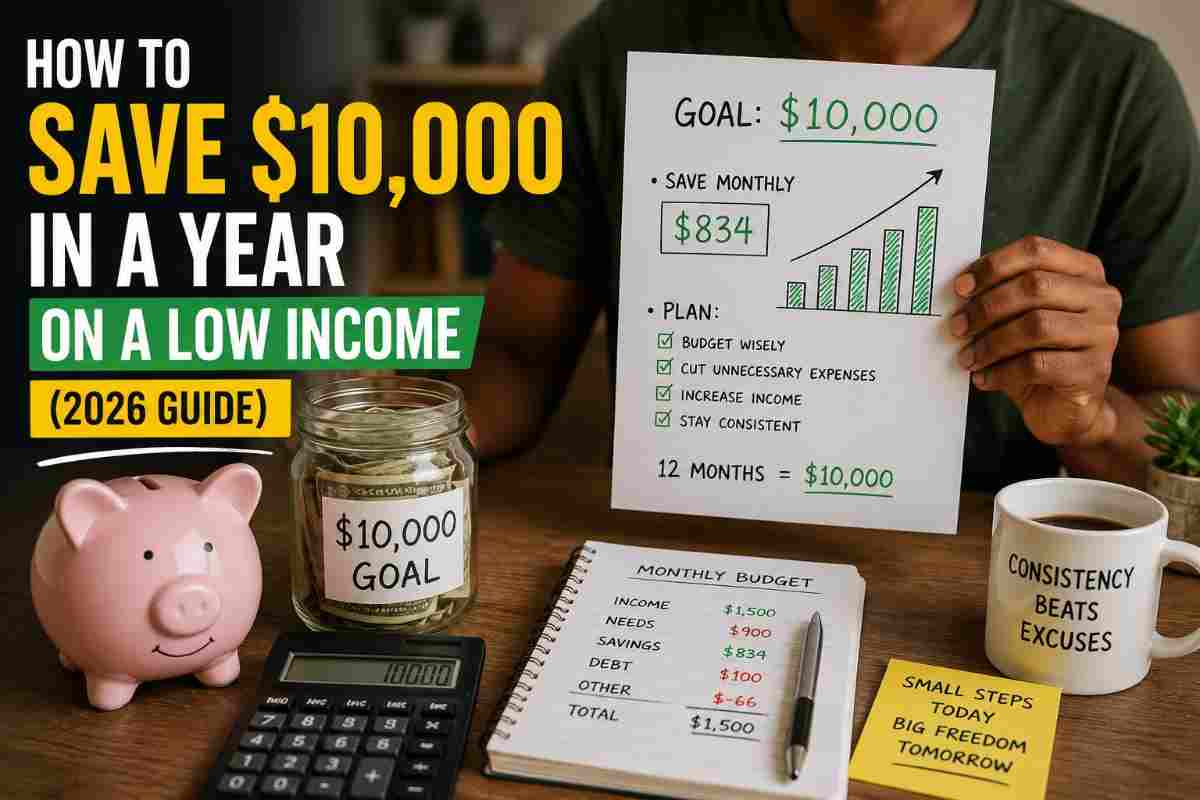
- The Fastest Way to Save $10,000 – Aggressive savings tactics that actually work.
📧 Want to ask me something personally? Drop me a message here. I read every single one.
Continue learning
Questions and answers
Can I really build wealth if I'm starting from absolutely zero?
Yes. I started from zero at age 28 and reached financial freedom by my late 30s. It takes time, consistency, and discipline, but the system works for anyone who follows it. The key is to start small and stay consistent. You don't need money to start building the habits that create wealth.
How long does it actually take to see results?
Realistically, 5 to 10 years to see significant progress. The first few years feel slow because your money isn't working hard yet. But around year 5, compounding starts to accelerate. Most people give up before year 3. If you can make it to year 5, you'll start seeing real results.
Should I invest or pay off debt first?
If your debt has an interest rate above 10%, pay it off aggressively. If it's low-interest debt (like a mortgage or student loans under 6%), invest while making minimum payments. And always keep a small emergency fund ($500-$1,000) before doing either. Don't leave yourself completely unprotected.
How much money do I actually need to start investing?
You can start with as little as $10. Many apps and brokers have no minimum. The habit matters more than the amount. Start small, stay consistent, and the amount will grow over time. What matters is that you start building the discipline.
What's the single biggest mistake people make?
Giving up too early. Most people quit in the first 1-2 years because they don't see immediate results. But wealth building is a long game. The biggest rewards come in years 5 through 20. If you can survive the boring middle, you win. Most people don't have the patience.
Building wealth is not complicated. It's just consistent. Track your money. Save before you spend. Invest what you can. Increase your income over time. Repeat this loop for years. It will feel boring. It will feel slow. But it works. The people who succeed are not the smartest or luckiest. They're just the ones who kept going when most people stopped.