Stock Market Investing for Beginners in 2026
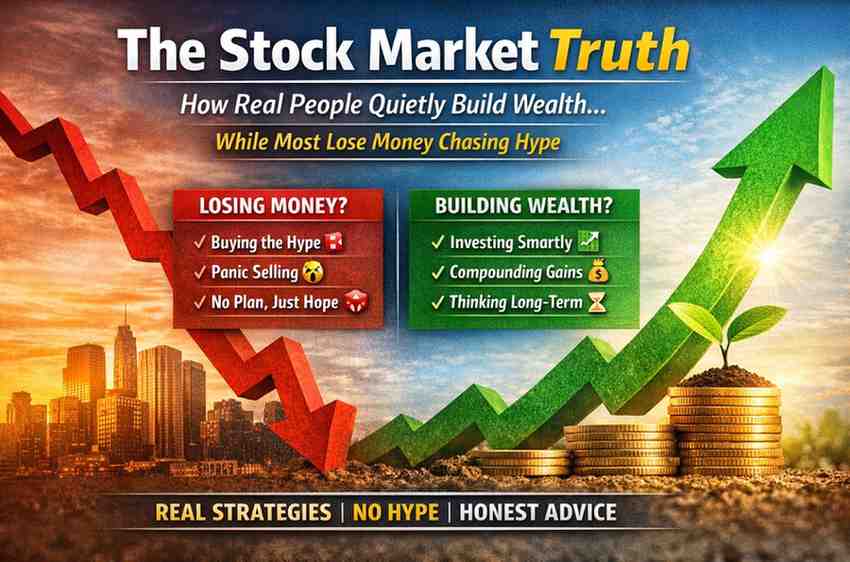
Tired of losing money in stocks? A real person's guide to building wealth in the stock market without hype, gambling, or unrealistic promises. Start with $10.
Let me tell you something embarrassing.
The first time I invested in the stock market, I had absolutely no idea what I was doing. None. Zero. I had read a few articles, watched a couple of YouTube videos, and felt like I was ready to become the next Warren Buffett.
I wasn't.
I bought a stock because people were talking about it on social media. It went up fast. I felt like a genius. Then it dropped hard. I panicked. I sold. And then it recovered without me.
I lost $2,400 in three weeks. That was real money. That was rent money. That was "I could have bought a decent used car" money.
That pain? It stays with you. But it also taught me everything.
If you're reading this, you might be feeling something similar. Maybe you've lost money before. Maybe you're afraid to start because you don't want to make mistakes. Maybe you see others making money and feel left behind.
I get it. I've been there. And I'm going to tell you exactly what I wish someone had told me 10 years ago.
What the Stock Market Actually Is (Not What You Think)
Here's the thing most people don't understand. The stock market isn't a casino. It's not a get-rich-quick machine. It's simply a place where people buy and sell ownership in real companies.
When you buy a share of Apple, you own a tiny piece of Apple. You're a part-owner of a company that makes iPhones and computers. When the company grows and earns more money, your piece becomes more valuable. When the company struggles, your piece becomes less valuable.
That's it. That's the whole thing.
But here's what makes it complicated: prices move every single day. And humans react emotionally to movement. That emotional reaction is what destroys portfolios. Not lack of intelligence. Not lack of access. Emotion.
The Emotional Cycle That Destroys Most Beginners
I've seen this play out hundreds of times. It looks like this:
- You hear about a stock going up fast. Everyone's talking about it.
- You feel the fear of missing out. You don't want to be left behind.
- You buy at a high price. Right when everyone else is buying.
- The stock drops. Of course it does. You bought at the top.
- You panic. You check your phone constantly. Every drop feels like a crisis.
- You sell. You lock in your losses. You tell yourself you'll never invest again.
- The stock rebounds. It always does. And you feel regret.
I've done this. I've watched friends do this. I've seen clients do this. It's the most common pattern in personal investing. And it's completely avoidable.
The Hard Truth About Market Returns
Let me give you some real numbers. Over the past 30 years, the S&P 500 has averaged about 10% annual returns. That's the long-term average. But here's what the average doesn't tell you.
In 2008, the S&P 500 dropped 38%. In 2020, it dropped 34% in a month. In 2022, it dropped 19%. If you had invested $10,000 at the beginning of 2008 and panicked in March 2009, you would have had about $6,200. If you had held on until 2024, you'd have over $30,000.
That's the difference between emotion and patience. The market rewards patience. It punishes panic.
The Two Paths in the Stock Market
| Path | Mindset | Behavior | Long-Term Result |
|---|---|---|---|
| The Emotional Path | “I don't want to miss out.” | Buys trends, reacts to news, panics | Inconsistent, stressful, often loses |
| The Strategic Path | “I follow a plan.” | Buys based on research and patience | Slow, steady compounding |
Most people think they're on the strategic path. Most people are actually on the emotional path. They just don't realize it until they've lost money.
Trading vs. Investing: Know the Difference
This is one of the most important distinctions you'll ever make. And most beginners get it wrong.
| Feature | Trading | Investing |
|---|---|---|
| Time Frame | Days to months | Years to decades |
| Focus | Price movement | Business growth |
| Stress Level | Very high | Moderate |
| Risk | Higher | Lower with diversification |
| Skill Needed | Timing and technical analysis | Patience and discipline |
| Success Rate for Beginners | Below 20% | Over 70% with long-term holding |
Here's a stat that blew my mind when I first learned it. Over 70% of active traders lose money. Most of them lose everything they started with. Meanwhile, long-term investors who simply buy and hold broad market funds have historically made money over any 10-year period.
Trading isn't investing. Trading is a profession. It takes years to learn. Most people never make it. Investing is for regular people. It's how regular people build wealth.
The Mistakes That Cost Me (And Most Beginners)
I made every mistake in the book. Here are the ones that hurt the most.
Mistake 1: Buying Based on Hype
Social media is not investment research. Reddit is not investment research. Your cousin who made $500 on a meme stock is not an investment expert.
If your reason for buying a stock is "everyone is talking about it," you're not investing. You're following a crowd. And crowds are usually wrong at the worst moments.
I bought a hyped stock at $120 because I saw it trending on Twitter. It dropped to $40 in six months. I sold at $45. Two years later, it was trading at $15. I got lucky. But I didn't learn my lesson then. I made the same mistake again.
Mistake 2: Watching Prices Every Hour
When you watch your portfolio constantly, every small move feels huge. A 2% drop feels like a crash. A 3% rise feels like a victory. You become addicted to the volatility. And addiction leads to bad decisions.
I used to check my portfolio 20 times a day. I couldn't focus on work. I couldn't sleep well. I was constantly stressed. And I made worse decisions because of it.
Now? I check my portfolio once a month. Sometimes once a quarter. My returns have improved significantly because I'm not making emotional decisions.
Mistake 3: Not Diversifying
I had 60% of my portfolio in one stock. I thought I was being smart. I thought I had found a winner. I was wrong.
That stock dropped 40% on bad earnings. I lost $3,000 in a single day. Diversification would have saved me. If I had spread that money across 10 or 20 different stocks, the loss would have been manageable.
Mistake 4: Investing Money I Needed Soon
I invested money I needed for rent. I told myself it was okay because "the stock was going to go up." It didn't. I had to borrow money to make rent. That's not investing. That's gambling with your survival.
Never invest money you need within five years. Never. That money belongs in a savings account or a CD. The stock market is for money you can leave alone.
How to Start the Right Way (Practical Plan)
Here's exactly what I wish someone had told me. It's simple. It's boring. It works.
Step 1: Build an Emergency Fund First
Before you invest a single dollar, save $500 to $1,000 in a separate savings account. This is your emergency fund. Flat tire? You're covered. Urgent dentist? You're covered. Unexpected job loss? You have time to breathe.
I can't tell you how many people I've seen who had to sell investments at a loss because they needed cash. An emergency fund prevents that. It's your financial firewall.
Step 2: Start With Broad Market Funds
Don't try to pick individual stocks as a beginner. You don't have the experience. You don't have the research skills. You're competing against professionals who do this for 80 hours a week.
Instead, buy index funds or ETFs that track the whole market. Think S&P 500, total stock market funds, or global market funds. These are boring. They're not exciting. But they have historically delivered 7-10% annual returns over the long term.
One of the best things you can do as a beginner is invest in a low-cost S&P 500 index fund. Companies like Vanguard, Fidelity, and Schwab offer these with very low fees. If you have $100, you can start.
Step 3: Invest Consistently (Not Perfectly)
Set up an automatic investment. $50 a month. $100 a month. Whatever you can afford. Automate it so you don't have to think about it.
Consistency beats timing. I've done the math. The person who invests $100 a month for 30 years at 7% will have over $120,000. The person who tries to time the market and invests nothing will have zero. Consistency wins every time.
Step 4: Think in Years, Not Weeks
Ask yourself this question before every investment: "Can I leave this money alone for at least five years?" If the answer is no, don't invest it.
The stock market rewards patience. It punishes panic. If you can't handle short-term volatility, you shouldn't be in stocks. And that's okay. There's nothing wrong with being a cautious investor.
Is the Stock Market Gambling?
This is the question I get asked most often. Here's my answer: it depends on how you approach it.
| Gambling | Investing |
|---|---|
| Based on chance | Based on business performance |
| Short-term thrill | Long-term ownership |
| Emotional decisions | Strategic decisions |
| No edge | Research-based edge |
| You're betting against the house | You own the house |
If you treat the stock market like a casino, it becomes one. If you treat it like ownership in real businesses, it becomes a wealth-building tool. The difference is entirely in how you approach it.
What Market Crashes Really Mean (And What to Do)
Let me tell you something that will save you thousands of dollars. Market crashes are not the end of the world. They're actually opportunities. But only if you understand what's happening.
In 2020, the market dropped 34% in a single month. People were terrified. They sold everything. They locked in losses. Two years later, the market had more than recovered. Those who held on made their money back and then some.
In 2022, the market dropped 19%. Again, people panicked. Again, those who stayed calm were rewarded. The market recovered and went on to hit new highs.
Here's the pattern: markets go down, then they go up. They always have. Not in a straight line. Not without pain. But over the long term, markets have historically trended upward.
What should you do during a crash? If you're investing for the long term, you should do nothing. Absolutely nothing. Don't sell. Don't panic. Just keep investing. If you have extra cash, consider buying more. Crashes are sales for long-term investors.
The Wealth-Building Mindset Shift
Here's the biggest shift I made. Most beginners focus on one question: "How much can I make this month?" Wealth builders focus on a different question: "How much can I grow over decades?"
That shift changes everything. It changes your behavior. It changes your stress levels. It changes your results.
When you think in decades, you stop caring about daily price movements. You stop checking your portfolio every hour. You stop making emotional decisions. You just... invest. And wait. And let compounding do its work.
Compounding is the quiet engine behind wealth. It's not sexy. It's not exciting. But it works. Albert Einstein supposedly called it the eighth wonder of the world. I understand why.
If you invest $100 a month at 7% annual return, you'll have about $17,000 after 10 years and over $120,000 after 30 years. That's not a trick. That's just math. And it's math that works for anyone who's consistent.
What Rich People Do Differently
I've studied wealthy investors for years. Here's what they actually do differently.
- They invest regularly. Rain or shine, up or down, they keep investing. Consistency is their superpower.
- They ignore short-term noise. They don't watch financial news. They don't follow meme stocks. They focus on the long term.
- They reinvest dividends. Instead of spending dividends, they reinvest them. This accelerates compounding dramatically.
- They diversify. They don't put all their eggs in one basket. They spread their risk across many companies and industries.
- They stay patient during crashes. They see crashes as buying opportunities, not catastrophes.
- They avoid emotional decisions. They have a plan and they stick to it. No panic selling. No FOMO buying.
It's boring. It's unglamorous. It works.
The Stock Market as Part of a Complete Wealth System
Here's something I don't see talked about enough. The stock market is just one piece of a complete wealth-building system. You need more than just investments.
You need a budget. You need an emergency fund. You need multiple income streams. You need to understand your numbers. You need to build the discipline of saving before spending.
If you're serious about building wealth, you need a complete system. I've written the full roadmap in my guide Building Wealth From Scratch: The 5-Step System That Actually Works. It covers everything from your first $500 saved to consistent investing and multiple income streams.
The stock market is your wealth accelerator. But it's not your foundation. Your foundation is your system. Build the system first. Then let the stock market accelerate your growth.
Final Word: You Can Do This
I started with nothing. I made mistakes. I lost money. I learned. I built a system. And now I'm financially free.
If I can do it, you can too. The stock market is not a mystery. It's not a casino. It's a tool. And like any tool, it works if you use it correctly.
Start small. Start simple. Start today. Even $10 is a start. The habit matters more than the amount. And if you're patient enough to stick with it, the results will come.
Recommended Reading
- Building Wealth From Scratch – The complete 5-step system.
- The 50/30/20 Rule – Master your budget first.
- How Regular People Get Rich in the Stock Market – More detailed investing strategies.
- Is It Worth Buying $10 of Stock? – Yes, and here's why.
📩 Want more honest money advice? Subscribe to my newsletter. No hype. Just real strategies from someone who's been there.
Continue learning
Questions and answers
Is the stock market safe for beginners?
It depends on how you approach it. If you invest in diversified index funds for the long term, it's historically been safe. If you trade individual stocks and try to time the market, it's very risky. Start with index funds and a long-term mindset.
How much money do I really need to start investing?
You can start with as little as $10. Many brokerages allow fractional share investing. The habit matters more than the amount. Start small, stay consistent, and let time do its work.
Can I lose all my money in the stock market?
Yes, especially if you invest in single high-risk stocks. Diversification reduces this risk. Index funds are much safer because they spread your money across hundreds of companies. But no investment is completely risk-free.
Is investing better than trading for beginners?
Absolutely. Investing is for building wealth over time. Trading is a profession that takes years to learn. Most retail traders lose money. For beginners, investing is far more sustainable and less stressful.
How long should I hold my investments?
Years, not weeks. A minimum of five years is a good rule of thumb. The longer your time horizon, the more time compounding has to work its magic. If you need the money in less than five years, consider safer options like savings accounts.
The stock market rewards patience, discipline, and emotional stability. It punishes greed, fear, and impulsiveness. It is not magic and it is not guaranteed — but when approached correctly, it has historically been one of the most powerful wealth-building tools available to ordinary people. Start small. Stay consistent. And give it time.