Best Trading for Beginners With $500 in 2026
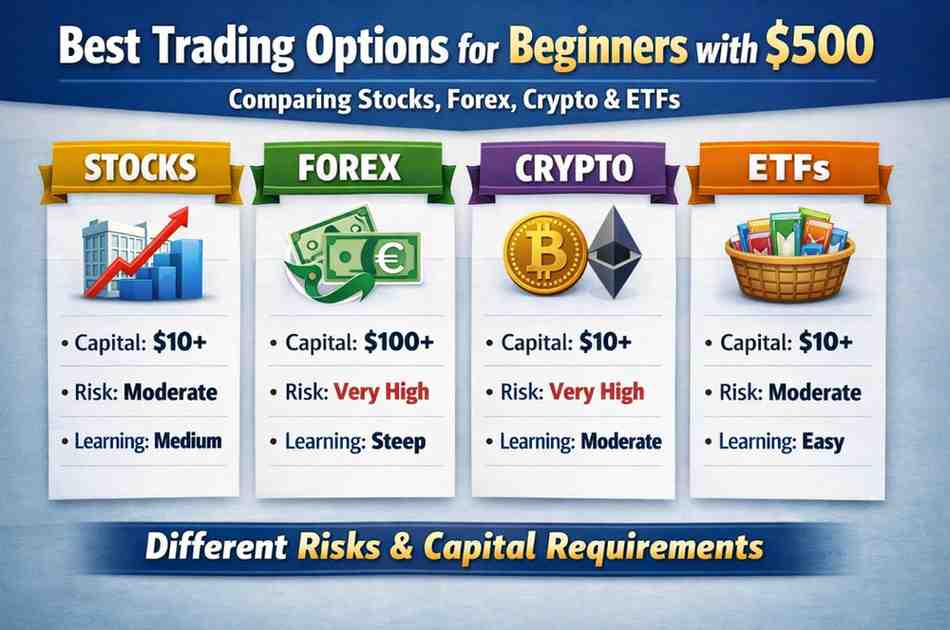
Most beginner trading advice is dangerous. Learn which markets work for a small account and why buying and holding may be smarter.
Let me tell you about the worst $500 I ever spent.
I was 24, had just saved my first real chunk of money, and I thought I was about to become a trader. I had watched a few YouTube videos, read some forums, and convinced myself that I could turn $500 into $5,000 in a few weeks.
Spoiler alert: I did not turn $500 into $5,000. I turned $500 into $147 in about three weeks. And then I turned that $147 into $0 a week later on a stupid options trade I didn't fully understand.
I felt embarrassed. I felt stupid. I felt like everyone else was making money and I was the only one who couldn't figure it out.
Here's the thing. I wasn't stupid. I was just misinformed. I was following advice that was designed for people with much larger accounts, much more experience, and much better risk management. I was trying to sprint before I could walk.
If you're sitting on $500 and wondering whether to start trading, I'm going to give you the honest truth. Not the hype. Not the get-rich-quick nonsense. The real truth that I wish someone had told me ten years ago.
The Brutal Reality of Trading With a Small Account
Let's start with the math. Because math doesn't care about your feelings.
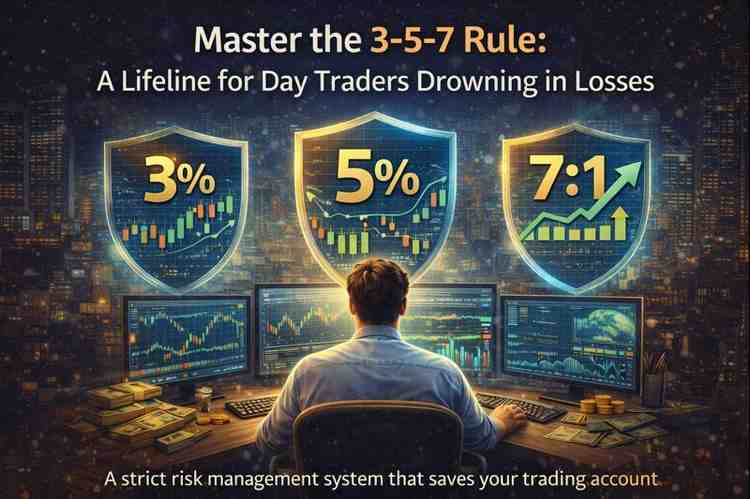
If you have a $500 account and you risk 1% per trade (the standard recommendation for professionals), you're risking $5 per trade. That's it. Five dollars. Now, with a $5 risk, you need to set your stop loss very tight. And tight stops get hit by normal market noise. You'll get stopped out constantly, losing your $5 again and again.
What about commissions? Even at $0 commissions, you're still paying spreads. In forex, the spread is the commission. In crypto, fees are 0.1% to 0.5% per trade. On a $500 trade, that's $0.50 to $2.50. Doesn't sound like much, but if you trade frequently, those fees eat a huge percentage of your account.
Now factor in the emotional cost. When your account is tiny, every trade feels huge. A $50 loss is 10% of your account. That hurts. And when you're hurting, you make emotional decisions. You revenge trade. You double down. You ignore your stop losses. And that's exactly how small accounts get blown up.
The data backs this up. Brokerage studies consistently show that 70% to 80% of retail traders lose money. And the ones who lose the fastest are those with small accounts who trade frequently.
The Markets: Which One Is Actually Worth Your $500?
Let's go through the main options and give you the unvarnished truth about each.
Stocks: The Classic Choice, But Not for Day Trading
Stock trading is the most familiar market. You buy shares of a company, hope the price goes up, and sell at a profit. Sounds simple, right?
With $500, you can buy fractional shares of expensive stocks like Amazon or Google. That's a good thing. But here's the problem: stock prices don't move much in a day. A 1% move on a $500 position is $5. That's your risk per trade. You might make $5 or lose $5. To make meaningful money, you need to take larger positions, which means more risk, which means you might lose it all.
Also, there's the pattern day trader rule in the U.S. If you make more than three day trades in a rolling five-day period, you need a minimum of $25,000 in your account. So with $500, you can't day trade stocks. You're limited to swing trading (holding for days or weeks). That's actually a blessing in disguise because it forces you to be patient.
I've found that the best use of a $500 stock account is to buy and hold a solid company or an ETF for the long term. Don't trade it. Invest it. But that's not trading; that's investing. And there's a huge difference.
ETFs: The Smartest Move for a Beginner
ETFs are baskets of stocks that trade like a single share. An S&P 500 ETF gives you exposure to 500 of the largest U.S. companies. Buying one share spreads your risk across hundreds of businesses.
With $500, you can buy an ETF and hold it. You don't need to research individual companies. You don't need to worry about one bad earnings report wiping you out. You just need to believe that the overall market will grow over time. Historically, it has.
If you're determined to "trade" rather than "invest," you can swing trade ETFs. They have lower volatility than individual stocks, but they still move. A 2% swing in a week is common. On $500, that's $10. It's not life-changing, but it's a way to practice without massive risk.
The biggest advantage of ETFs for beginners is psychological. You're less likely to panic because the moves are gentler. And you're less likely to blow up your account because diversification protects you from complete loss.
Forex: The Market That Eats Beginners for Breakfast
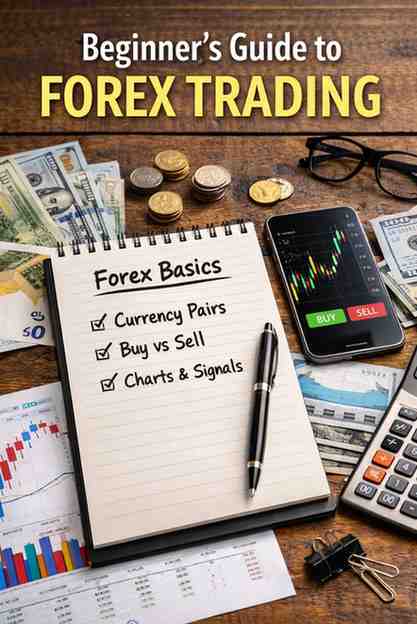
I'm going to be blunt: forex is a terrible choice for most beginners. I know it looks tempting. You see ads for "trade forex with $50" and massive leverage. But that leverage is a trap.
Forex brokers offer leverage of 50:1, 100:1, or even 500:1. That means with $500, you can control $25,000 or $250,000 worth of currency. That sounds amazing. But leverage works both ways. A 1% move against you can wipe out your entire account in minutes. I've seen it happen. I've done it myself.
The forex market is also highly unpredictable. Currency movements are driven by central bank decisions, geopolitical events, and economic data. Unless you're an economist with deep knowledge, you're essentially gambling.
A statistic that always sticks with me: over 70% of retail forex traders lose money, and the average account lasts less than six months. Your $500 is not going to survive if you trade forex aggressively. It's just not.
Cryptocurrency: The Wild West of Trading
Crypto is exciting. Bitcoin and Ethereum have made people rich. But they've also destroyed many portfolios. In 2022, Bitcoin dropped 65% from its peak. That's a normal crypto cycle.
With $500, you can buy a fraction of a Bitcoin or several altcoins. The fees are low, and there's no pattern day trader rule. You can day trade crypto to your heart's content. But should you?
The problem is volatility. A 10% drop in a day is common. A 20% drop in a week is normal. If you're leveraged (and many crypto exchanges offer leverage), you could lose your $500 in an hour. I've seen people lose everything on a sudden crash while they were asleep.
If you want to experiment with crypto, I'd suggest buying a small amount and holding for years. That's investing, not trading. If you trade crypto with $500, you're playing a dangerous game.
Options: Stay Away Until You're an Expert
Options trading is one of the most complex financial instruments. It's not for beginners. Even experienced traders can lose money quickly with options. I lost my last $147 on an options trade because I didn't understand time decay.
Options give you the right to buy or sell a stock at a certain price by a certain date. They're like betting on how high or low a stock will go. But they expire worthless if you're wrong. Many beginners buy cheap options (called "lottery tickets") hoping for a 10x return. Most of them lose 100% of their investment.
If you're a beginner, just don't. Seriously. Learn the basics with stocks and ETFs first. Options are for later, if ever.
So What Should You Actually Do With Your $500?
I've been where you are. I know you want to trade. I know you want to make money fast. But I'm going to give you the best advice you'll get all year: don't trade. Invest.
With $500, your best move is to open a brokerage account, buy a low-cost S&P 500 ETF (like VOO or SPY), and add $50 to it every month. In 10 years, you'll have over $15,000 if you just hold and add consistently. In 20 years, over $40,000. That's not a trading strategy. That's a wealth-building strategy.
I know that's not exciting. I know it doesn't make a good story. But it's what actually works. The people who get rich in the stock market aren't day traders. They're patient holders who let compounding do the work.
If you absolutely must trade, use a paper trading account for at least six months. Prove to yourself that you can be consistently profitable without risking real money. Most people can't. That's a valuable lesson to learn for free.
And if you find that you enjoy studying markets and want to pursue trading as a serious skill, then start with a larger account (at least $2,000 to $5,000) after you've paper traded successfully. But even then, limit your risk to 1% per trade. It's not about making money fast. It's about surviving long enough to learn.
Trading vs. Building Wealth: Know the Difference
Here's something I wish I'd understood at 24. Trading is a profession. It requires years of study, discipline, and emotional control. Most people don't succeed. Building wealth is a system. It requires consistency, patience, and a simple plan. Most people can succeed.
If your goal is to build wealth, you don't need to trade. You need to earn, save, invest consistently, and increase your income over time. That's it. That's the whole formula. It's not sexy. It's not exciting. But it's the path that actually works.
I've written a complete guide to this approach in Building Wealth From Scratch: The 5-Step System That Actually Works. It starts with budgeting, moves to saving, then investing, and finally increasing your income. Trading is not part of that system because trading is not a reliable wealth-building tool for ordinary people.
I wasted $500 learning that lesson. You don't have to.
The Final Verdict: Which Market for a $500 Beginner?
| Market | Minimum Capital | Fees | Learning Curve | Risk Level | Suitability for $500 Account |
|---|---|---|---|---|---|
| Stocks (Swing) | $0 | $0 | Moderate | Moderate | Good for learning |
| ETFs | $0 | $0 | Low | Moderate | Best for beginners |
| Forex | $100 | Spread | Steep | Very High | Avoid as a beginner |
| Crypto | $10 | 0.1-0.5% | Steep | Extreme | High risk, minimal allocation |
| Options | $100 | $0.50-$1.00 | Very Steep | Very High | Avoid entirely |
As you can see, ETFs are the clear winner for a beginner with $500. They offer diversification, low risk, and a gentle learning curve. If you want to practice trading, swing trade ETFs. If you want to build wealth, buy and hold them.
A Realistic Plan for Your $500
- Step 1: Open a brokerage account with a reputable broker (Fidelity, Vanguard, Schwab, or Robinhood).
- Step 2: Put $500 into the account. Don't trade yet. Just let it sit.
- Step 3: Spend at least two months paper trading. Learn about support/resistance, moving averages, and risk management.
- Step 4: If you're consistently profitable in paper trading, start with $50 real money. Trade with that for a month. See how emotions affect you.
- Step 5: If you're still profitable and feel in control, scale up to $200. Eventually, if it works, you can add more. But the most likely outcome is that you'll realize trading isn't for you, and you'll decide to invest the $500 in an ETF and leave it alone.
That's the honest path. It's not glamorous. But it's how you avoid losing your money.
Final Thought: Don't Let FOMO Ruin Your Finances
The biggest danger for beginners is fear of missing out. You see others making money on social media. You see headlines about crypto mooning. You feel like you're being left behind.
Stop. Those posts are curated. They show wins, not losses. The people who made money on crypto also lost money. The people who post huge gains also took huge risks that could have wiped them out. You're seeing the highlight reel, not the full picture.
Your $500 is real money. It took time to earn. Don't gamble it away because of FOMO. Use it wisely. Invest it. Let it grow. And if you want to learn trading, learn with fake money first. Your future self will thank you.
I learned this the hard way. I wish I hadn't. Now I'm telling you so you don't have to make the same mistake.
Recommended Reading
- Building Wealth From Scratch – The complete wealth-building system.
- The Stock Market Truth – Build wealth without gambling.
- How Regular People Get Rich in the Stock Market – The simple strategy that works.
- Is It Worth Buying $10 of Stock? – Yes, and here's why.
- Forex Trading Real Talk – The honest truth about forex.
📩 Want more honest financial advice? Subscribe to my newsletter. No hype. Just real strategies from someone who's been there.
Continue learning
Questions and answers
What is the best type of trading for a beginner with $500?
Swing trading ETFs is the most practical approach. It requires less time, has lower transaction costs, and spreads risk across hundreds of companies. Day trading stocks is not allowed with less than $25,000, and forex/crypto trading is too risky for most beginners.
Can I day trade with $500?
In the U.S., day trading stocks requires a $25,000 minimum account. Forex and crypto have no such rule, but day trading with $500 carries extremely high risk due to leverage and transaction costs. Most day traders with small accounts lose everything.
Is forex trading good for beginners?
No. Forex trading is highly leveraged and volatile. Over 70% of retail forex traders lose money. Beginners are better off avoiding forex entirely until they have extensive education and a larger capital base.
How much money do I need to start trading stocks?
A person can start with $0 using fractional shares. Many brokers let you buy $1 worth of a stock. However, for meaningful returns and to cover transaction costs, $500 is a reasonable starting point for learning.
What is the riskiest trading market for beginners?
Options and cryptocurrencies carry the highest risk for beginners. Options have complex mechanics and time decay. Cryptocurrencies have extreme price volatility, with daily swings of 10-20% being common, and they are unregulated in many jurisdictions.
Should I use leverage as a beginner?
Absolutely not. Leverage amplifies losses just as much as gains. Most small accounts that use leverage fail within the first year. A beginner should trade without leverage until they have a proven track record of profitability.
What percentage of beginner traders succeed?
Broker and regulator disclosures consistently show that 70% to 80% of active retail traders lose money over time. Success rates are higher for long-term investors who buy and hold diversified ETFs.
How long should I paper trade before using real money?
Paper trade for at least three to six months. You should show consistent profitability and emotional control in your simulated trades before risking any real capital. If you can't be profitable on paper, you won't be profitable with real money.
Trading is hard. Most people fail. Your $500 is better spent on building a foundation of wealth through budgeting, saving, and long-term investing. If you must trade, treat it as a learning experience, not a path to riches. Start with paper trading, keep your risk small, and never invest money you can't afford to lose. The real wealth-building path is boring, but it works.