Forex Trading for Beginners: A Real Talk Guide
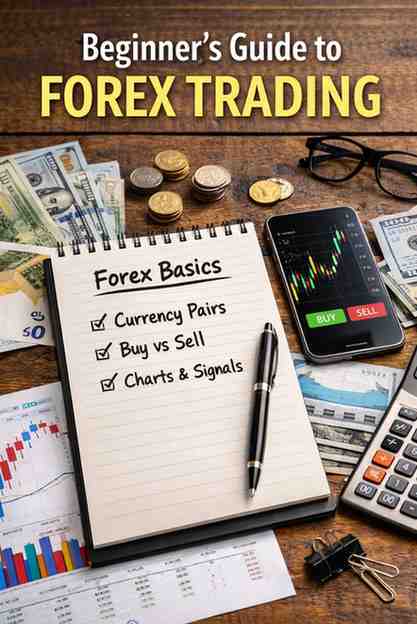
A realistic forex guide for beginners: understand the risks, start safely, and learn why patience matters more than hype.
Hey there. You’ve probably seen the ads the fancy cars, the beachside laptops, the promise of financial freedom in just “30 minutes a day.” It looks tempting, right? Let’s be real for a second: trading forex isn’t a magic money button. But can it be a legit way to make some extra income? Absolutely. If you’re patient, disciplined, and willing to learn.
I’m not here to sell you a dream. I’m here to give you the honest, no BS roadmap that most gurus charge thousands for. Think of this as a chat with a friend who’s been where you are and made all the mistakes, so you don’t have to.
What IS Forex, Anyway?
Remember that time you went on vacation and had to swap your dollars for euros? That’s forex in its simplest form. You’re trading the value of one country’s money for another’s.
The online trading part is just betting on whether that exchange rate will go up or down. If you think the Euro will get stronger against the US Dollar, you buy the EUR/USD pair. If you’re right, you profit. If you’re wrong, you lose. That’s it. No mysterious algorithms, no secret society just supply and demand on a global scale.
Zero-based budgeting gives every dollar a purpose. If you want tighter control over spending, the full method is explained step by step in this guide.
Why It’s Actually a Pretty Cool Side Hustle
Listen, I have a day job. I get it. Here’s why forex grabbed my attention (and why it might grab yours):
- You can start small. I began with $200. No, really. You don’t need a trust fund.
- The market never sleeps. It’s open 24 hours a day during the week. Early bird or night owl? You can trade when it fits your life.
- Practice is free. Every legit broker will give you a “demo account” with fake money. It’s like a flight simulator for traders. Use it first.
- It’s a skill. Unlike gambling, this is something you can actually get better at with study and practice.
The Scary Part (And How to Not Get Wrecked)
Let’s address the elephant in the room: You can lose money. Fast. The main culprit? Leverage.
Brokers might let you control $10,000 with only $100 of your own money (that’s 100:1 leverage). Sounds amazing for profits, right? It’s also terrifying for losses. A tiny move against you can wipe out your whole account.
Your Golden Rule 1: Never, ever trade with money you can’t afford to lose. Your rent money? Your kid’s college fund? Off-limits. This is risk capital.
Your First Week: What to Actually Do
- Pick a Broker, Not a Scam. Go with a name that’s regulated (look for FCA, ASIC). I started with OANDA for its user-friendly platform. eToro or IG are also solid for beginners. Just avoid the flashy pop-up ads promising “100% returns.”
- Open That Demo Account. Seriously. Don’t even think about real money yet. Play with the platform for at least a month. Make all your beginner mistakes here, where it doesn’t cost you a dime.
- Learn ONE Thing. Don’t drown in information. This week, just learn to read a basic candlestick chart on YouTube. See how price moves. That’s enough.
Wealth building rarely happens overnight. Understanding how everyday investors grow money steadily, as explained in this post, helps set realistic expectations.
The One Strategy to Start With
Forget the complicated indicators. Start here:
Trade the Obvious Trend. Look at a chart (try the EUR/USD on the 4-hour timeframe). Is it generally making higher highs? That’s an uptrend. Is it making lower lows? That’s a downtrend.
Your job as a beginner is simple: In an uptrend, look for opportunities to BUY. In a downtrend, look for opportunities to SELL.
That’s it. Don’t try to guess the top or bottom. Just go with the flow. It’s like surfing you catch the wave that’s already moving, you don’t try to create it.
The Mind Game: This is Where Most People Fail
Trading is 80% psychology. Here’s what nobody tells you:
- You WILL have losing trades. It’s not failure; it’s part of the job. Even the pros are wrong 40-50% of the time.
- The “Revenge Trade” is a trap. You lose $20, get mad, and immediately jump into another trade to win it back. That’s how you lose $200. Walk away. Close the laptop. Breathe.
- FOMO (Fear Of Missing Out) is your enemy. That feeling that you have to be in a trade? Ignore it. The market will be there tomorrow. There are always more opportunities.
Your Realistic First-Year Roadmap
| Time Period | Focus | What You Should Be Doing | Real Goal |
|---|---|---|---|
| Months 1–3 | Demo Trading Only | Trade with fake money. Practice entries, stop-losses, and exits. Get used to being wrong without emotional damage. | Don’t blow up the demo account. Build discipline, not confidence. |
| Months 4–6 | Micro Live Account | Fund a small account with $100–$500. Trade the smallest size possible (0.01 lots). Follow your plan strictly. | Execute your strategy and control emotions with real money on the line. |
| Months 7–12 | Consistency Phase | Keep position size small. Journal every trade. Review mistakes weekly. Avoid emotional decisions. | Go 3 months in a row without revenge trading. Consistency matters more than profit. |
forex markets can be rewarding but unforgiving. Having a structured plan matters even more when volatility is high, which is why learning solid risk frameworks from this post is essential.
The Bottom Line
Forex isn’t a side hustle where you make $500 in your first hour. It’s a skill you develop, like learning guitar or coding. It’s frustrating, rewarding, and requires a ton of patience.
But if you approach it with respect, a learner’s mindset, and rock-solid risk management, it can be one of the most interesting and empowering skills you ever pick up.
Ready to just dip your toes in? Here’s your homework:
- Google "OANDA demo account" (https://www.oanda.com) or "eToro demo account" (https://www.etoro.com).
- Sign up. Don’t deposit any money.
- For one week, just watch the EUR/USD chart move. That’s it.
No pressure. No risk. Just start looking. You might just get hooked on the puzzle of it all.
P.,S. I’m not a financial advisor. This is just my experience. Trading is risky. Please don’t risk what you can’t afford to lose. Start slow, learn fast, and keep your day job while you figure this out. You’ve got this.
Trading and investing become easier when personal finances are stable. If saving is a priority for you, the step-by-step approach shared in this guide provides a practical roadmap.
To bulding a wealth in any space not only in trading, you need proper scaling, not only making profit is important but securing it, cutting loss and expenses is more important, you can check : building wealth from scratch to learn more about building wealth. the aim is to build wealth not just to be rich!