How to Save $10,000 in a Year on a Low Income (2026 Guide)

Learn how to save $10,000 in a year on a low income with this step-by-step guide. Realistic strategies, budgeting tips, and income boosts that actually work.
Let me tell you about the moment I realized that saving $10,000 on a low income was not only possible, but absolutely necessary.
I was 27, working as a retail supervisor making $34,000 a year. My car needed a $1,800 transmission repair. I didn't have it. I put it on a credit card at 22% APR and spent the next 18 months paying it off. That $1,800 repair ended up costing me $2,400. I was a grown adult who couldn't cover a basic emergency without going deeper into debt.
That moment changed everything. I promised myself I would never be in that position again. I set a goal: save $10,000 in one year, even on my low income. Twelve months later, I had $10,200 in a high-yield savings account. I didn't win the lottery. I didn't get a massive raise. I just followed a system. A disciplined, realistic system that anyone can follow.
Here's the truth about saving $10,000 in a year on a low income. Most people think it's impossible because they only focus on cutting expenses. They think they need to live on rice and beans and never have fun. That's not sustainable. And it's not the smartest way.
The smartest way is to attack the problem from both sides. Cut expenses AND increase income. When you do both simultaneously, you create a savings accelerator that can get you to $10,000 faster than you think, even when your paycheck is modest.
Why $10,000? The Real Cost of Having No Safety Net
Ten thousand dollars is not a random number pulled from a motivational poster. It is roughly three to six months of essential living expenses for the average American household — the gold standard for an emergency fund recommended by financial planners across the industry. Yet for millions of people earning modest incomes, this figure feels impossibly out of reach.
Here is the reality: according to Debt.com's 2026 annual budgeting survey, 48% of Americans are still living paycheck to paycheck. While this marks an improvement from the record high of 69% in 2025, nearly half the country remains one missed paycheck away from financial crisis. Even more telling, 95% of survey respondents say that economic uncertainty and rising costs have made budgeting more important than ever.
The Federal Reserve's Survey of Household Economics and Decisionmaking found that only 37% of adults in their 20s have enough emergency savings to cover three months of expenses. For Gen Z specifically, the median emergency savings balance sits at just $400. That is not a safety net. That is a tightrope.
Saving $10,000 in a year on a low income is not about deprivation. It is about building a financial buffer that protects you from predatory payday loans, high-interest credit card debt, and the sleepless nights that come with financial precarity. This guide was written for the server earning $32,000 a year, the retail worker making $15 an hour, the single parent stretching every dollar, and the recent graduate drowning in entry-level wages. If you have been told that saving significant money requires a six-figure salary, you have been misinformed.
The Math: Breaking Down $10,000 Into Bite-Sized Goals
The most common reason people abandon savings goals is psychological overwhelm. Ten thousand dollars sounds massive until you dissect it. Here is how the math breaks down across different timeframes:
| Timeframe | Amount to Save |
|---|---|
| Monthly | $833.33 |
| Bi-Weekly | $384.62 |
| Weekly | $192.31 |
| Daily | $27.40 |
Viewed daily, the goal requires setting aside less than the cost of a restaurant meal. Viewed monthly, it is comparable to a car payment. The key is choosing a rhythm that aligns with your pay schedule. If you are paid bi-weekly (26 paychecks per year), saving $385 per check gets you to $10,010 by year's end.
But here is what most guides will not tell you: you do not need to save the full amount from your existing income. The most effective low-income savers combine expense reduction with income generation. If you can cut $400 from your monthly spending and earn an extra $433 through side work, you hit your target without touching your base salary. This dual-approach strategy is what separates successful savers from those who burn out after month two.
Step 1: Audit Your Finances (Most People Skip This)
Before you can save $10,000, you need to know exactly where your money is going. Not approximately. Exactly. A financial audit sounds intimidating, but it is simply a 30-day exercise in radical honesty.
The 30-Day Expense Audit
For one month, track every single dollar that leaves your possession. Use a spreadsheet, a notebook, or a budgeting app — the tool does not matter. The accountability does. Categorize every expense into three buckets:
- Fixed Essentials: Rent, utilities, minimum debt payments, insurance, basic groceries, transportation to work.
- Variable Discretionary: Dining out, entertainment, subscriptions, hobbies, non-essential shopping.
- Financial Leaks: Late fees, unused memberships, impulse purchases, convenience store runs.
According to the Bureau of Labor Statistics' Consumer Expenditure Survey, the average American household spends $78,535 annually, with housing ($26,266), transportation ($13,318), and food ($10,169) consuming the largest shares. For low-income households, these three categories often consume 70-80% of take-home pay, leaving almost no room for savings.
After 30 days, ask yourself these questions: Am I paying for subscriptions I forgot about? The average American underestimates their monthly subscription spending by $133. How much am I spending on food away from home? The BLS reports that food away from home costs significantly more per meal than home-cooked equivalents. Are my banking fees eating into my balance? Overdraft fees, monthly maintenance fees, and out-of-network ATM charges can total $300+ annually.
**Pro Tip:** Do not judge yourself during the audit. This is data collection, not a confession. The goal is to create a baseline, not to induce shame.
Step 2: Build a Budget That Actually Works for Low Incomes
Once you have your audit data, it is time to build a budget framework. The popular 50/30/20 rule — 50% needs, 30% wants, 20% savings — is mathematically sound but often unrealistic for low-income earners. If 80% of your income covers basic survival, allocating 20% to savings feels like a cruel joke.
Instead, consider these modified approaches designed for constrained cash flow:
The 60/20/20 Survival Budget
60% to essentials (housing, utilities, groceries, transportation, minimum debt payments). 20% to savings and extra debt payments. **20%** to discretionary spending. This framework acknowledges that low-income households need more breathing room in their essentials category while still prioritizing savings.
Zero-Based Budgeting
Every dollar gets a job before the month begins. Income minus expenses equals zero — not because you spend everything, but because every dollar is assigned to a category, including savings. This method prevents the "I will save what is left over" trap, which almost always results in saving nothing.
The Envelope Method (Digital or Physical)
Withdraw your discretionary spending in cash and divide it into envelopes labeled "Groceries," "Gas," "Entertainment," etc. When an envelope is empty, spending in that category stops until the next pay period. Digital alternatives like Qube Money and Goodbudget replicate this system without the ATM visits.
**Expert Insight:** "When I work with clients living paycheck to paycheck, I begin by reassuring them that their situation is common and that they are not failing in any way. From there, I recommend budgeting apps to help them gain clarity on where their money is going and identify areas where they can cut back or make adjustments. I will also advise them to prioritize essential expenses — food, utilities, housing, and transportation — with everything else considered secondary or negotiable." — Certified Financial Counselor, LendEDU
Step 3: Cut Expenses Without Sacrificing Everything
The word "budget" triggers images of instant ramen and canceled Netflix accounts. That is not sustainable, and sustainability is what gets you to $10,000. The goal is strategic reduction, not masochistic deprivation.
Housing (Your Biggest Lever)
Housing consumes 33% of the average household budget — the largest single category. While moving is not always possible, consider these options:
- Negotiate your rent: A proven track record of on-time payments gives you leverage. Ask for a reduction in exchange for a longer lease term.
- Get a roommate: Splitting rent can free up $400-$800 monthly, depending on your market.
- Rent out unused space: Platforms like Neighbor allow you to monetize parking spots, storage areas, or spare rooms without taking on a full-time roommate.
Food (The Second-Largest Expense)
The average household spends $847 monthly on food. For a family of four, that figure climbs to $950-$1,200. Here is how to reduce it without eating beans and rice exclusively:
- **Meal plan around sales:** Check grocery store flyers before planning meals. Build your week around what is discounted.
- **Embrace generic brands:** Store-brand products typically cost 20-40% less than name brands with minimal quality difference.
- **Limit dining out:** Three in four Americans now consider dining out a regular grocery expense rather than a special occasion. If you currently eat out four times per week, reducing to once weekly could save $200-$300 monthly.
- **Use cashback apps:** Apps like Upside, Ibotta, and Fetch Rewards return real money on purchases you are already making.
Transportation
The American Automobile Association estimates the total cost to own and operate a new vehicle at $11,577 annually, or roughly $965 monthly. Consider:
- Refinancing your auto loan: If interest rates have dropped since your purchase, refinancing could lower your monthly payment.
- Shopping insurance annually: Use comparison tools to review auto insurance rates. The average driver who switches saves $610 per year.
- Using public transit or carpooling: Even two days per week of alternative transportation can save $100+ monthly in gas and parking.
Subscriptions and Digital Leaks
Audit every recurring charge. Cancel services you have not used in 30 days. Downgrade plans where possible. That $15 streaming service you opened for one show and forgot about? That is $180 annually — nearly two weeks of savings toward your $10,000 goal.
Step 4: Automate Your Savings (Set It and Forget It)
Willpower is a finite resource. The most successful savers remove decision-making from the equation entirely through automation.
Pay Yourself First
Treat your savings contribution like a non-negotiable bill. On payday, before you pay anyone else, transfer your predetermined savings amount to a separate account. If you are paid bi-weekly and aiming for $10,000, that means moving $385 per check immediately upon deposit.
Use a High-Yield Savings Account
Your savings should not sit in a traditional checking account earning 0.01% APY. As of mid-2026, the best high-yield savings accounts offer APYs between 3.00% and 4.21% — rates that outpace current inflation levels of approximately 2.7%. The FDIC reports that the national average savings account APY is just 0.38%, meaning the difference between a traditional bank and a top online high-yield account can equal hundreds of dollars in passive income over a year.
Consider these top options for 2026: Axos Bank offers up to 4.21% APY with qualifying activity. EverBank Performance Savings offers 3.90% APY with no minimum balance. Marcus by Goldman Sachs offers 3.40% APY with no monthly fees. Ally Bank offers 3.00% APY with strong digital tools.
On a $10,000 balance, the difference between 0.01% and 4.00% APY is approximately $400 in interest over one year. That is free money simply for choosing the right account.
Set Up Automatic Transfers
Most banks allow you to schedule recurring transfers from checking to savings. Time these transfers to occur within 24 hours of your paycheck deposit. This creates an artificial scarcity in your checking account, forcing you to live on what remains rather than what you hoped to save.
The 52-Week Challenge Variation
The traditional 52-week challenge has you save $1 in week one, $2 in week two, and so on, totaling $1,378. For a $10,000 goal, try a modified version: start with $50 in week one and increase by $2 each week. By week 52, you are saving $152 that week, and your total exceeds $5,200. Pair this with automated monthly transfers of $400, and you hit $10,000 comfortably.
Step 5: Boost Your Income (Even by $200/Month Changes Everything)
Cutting expenses has limits. Income generation does not. If your current job covers bare survival, increasing your earnings is the fastest path to $10,000.
Negotiate a Raise
If you have been in your position for 12+ months with solid performance, you have leverage. Research salary benchmarks for your role on sites like Glassdoor and Payscale. Prepare a one-page document highlighting your contributions, then schedule a conversation with your manager. Even a 5% raise on a $35,000 salary adds $1,750 annually — 17.5% of your savings goal.
Start a Side Hustle
The side-hustle economy has evolved significantly. In 2026, AI-powered tools have lowered the barrier to entry for freelancing, allowing individuals to handle invoicing, marketing, and client acquisition with minimal overhead. Consider:
- **Freelance writing, graphic design, or virtual assistance:** Platforms like Upwork and Fiverr connect you with clients immediately.
- **Tutoring or teaching online:** If you have expertise in any subject, sites like Wyzant and Preply pay $15-$50 per hour.
- **Delivery driving or rideshare:** Flexible hours allow you to work around your primary job.
- **Selling unused items:** Clothing, electronics, furniture, and sports equipment can generate $500-$1,500 in a single weekend of listing on Facebook Marketplace or eBay.
Realistic Math: An extra $200 per month from a side hustle equals $2,400 annually. Combined with $7,600 in expense reductions and automated savings, you reach $10,000 without extreme sacrifice.
Monetize Existing Assets
- Rent your car: Turo allows you to rent your vehicle when you are not using it.
- Rent storage space: If you have a garage, basement, or parking spot, platforms like Neighbor turn unused space into monthly income.
- Cashback and rewards: Use a cashback credit card for essential purchases you already make, then pay it off in full monthly. Never carry a balance — the interest will erase your rewards.
Step 6: Protect Your Progress and Avoid Common Pitfalls
Saving $10,000 is only half the battle. Keeping it requires discipline and awareness of the traps that derail most savers.
Avoid New Debt
This is non-negotiable. New credit card debt, buy-now-pay-later plans, and payday loans will destroy your progress faster than you can build it. The average credit card interest rate in 2026 hovers near 20% APR. Carrying a $3,000 balance costs $600 annually in interest alone — money that should be going toward your goal.
If you have existing high-interest debt, use the avalanche method: make minimum payments on all debts, then throw every extra dollar at the highest-interest balance first. Once that is eliminated, roll that payment into the next highest. This mathematically optimal approach saves the most money over time.
Build a Mini Emergency Fund First
Before attacking your $10,000 goal aggressively, save $1,000 in a separate account as a buffer. This prevents you from tapping your main savings when the car battery dies or the dentist finds a cavity. Think of it as insurance against your own plan.
Beware Lifestyle Inflation
When you start earning more or spending less, the temptation to upgrade your lifestyle is intense. You might think, "I have been eating rice and beans for three months; I deserve this dinner out." One dinner becomes two. Two becomes a habit. Before you know it, your $400 monthly surplus has evaporated.
Combat this by automating your lifestyle. Set your savings transfers, then intentionally allocate a small "fun money" category — $50-$100 monthly — that you can spend guilt-free. Deprivation leads to rebellion. Moderation leads to sustainability.
Review and Adjust Quarterly
Your financial situation changes. Maybe you got a raise. Maybe your rent increased. Maybe your side hustle took off. Every three months, review your budget, savings rate, and progress toward the $10,000 goal. Adjust your automation settings accordingly.
Real-World Scenario: How Maria Saved $10,000 on $35,000/Year
Maria is a 28-year-old administrative assistant in Phoenix, Arizona. She earns $35,000 annually, or approximately $2,400 monthly after taxes. Here is exactly how she saved $10,000 in 12 months:
Income Boosts:
- Negotiated a 4% raise after documenting her contributions: +$1,400/year
- Tutored elementary students online for 4 hours weekly at $20/hour: +$4,160/year
- Sold unused clothing and furniture: +$800 one-time
Expense Reductions:
- Moved in with a roommate, reducing rent from $1,200 to $700: -$500/month = $6,000/year
- Meal prepped and stopped dining out except once monthly: -$180/month = $2,160/year
- Switched auto insurance and phone plans: -$85/month = $1,020/year
- Canceled unused subscriptions and gym membership (switched to home workouts): -$65/month = $780/year
**Total Annual Changes:** $15,320 in freed-up cash flow. She saved $10,000, used $2,000 to pay down credit card debt, and kept $3,320 as a buffer for irregular expenses. Maria's situation is not unique. It is representative of what happens when you combine modest income increases with systematic expense reduction.
Pros and Cons of Aggressive Saving
Before committing to this goal, understand the tradeoffs:
| Pros | Cons |
|---|---|
| Builds financial security and reduces anxiety | Requires short-term lifestyle adjustments |
| Establishes disciplined money habits that last decades | May limit social activities temporarily |
| Creates opportunities (career changes, investments, emergencies) | Can feel isolating if friends/family do not share the goal |
| Qualifies you for better financial products and rates | Risk of burnout if you cut too deeply |
| Proves to yourself that financial goals are achievable | Unexpected expenses can derail progress without a buffer |
The key is balance. Saving $10,000 should improve your life, not make it miserable. If you find yourself dreading every day, your plan is too aggressive. Scale back slightly and extend your timeline by a month or two. A sustainable 14-month plan is infinitely better than a failed 12-month plan.
Tools and Resources to Speed Up Your Journey
Budgeting Apps: YNAB (You Need A Budget) is best for zero-based budgeting and offers a 34-day free trial. PocketGuard shows exactly how much "safe to spend" money you have after bills and goals. EveryDollar offers simple envelope-style budgeting with a free tier.
Savings Automation:Qapital rounds up purchases and saves the difference. Digit analyzes your spending and automatically saves small amounts you will not miss. Your bank's auto-transfer feature is often the simplest and most reliable option.
High-Yield Savings Accounts (2026):*Compare rates at Bankrate, NerdWallet, and Forbes Advisor before opening an account. Look for no minimum balance, no monthly fees, and daily compounding interest.
Side Hustle Platforms: Upwork offers freelancing across hundreds of categories. Rover connects you with dog walking and pet sitting gigs. TaskRabbit offers handyman services, furniture assembly, and errand running.
Conclusion: Your $10,000 Starts With One Decision
Saving $10,000 in a year on a low income is not about finding a magic trick or discovering a hidden fortune. It is about making a series of small, intentional decisions that compound over 365 days. It is about choosing the high-yield savings account over the traditional one. It is about meal prepping on Sunday instead of grabbing takeout on Tuesday. It is about asking for the raise you have earned and picking up the side hustle that fits your skills.
The Debt.com 2026 survey found that 88% of people who budget say it has helped them get out of debt or stay out of it. The system works — but only if you start.
You do not need to implement every strategy in this guide tomorrow. Pick one expense to cut this week. Open one high-yield savings account this weekend. List one item for sale online tonight. Momentum builds momentum, and $10,000 is simply the sum of 365 small wins.
Your next step: Open a high-yield savings account today and set up an automatic transfer of $50 from your next paycheck. It is not the full $833, but it is the first brick in a foundation that will support you for years to come.
Recommended Reading
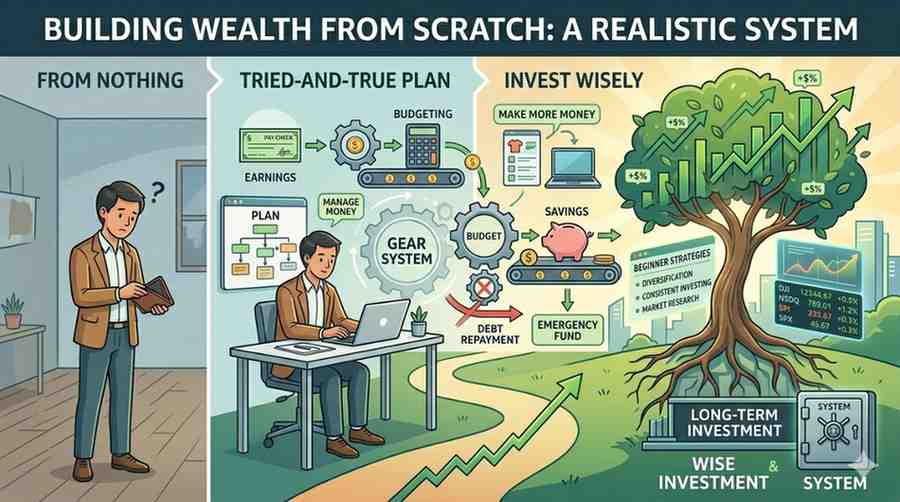
- Building Wealth From Scratch – The complete system.
- Zero-Based Budgeting – Total control over every dollar.
- 50 Smart Budgeting Hacks – Quick wins to save more.
- The 50/30/20 Rule – A simple budgeting alternative.
- 15 Side Hustles – Real ways to earn extra money.
Continue learning

Questions and answers
How much do I need to save per month to reach $10,000 in a year?
You need to save approximately $833 per month, $385 per bi-weekly paycheck, or $192 per week. However, you can reach this goal through a combination of expense cuts and income boosts rather than relying solely on your existing surplus.
Can I save $10,000 in a year if I earn minimum wage?
It is extremely challenging but not impossible if you combine aggressive expense reduction with significant income supplementation. You may need to extend your timeline to 18 months or share housing costs to make the math work on a minimum-wage income.
What is the fastest way to save $10,000?
The fastest way is to simultaneously reduce your largest expenses (housing, transportation, food) and increase your income through a side hustle or overtime. Selling unused high-value items can also provide an immediate lump sum boost.
Should I pay off debt or save $10,000 first?
If you have high-interest debt (credit cards with 15%+ APR), pay it down aggressively while building a $1,000 mini emergency fund. Once high-interest debt is eliminated, redirect those payments toward your $10,000 savings goal. Low-interest debt (student loans, mortgages) can coexist with savings.
Where should I keep my $10,000 savings?
A high-yield savings account at an FDIC-insured online bank is ideal. It keeps your money liquid, safe, and growing at 3-4% APY. Avoid checking accounts (too easy to spend) and certificates of deposit (too restrictive for emergency funds).
What if I have an emergency and need to use my savings?
That is exactly what the money is for. If you deplete your fund, do not abandon the goal. Rebuild it using the same system that got you there. Financial resilience is not about never falling down; it is about having the structure to get back up.
Is the $10,000 savings challenge realistic for families?
Yes, though it requires household-wide commitment. Families often have more expense-cutting opportunities (shared housing, bulk grocery shopping) but also higher baseline costs. A family of four might aim for $10,000 over 18 months rather than 12.
How do I stay motivated when progress feels slow?
Track your net worth monthly, not just your account balance. Celebrate milestones ($1,000, $2,500, $5,000) with small, budgeted rewards. Join online communities like Reddit's r/personalfinance or r/Frugal for accountability and inspiration.
The fastest way to save $10,000 on a low income is to combine increased income, automated savings, and a tighter budget working together at the same time. No single trick gets you there the combination does. Cut expenses where you can. Earn more where you can. Automate everything. Stay consistent. Track your progress monthly. And remember that daily habits build wealth, not one-time efforts. Your $10,000 goal is achievable. Start today.