Accountsmaxxing Explained: Gen Z Money Trend
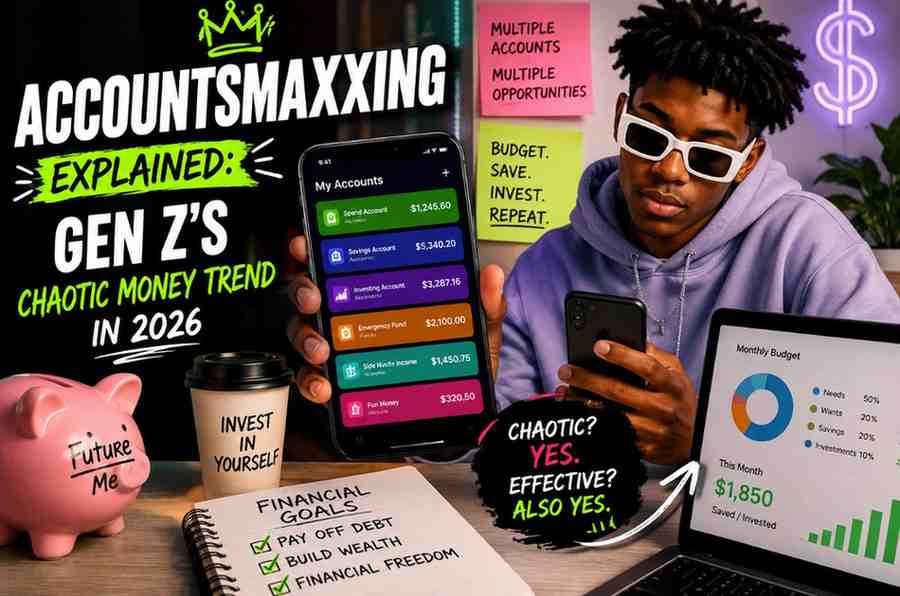
Accountsmaxxing is Gen Z's chaotic yet genius approach to money. Learn what it is, why it's trending, and how to make it work for your finances.
Let me tell you about a money trend that's confusing the heck out of financial advisors everywhere.
On one hand, you've got Gen Zers saving like their lives depend on it. Twenty-six-year-old Natalie Baddour has socked away $300,000 for retirement. Her peer Grace Colvin has $100,000 saved. They're driving old cars, splitting rent with roommates, and eating at home to make it happen [citation:6].
On the other hand, Gen Z is pouring money into crypto, day trading, meme stocks, and prediction markets. According to the World Economic Forum, 71% of Gen Z crypto investors have more than one-third of their portfolio in crypto [citation:1]. Thirty-two percent are currently invested in or considering cryptocurrency [citation:11].
This contradiction is called Accountsmaxxing.
It's the financial equivalent of having your cake and eating it too. Or, as financial planner Rohit Shah puts it, a "chaotic yet genius approach to managing money" [citation:1][citation:2].
Accountsmaxxing is the term for Gen Z's tendency to simultaneously open and manage multiple financial accounts, from 401(k)s to crypto wallets, while juggling side hustles and spending on things that bring them joy. It's not just about saving. It's about optimizing every single dollar and account to its maximum potential.
What Is Accountsmaxxing? The Definition
Accountsmaxxing is exactly what it sounds like: maximizing your accounts. Every financial account you can open, you open. Every dollar you can save, you save. Every perk, rewards point, and interest rate you can optimize, you optimize.
It's a variation of the broader "maxxing" trend that's taken over TikTok. There's looksmaxxing (optimizing physical appearance), sleepmaxxing (optimizing sleep), and moneymaxxing (optimizing money) [citation:4][citation:12]. Accountsmaxxing is the financial arm of this optimization obsession.
But here's what makes it different. Accountsmaxxing isn't just about frugality. It's about aggressive financial participation across multiple fronts. One Gen Zer might have:
- A 401(k) with employer matching
- A Roth IRA
- A high-yield savings account (HYSA)
- A crypto wallet with Bitcoin and Ethereum
- A brokerage account for individual stocks
- A side hustle account for freelance income
- Multiple credit cards to maximize rewards points
This is the "scattered, contradictory, yet surprisingly effective" approach to money that defines Gen Z's financial strategy [citation:1].
The Contradiction: Saving Like a Boomer, Investing Like a Degenerate
Here's what makes Accountsmaxxing so fascinating. Gen Z is doing two things at once that should be impossible: they're saving aggressively for retirement AND taking massive risks with their money.
Let me show you the numbers.
The Saving Side:
- Two-thirds of Gen Z say they are saving, up from 60% in 2024 [citation:3].
- Gen Zers have three times as much invested in retirement accounts as Gen Xers did at the same age [citation:6].
- By 2024, young people were starting to save and invest in retirement accounts as early as 19 years old — more than a decade earlier than previous generations [citation:6].
- Forty-two percent practice "loud budgeting" being vocal with friends about what they can and cannot afford [citation:3].
The Risk Side:
- Nearly 40% of Gen Z are investing in high-risk assets like prediction markets, sports betting, and crypto [citation:11].
- Thirty-two percent are invested in or considering cryptocurrency [citation:11].
- Seventy-one percent of Gen Z crypto investors have more than one-third of their portfolio in crypto [citation:1].
- Eighty percent of Gen Z respondents are considering high-risk assets because they feel financially behind and believe those investments may accelerate progress toward their financial goals [citation:11].
This is the Accountsmaxxing paradox. Young people are building responsible, long-term wealth while simultaneously chasing get-rich-quick schemes. They're treating the market like a casino AND a retirement plan.
Mohit Gang, CEO of Moneyfront, says it plainly: "Gen Z is getting addicted to betting sites, prediction markets, gaming apps, F&O and crypto platforms. They want everything quick and now" [citation:1].
Why Is Accountsmaxxing So Popular? The Economic Anxiety Factor
Accountsmaxxing isn't happening in a vacuum. It's a direct response to the economic reality Gen Z is facing.
Let's be honest. This generation inherited a mess. Student loan debt averaging $94,101. Housing costs that have skyrocketed. Inflation that keeps eating away at purchasing power [citation:6][citation:3].
Gen Z is struggling with higher rates of unemployment, low wages, and a high cost of living [citation:6]. Forty-two percent report living paycheck to paycheck [citation:3]. Nearly 30% point to housing and rent as top barriers to financial success [citation:3].
At the same time, traditional safety nets are shrinking. Employer-sponsored retirement plans are declining. Social welfare programs are being cut [citation:8]. And 72% of Gen Zers still rely on their parents for financial support [citation:4].
This generation has "less financial stability and social safety nets, so the onus shifts to the individual to think about their financial wellbeing," says Natalya Guseva, head of the World Economic Forum's financial markets and resilience initiatives [citation:8].
When the system isn't providing security, people create their own. Accountsmaxxing is that creation. It's a way to build multiple safety nets, diversify risk, and create options where none seem to exist.
As Grace Colvin, the 26-year-old with $100,000 saved, told Bloomberg: "I might not leave my job necessarily, but I'm going to say no to things that I simply don't want to do. You're not as tempted by the 'golden handcuffs' anymore" [citation:6].
The Social Media Effect: Finance as Entertainment
Here's another factor driving Accountsmaxxing: social media has completely rewritten how people learn about money.
Personal finance is no longer something that comes neatly packaged from classrooms or textbooks. Instead, it's being picked up by scrolling through Instagram, YouTube Shorts, and finance reels between memes and music drops [citation:1].
Finance is no longer an elite language spoken in boardrooms. It's now bite-sized, viral, and sometimes dangerously oversimplified [citation:1].
The problem? When financial advice comes wrapped in 30-second clips and catchy hooks, it becomes just as easy to misunderstand as it is to consume. The result is a generation that is informed, but sometimes dangerously overconfident and exposed to get-rich-quick temptations [citation:1].
Almost 44% of Gen Z rely on YouTube videos for financial information, while 34% turn to Instagram or TikTok [citation:7]. Six in ten young adults who followed financial advice they found on social media ended up regretting it [citation:14].
This is the dark side of Accountsmaxxing. The same platforms that teach Gen Z about Roth IRAs and high-yield savings accounts also push crypto speculation and meme stock gambling. The advice is democratized, but so is the misinformation.
Is Accountsmaxxing Smart Finance or Chaotic Spending?
This is the million-dollar question. And the answer, like most things, is complicated.
The Smart Side: What Accountsmaxxing Gets Right
- Early start = massive compounding. Gen Z is starting to save and invest earlier than any generation in history. By 2024, young people were opening retirement accounts at 19 more than a decade earlier than their parents. That's not just smart. That's generational wealth in the making.
- Multiple income streams. Gen Z is earning money in a very different way compared to earlier generations. Along with regular jobs, they're stacking up side hustles like freelancing, creator-led work, affiliate marketing, online tutoring, reselling, and entrepreneurship [citation:1]. This builds resilience.
- Cost-consciousness. Despite the risk-taking, Gen Z is also incredibly cost-conscious. They're cutting back on dining out (40%), passing on events with friends (24%), and picking up side hustles (16%) [citation:3]. Three-quarters of Gen Z take active steps to save money when making social plans [citation:3].
- Financial transparency. Gen Z is normalizing conversations about money. Forty-two percent practice "loud budgeting," openly discussing financial limits with friends [citation:3][citation:5]. This destigmatizes saving and creates accountability.
The Dangerous Side: What Accountsmaxxing Gets Wrong
- Overexposure to risk. Seventy-one percent of Gen Z crypto investors have more than one-third of their portfolio in crypto [citation:1]. That's not diversification. That's a gamble. Cryptocurrency is volatile and unregulated in many jurisdictions.
- Retirement account raiding. Forty-two percent of Gen Zers who built up retirement accounts dipped into them to cover debt [citation:6]. This is a financial disaster. Early withdrawal penalties and taxes destroy wealth.
- FOMO-driven decisions. Eighty percent of Gen Z respondents are considering high-risk assets because they feel financially behind [citation:11]. Fear of missing out is a terrible investment strategy.
- Short-form misinformation. Social media financial advice is often oversimplified and dangerous. The influencers shaping Gen Z's money mindset are often operating in a space that is "far more viral than verified" [citation:1].
How to Do Accountsmaxxing the Right Way
Accountsmaxxing isn't going away. The economic conditions that created it are too entrenched. But here's how to use it as a wealth-building tool rather than a wealth-destroying trap.
- 1. Get the Order Right: Build your financial foundation first. Emergency fund ($500-$1,000). High-interest debt paid off. Retirement accounts funded (at least to employer match). Then, and only then, consider speculative investments. High-risk assets like crypto should be a small percentage of your portfolio, not a third of it.
- 2. Distinguish Investing from Gambling: Investing is long-term ownership in businesses that create value. Gambling is betting on short-term price movements. Understand the difference. If you can't explain what you own, you're gambling.
- 3. Automate Your Savings: The most successful Accountsmaxxers automate their savings before they can spend the money. Set up automatic transfers to your 401(k), Roth IRA, and HYSA on payday. If you never see it, you can't spend it.
- 4. Use the 75-15-10 Rule: A realistic budget for high-cost environments. Allocate 75% to needs, 15% to savings and investments, and 10% to debt repayment. This gives you room to live while still building wealth. Learn more in our guide on the 75-15-10 budget rule.
- 5. Be Intentional About Your Feed: Curate your social media feed to include people with similar financial aspirations. This can provide both practical ideas and a sense of accountability [citation:4].
- 6. Build Your Complete Wealth System: Accountsmaxxing is just one piece of the puzzle. To build real wealth, you need a complete system. Budgeting. Saving. Investing. Income growth. I've written the full roadmap in Building Wealth From Scratch: The 5-Step System That Actually Works.
Final Thoughts: The Future of Accountsmaxxing
Accountsmaxxing is not a fad. It's a response to economic reality. Gen Z is navigating a world with less stability, higher costs, and fewer safety nets than any generation in living memory. Their financial strategy reflects that.
There's a reason financial advisors like Winnie Sun call it a "cultural shift," not just a trend [citation:4]. It's "frugality made cool again" [citation:4]. And as Jack Howard, head of money wellness at Ally Bank, notes, it focuses on creating everyday habits for long-term financial success, "rather than jumping from one money trend to the next in search of a quick fix" [citation:4].
The challenge is balance. Gen Z's aggressive risk-taking needs to be tempered with disciplined, long-term wealth-building strategies [citation:2]. Quick wins are tempting. But sustainable wealth comes from consistency, not luck.
If you're an Accountsmaxxer, keep optimizing. Keep saving. Keep investing. But build a foundation first. Protect your emergency fund. Don't gamble with your retirement. And remember: the goal isn't just to have accounts. It's to build the life you want.
Recommended Reading
- Building Wealth From Scratch The complete wealth system.
- The 50/30/20 Rule A simple budgeting alternative.
- Zero-Based Budgeting Total control over every dollar.
- How to Budget With Irregular Income For freelancers and gig workers.
- The Fastest Way to Save $10,000 Achieve your savings goals.
- 25 Money Habits Keeping You Broke More traps to avoid.
- 10 Free Ways to Start Earning Passive Income Build multiple income streams.
Continue learning

Questions and answers
What is accountsmaxxing in personal finance?
Accountsmaxxing is the Gen Z money trend of aggressively opening and managing multiple financial accounts, from 401(k)s and Roth IRAs to crypto wallets and brokerage accounts, while optimizing every dollar and account to its maximum potential. It combines long-term retirement saving with short-term speculation.
Is accountsmaxxing a smart financial strategy?
It depends on how you do it. The smart side is starting early, saving consistently, and building multiple income streams. The dangerous side is overexposure to high-risk assets like crypto and raiding retirement accounts to cover debt. The key is building a foundation first and keeping speculation as a small percentage of your portfolio.
Why is Gen Z so interested in accountsmaxxing?
Gen Z is navigating a world with less financial stability, higher costs, and fewer safety nets than previous generations. They're facing student loan debt, high housing costs, inflation, and declining employer-sponsored retirement plans. Accountsmaxxing is a response to this economic anxiety.
What percentage of Gen Z invests in crypto?
Thirty-two percent of Gen Z are invested in or considering cryptocurrency [citation:11]. Among Gen Z crypto investors, 71% have more than one-third of their portfolio in crypto [citation:1].
What is loud budgeting?
Loud budgeting is the practice of being vocal with friends about which social outings you can and cannot afford [citation:3]. It's a form of financial transparency that destigmatizes saving and creates accountability. Forty-two percent of Gen Z practice it [citation:3].
How can I start accountsmaxxing without taking too much risk?
Start with a 401(k) (especially if your employer matches) and a Roth IRA. Then build an emergency fund. Then invest in low-cost index funds or ETFs. Only after you have a solid foundation should you consider speculative investments like crypto. Keep crypto under 5-10% of your portfolio.
Accountsmaxxing is a double-edged sword. It's responsible for a generation that saves earlier and more aggressively than any before. But it's also fueling a gambling culture that could destroy that same wealth. The key is balance. Build your foundation. Save consistently. Invest safely. And treat high-risk speculation as exactly that: speculation, not wealth-building. If you can master that balance, Accountsmaxxing can be the tool that takes you from zero to financial freedom.