Financial Independence Roadmap: $0 to $1 Million
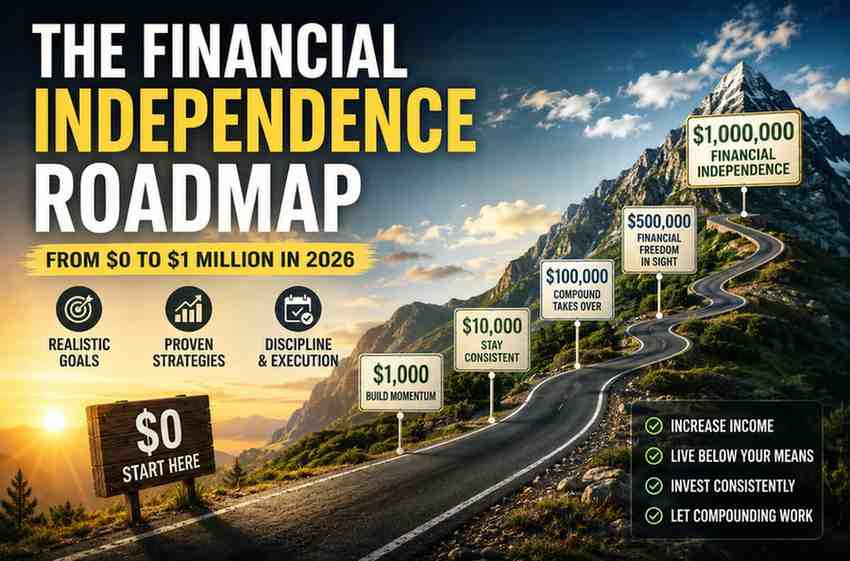
Skip the latte advice. This math-backed guide maps a practical route from zero to $1 million.
Most financial advice reads like it was written by a compliance attorney who has never actually missed a credit card payment. You’ve seen the standard playbook blasted across social media: 'Stop buying your morning lattes, maximize your employer matching program, and quietly compound your way to wealth over forty-five agonizing years.' It sounds safe. It sounds responsible. It is also completely disconnected from the reality of modern economic structures.
If you are starting at absolute zero, saving $5 a day on coffee isn't going to make you a millionaire; it’s just going to make you caffeinated, miserable, and hyper-focused on scarcity. Reaching a $1 million net worth from scratch requires a violent, structural shift in strategy as you cross different wealth thresholds. What gets you out of the financial gutter is entirely different from what gets you into the investor penthouse. If you apply late-stage portfolio strategies when you are broke, you stay broke. If you apply early-stage scarcity habits when you are wealthy, you stunt your compounding potential.
This guide is the unfiltered, math-backed reality of how wealth is actually built. We are going to break down the psychological chokepoints, the structural traps, and the precise mechanical shifts required to scale from a net worth of zero to a cool $1,000,000. No fluff, no toxic positivity—just pure strategic engineering.
Phase 1: The Survivalist Zone ($0 to $10,000)
When your net worth is hovering around zero, your primary enemy isn’t the stock market, inflation, or the tax code. Your enemy is structural volatility. At this stage, a broken transmission, a sudden layoff, or an unexpected root canal isn't just an inconvenience; it’s a financial catastrophic event that sends you spiraling back into high-interest credit card debt, erasing months of discipline in a single afternoon.
The internet loves to tell people in this bracket to 'start investing early to capture compound interest.' This is fundamentally flawed, mathematically illiterate advice. If you have $500 to your name, putting it into an index fund that yields a historical average of 8% to 10% annually is going to make you roughly $50 a year. That doesn't move the needle. A single late fee on a utility bill or a minor overdraft charge will instantly wipe out an entire year of your market gains. When you have less than $10,000, your investment return is entirely irrelevant. Your savings rate and your offense (income) are the only variables that matter. Stop looking at stock charts and start looking at your immediate cash flow statement.
To claw your way out of this zone, you must establish defensive armor. This means building a baseline liquid buffer while ruthlessly optimizing your fixed costs. To anchor your day-to-day habits during this grueling initial push, it helps to master the core mechanics of cash tracking. For a granular, highly tactical breakdown of how to segment your income without losing your mind, see our comprehensive guide on How to Build an Unbreakable Budgeting System That Actually Fits Your Life, which outlines the exact percentages needed to survive this phase.
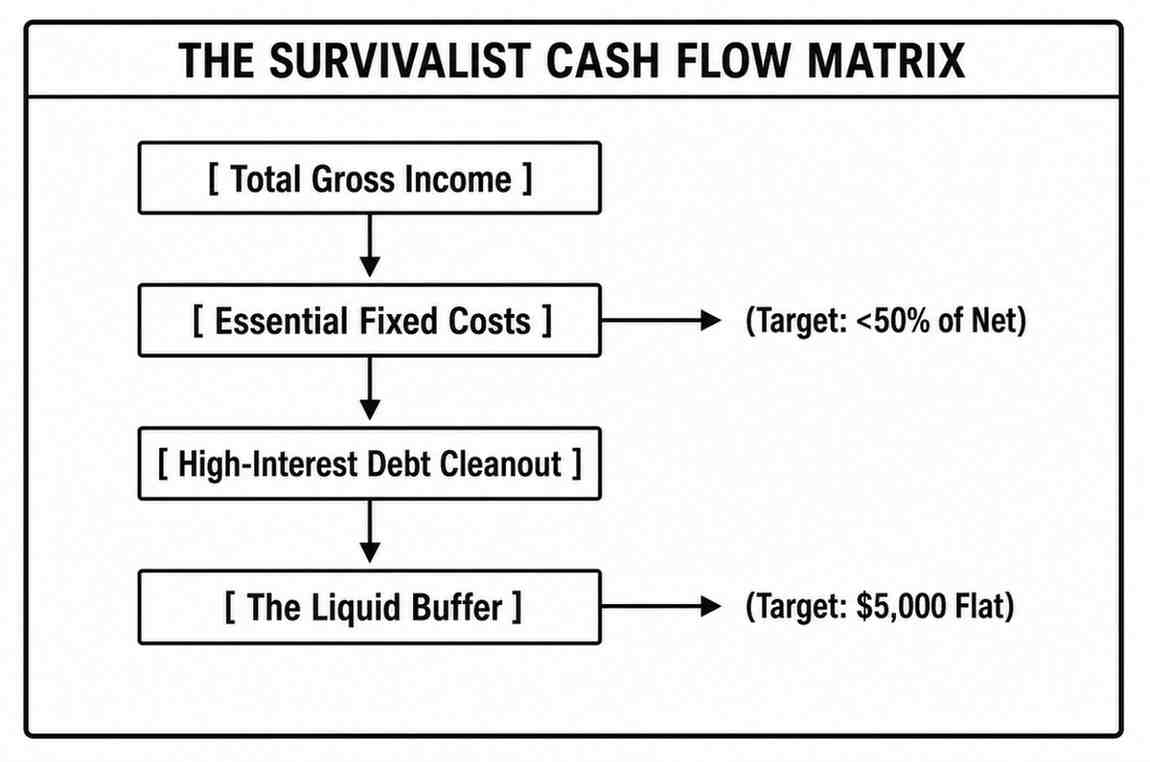
Forget the standard '3 to 6 months of expenses' advice for a moment. When income is low or irregular, that math is too abstract and intimidating. Aim for a flat $5,000 in a high-yield savings account (HYSA). This is your shield against the universe. It sits there, earns minimal interest, and protects your peace of mind. Concurrently, you must kill the cash-sucking parasites. Credit card debt at 22% to 29% APR is a blazing financial emergency. You cannot out-invest bad debt. Use the debt snowball or avalanche method—pick one, strip away all non-essential luxury, and attack it with every spare dollar.
Phase 2: The Velocity Engine ($10,000 to $100,000)
Welcome to the hardest phase of the entire financial independence journey. This is where most people burn out and quit. Why? Because the math hasn't started working for you yet. Let's look at the cold numbers. If you have $50,000 aggressively invested and the market has a phenomenal year, returning 10%, your net worth increases by $5,000. That is an amazing psychological win, but practically speaking, it doesn't change your lifestyle. You still have to wake up and go to work on Monday. It feels like you are running on a treadmill turned up to maximum incline.
The trap here is thinking you can get to $100,000 purely by cutting expenses. There is a hard structural floor to how low your expenses can go—you always have to pay for shelter, basic nutrition, and basic health insurance. However, there is absolutely no ceiling on your income. To cross the $100,000 mark quickly, you have to engineer an income jump. This typically happens through three specific avenues: the lateral company leap (changing employers every 2 to 3 years yields an average salary increase of 10% to 20%, compared to the standard 3% internal annual raise), skill stacking, or a minimum viable side hustle.
| Asset Milestone | Primary Driver | Secondary Driver | Psychological Threat |
|---|---|---|---|
| $0 - $10k | Income Offense | Frugality / Defense | Despair & Volatility |
| $10k - $100k | Aggressive Savings Rate | Basic Market Exposure | Lifestyle Creep / Burnout |
| $100k - $500k | Consistency & Systems | Compounding Core | Mid-Game Ennui |
| $500k - $1M | Compounding Autopilot | Portfolio Optimization | Fear of Market Crashes |
Income Hacking vs. Cheap Living
To cross the $100,000 mark quickly, you have to engineer an income jump. This typically happens through three avenues:
- The Lateral Leap: Changing employers every 2 to 3 years yields an average salary increase of 10% to 20%, compared to the standard 3% internal annual raise.
- Skill Stacking: Acquiring rare, complementary skill combinations (e.g., combining deep data analysis with high-end public speaking).
- The Minimum Viable Side Hustle: Not a multi-million dollar startup, but a high-margin service business (consulting, freelancing) that utilizes your primary job skills after hours.
As your income scales during this phase, the temptation to upgrade your lifestyle will be intense. If your salary jumps by $20,000 and your rent, car payment, and restaurant budget jump by $20,000 alongside it, you have effectively reset your wealth-building clock back to zero. You must maintain a wide, intentional gap between what you bring in and what you output. Securing this specific surplus cash flow requires an aggressive, highly strategic approach to asset preservation. To discover how to systematically ring-fence your earnings before lifestyle inflation devours them, explore our deep-dive analysis on are savings bonds good investment.
Phase 3: The Mid-Game Grind ($100,000 to $500,000)
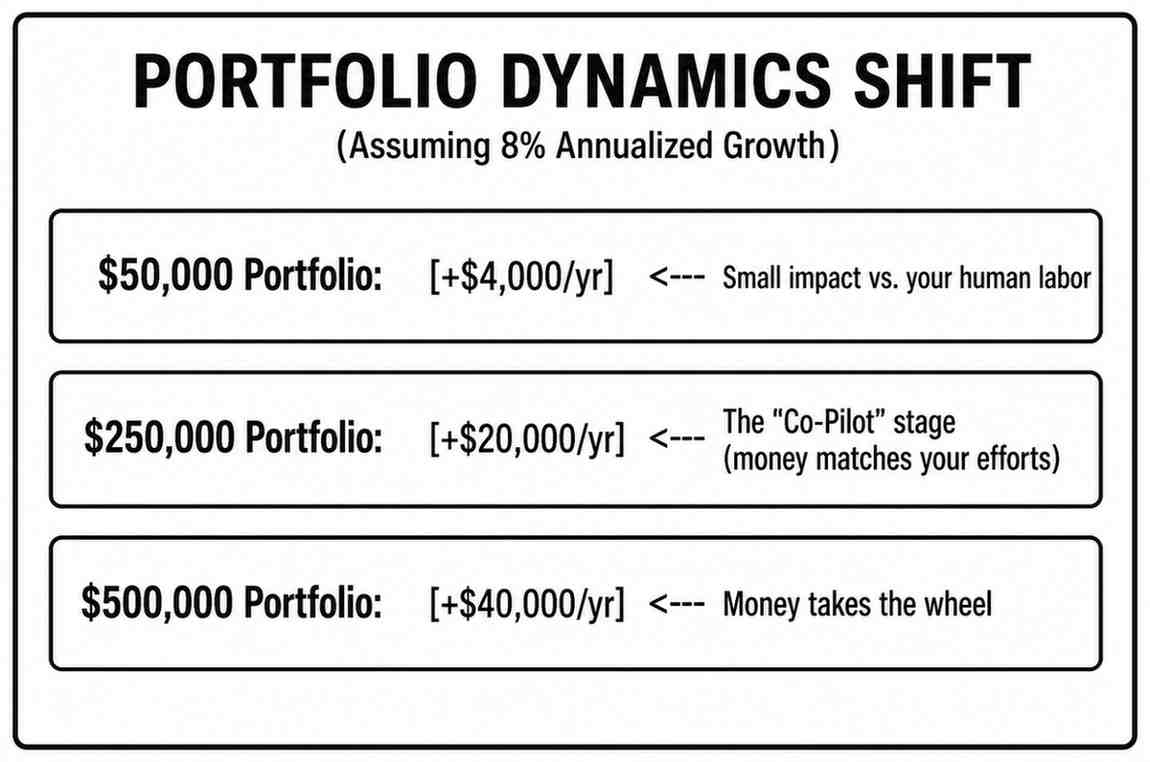
Once you cross $100,000, the physics of wealth creation undergo a fundamental, irreversible shift. The invisible hand of compound interest finally enters the chat. Let’s look at a concrete example. Consider a $300,000 portfolio tracking a standard equity index. If the market shifts upward by a completely normal 8%, your net worth moves by $24,000. For a massive percentage of working professionals, $24,000 represents more than their entire annual net savings contribution from their day-to-day salary. For the first time in your life, your money is doing more heavy lifting than your muscle.
The Systematization of Wealth
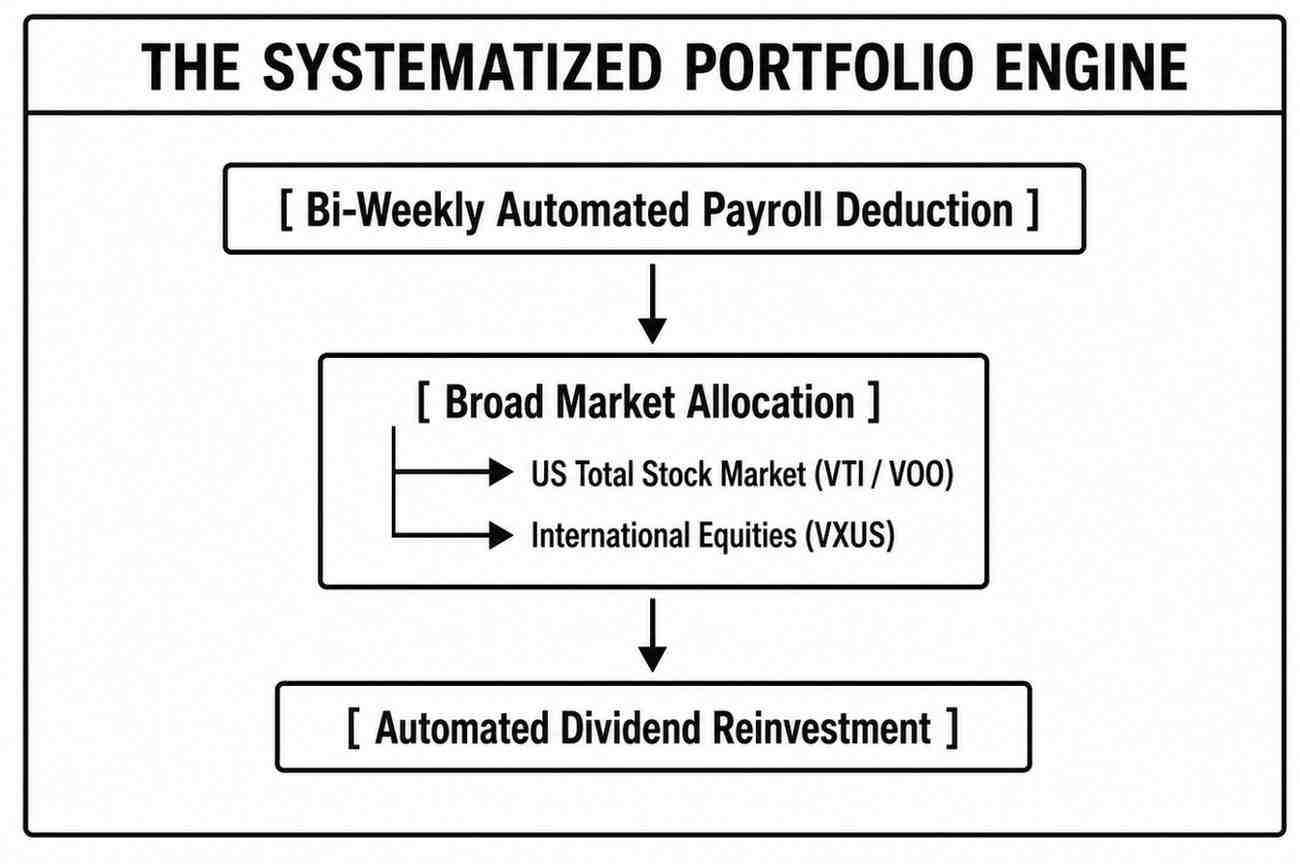
In this phase, manual intervention is your enemy. You want to remove human emotion from the equation entirely. If you have to think about investing every time you get paid, you are introducing a failure point.
- Automated Dollar-Cost Averaging (DCA): Your investment contributions should be swept from your payroll or primary bank account before your eyes ever see it.
- The Core Portfolio Architecture: Stop chasing thematic tech ETFs, meme tokens, or individual stock tips from social media. Stick to ultra-low-cost, broad-market index funds or total market exchange-traded funds (ETFs) with an expense ratio below 0.05%.
In this phase, manual intervention and financial over-analysis are your greatest enemies. You want to remove human emotion and daily decision-making from the equation entirely. If you have to manually think about investing every time you get paid, you are introducing a psychological failure point. You need automated systems.
Your investment contributions should be swept from your payroll or primary bank account via automated dollar-cost averaging (DCA) before your eyes ever see it. Stop chasing thematic tech ETFs, meme tokens, or individual stock tips from social media influencers. Stick to ultra-low-cost, broad-market index funds or total market exchange-traded funds (ETFs) with an expense ratio below 0.05%. You are no longer trying to beat the market; you are trying to buy the market and let it compound.
Phase 4: The Apex Push ($500,000 to $1,000,000)
When you cross the $500,000 threshold, you are in the definitive endgame. At this altitude, portfolio volatility will completely dwarf your physical savings contributions. A standard, minor 2% market correction on a $750,000 portfolio means your balance sheet swings by $15,000 in a single afternoon. This can be incredibly jarring if you still view money through the lens of hourly wages or monthly expenses. You'll find yourself saying, 'I just lost half a month's salary while I was eating lunch.' This is precisely where emotional regulation becomes your highest-yielding financial asset.
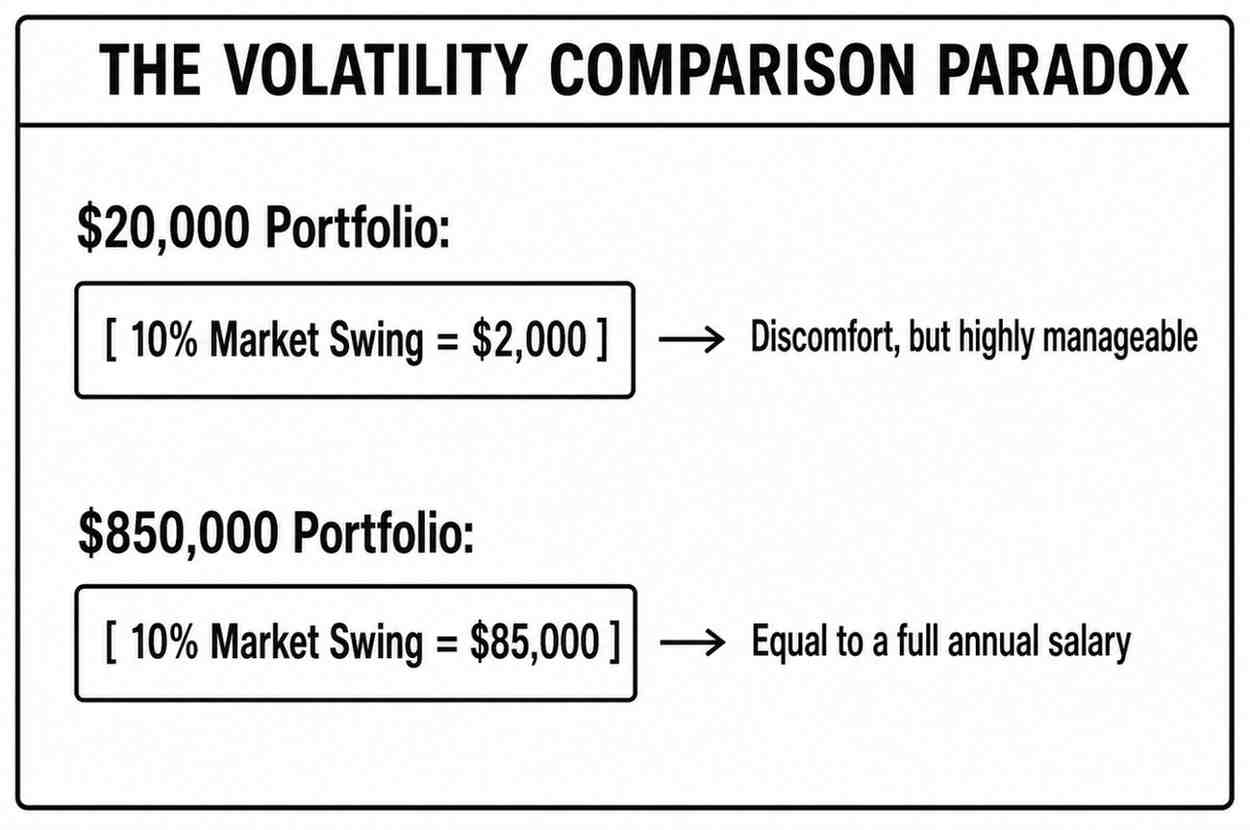
The climb from $0 to $100,000 might take five to seven years of intense grinding, manual side hustles, and lifestyle sacrifices. Conversely, the climb from $500,000 to $1,000,000 often takes a fraction of that time, purely because of the sheer mass of the principal balance. If you maintain a steady contribution profile, an 8% compounding return on a $600,000 balance adds nearly $50,000 in passive generation inside of twelve months. You aren't working harder; your money is simply operating with immense, compounding scale.
During this critical window, your operational framework shifts from raw asset accumulation to optimizing the tax drag and structural efficiency of your portfolio. To ensure you aren't leaking critical percentages to the government right before the seven-figure finish line, check out 25 Money Habits Keeping You Broke, which covers many of the behavioral and structural pitfalls that sabotage wealth at every stage of the journey.
The Wealth Progression Roadmap Summarized
To visualize exactly how your strategic focus must shift across these different milestones, review the structural breakdown below. Notice how the primary driver transitions from personal labor to automated asset performance as your net worth scales.
- $0 - $10,000 (The Survivalist Zone): Driven by income offense and aggressive frugality. Your main psychological threat is despair and volatility. Focus entirely on building a liquid emergency buffer.
- $10,000 - $100,000 (The Velocity Engine): Driven by aggressive salary jumps and maintaining a high savings rate. Your main threat is lifestyle creep and professional burnout. Focus on expanding the gap between income and expenses.
- $10,000 - $100,000 (The Velocity Engine Addendum): For freelancers and professionals handling uneven baseline cycles during this phase, managing volatility becomes an art form. It requires structuring cash flows so lean cycles never disrupt your core velocity. If you navigate unpredictable pay periods, check out how to budget irregular income 2026 to align your baseline budget before trying to scale[cite: 1].
- $100,000 - $500,000 (The Mid-Game Grind): Driven by automated consistency and systemic investing. Your main threat is mid-game fatigue and portfolio meddling. Focus on broad-market index funds.
- $500,000 - $1,000,000 (The Apex Push): Driven by compounding autopilot and portfolio optimization. Your main threat is emotional panic during market corrections. Focus on tax efficiency and asset location.
Wealth building is not an intellectual challenge; it is a behavioral endurance test. The mathematical equation remains incredibly simple: create a massive structural surplus, automate the investment of that surplus into broad economic assets, and let time run its course. Find your current phase on this roadmap, execute the specific playbook for that zone, ignore the daily media noise, and build your engine.
Continue learning


Questions and answers
Is saving money or investing more important when starting at zero?
When starting at zero, your savings rate and income offense are exponentially more important than your investing returns. A 10% return on $500 is only $50, which can be wiped out by a single unexpected expense. Focus on building a flat cash buffer first before worrying about market investments.
How do I prevent lifestyle inflation as my income increases?
The most effective way is to automate your savings. When you receive a raise or an income jump, immediately set up an automatic transfer to your investment or savings account for at least 50% of the increase before it hits your main checking account. If you never see the money, you won't spend it.
What should I invest in once I cross the $100,000 net worth milestone?
Once you cross $100,000, you should shift focus toward automation and simplicity. Invest in low-cost, highly diversified broad-market index funds or total market ETFs (like VTI or VOO). Avoid speculative individual stock picking or trendy sector funds, as consistency and fee minimization become your primary growth drivers.
Building a million-dollar net worth from scratch isn't about finding a magical investment or depriving yourself of joy for half a century. It's about knowing which game you are playing at each stage of the journey. Stop acting like a late-stage portfolio manager when you have less than $10,000, and stop acting like a panicked survivalist when you have half a million. Master your cash flow, automate your investments, protect your mindset during market corrections, and let the unstoppable math of compounding do the heavy lifting for you.