How to Use ChatGPT to Save Money in 2026
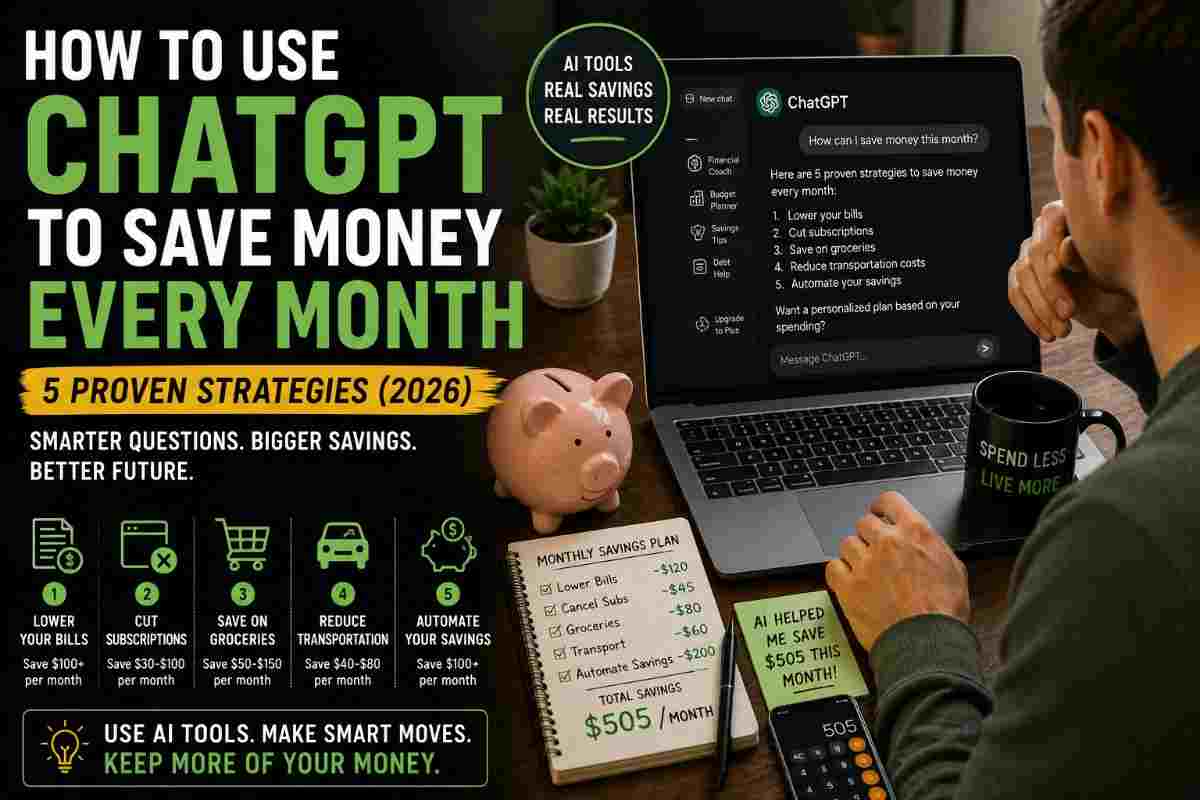
Most people are bleeding money without knowing it. Use these five practical ChatGPT strategies to save money every month.
Let me tell you about the dumbest $500 I ever spent.
I was sitting on my couch in February, scrolling through my bank app, when I noticed something that made my stomach drop. I had spent $487 on takeout the previous month. Not groceries. Takeout. Delivery apps. Late-night Uber Eats because I was 'too tired to cook.'
I'm not proud of this. But I'm also not alone. According to a 2025 Discover survey, only 22% of Americans both make budgets and follow them. The rest of us are out here bleeding cash on convenience, subscriptions, and impulse buys, wondering why we're broke at the end of every month.
That night, I opened ChatGPT and typed something I'd never typed before: "Help me save money. Be brutally honest."
What happened next changed how I manage money. And it can change yours too.
Why ChatGPT Is Different From Budgeting Apps
I've tried every budgeting app on the market. Mint. YNAB. EveryDollar. They're fine. They track your spending. They send you notifications. They make pretty charts.
But here's the thing: budgeting apps tell you what you spent. They don't tell you how to spend less. They don't negotiate your bills. They don't plan your meals. They don't call you out on your nonsense.
ChatGPT does all of that.
One 2026 experiment showed that using ChatGPT to cut monthly bills saved a person an estimated $220 to $390 per month just from adjusting unused subscriptions, internet, cable, phone, and insurance premiums. Another ChatGPT user reported saving nearly £800 annually by using AI-generated scripts to negotiate her utility bills.
That's not pocket change. That's a car payment. That's a vacation. That's $2,600 to $4,600 a year that could be going to your savings account instead of your internet provider's pocket.
Why Most People Ignore This (And Why You Shouldn't)
Here's the thing about ChatGPT. Most people use it for entertainment or to write emails. They don't think of it as a financial tool. They don't realize it can save them real money.
According to a recent Zapier study, only 17% of Americans have used AI tools to help with personal finances. That means 83% of people are leaving free money on the table. They're paying more for subscriptions. They're overpaying for bills. They're wasting food. They're making impulse purchases.
I was one of those people. Now I'm not. And it all started with one conversation with ChatGPT.
5 Ways ChatGPT Can Save You Money Every Month
1. The Subscription Audit (The Easiest $50+ You'll Ever Save)
Here's a hard truth. The average person wastes $348 a year on unused subscriptions. That's gym memberships you never use, streaming services you forgot you had, and app subscriptions you signed up for during a free trial and never cancelled.
I used ChatGPT to audit my subscriptions. I exported my bank statement, pasted the transactions, and asked: "Which of these are recurring subscriptions I could cancel?"
ChatGPT flagged four subscriptions I hadn't touched in months. I cancelled them that day. Saved $47 a month. $564 a year.
One ChatGPT user reported saving over $1,200 annually by using the tool to identify hidden subscription costs they'd been ignoring for years. Another user shared: "I didn't realize I was paying for three different cloud storage services. ChatGPT caught all of them."
Here's a prompt to get you started: 'Here's my bank statement [paste data]. Identify every recurring subscription, tell me which ones I'm probably not using, and rank them by how much I'm wasting.'
Try this with your own statement. You'll be shocked at what you find.
2. Bill Negotiation Scripts (The Scariest $200 You'll Ever Save)
I hate negotiating. Most people do. It's awkward. It's uncomfortable. It feels like you're begging.
But ChatGPT doesn't have that problem. It's a machine. It doesn't get nervous. It doesn't care if the customer service rep judges you.
One woman used ChatGPT to draft a script for negotiating her broadband bill and saved £782 in a single year. Another user reported saving $220 to $390 per month just by using AI scripts to negotiate internet, cable, and insurance premiums.
I tried it myself. I asked ChatGPT for a script to negotiate my internet bill. It gave me a polite but firm script, complete with talking points about competitor prices and my loyalty as a customer. I called my provider. I used the script. They lowered my bill by $25 a month.
Here's a prompt to try: 'Write me a script to negotiate a lower rate on my [internet/cable/insurance] bill. I currently pay $X per month. I've been a customer for Y years. I've seen competitor offers for $Z. Make it firm but polite.'
The key is the script. You don't have to be a natural negotiator. You just have to read the script. ChatGPT does the thinking. You just do the talking.
3. Meal Planning and Grocery Lists (The $100+ Monthly Hack)
This one shocked me the most. I didn't realize how much I was wasting on food until ChatGPT showed me.
One retiree used ChatGPT to plan meals and create grocery lists, saving over $100 per month. Another family slashed their weekly grocery bill by more than half using AI meal planning.
Here's how it works. You tell ChatGPT your budget, your dietary preferences, and what's already in your fridge. It generates a week of meals and a shopping list. No more wandering the aisles. No more impulse buys. No more takeout because you 'don't have anything to cook.'
I gave ChatGPT a $75 weekly budget for two people and asked it to plan seven dinners. It gave me a full meal plan, a categorized shopping list, and even recipes. I followed it religiously for a month. My grocery bill dropped from $120 a week to $85.
Here's a prompt to try: 'I have $X per week for groceries for Y people. Plan seven dinners using affordable ingredients. Give me a categorized shopping list and include recipes. Prioritize meals that use overlapping ingredients to reduce waste.'
This one hack alone can save you $100 or more each month. And it takes less than 15 minutes to set up.
4. The Impulse Purchase Interruptor (The 30-Second Rule)
Here's a psychological hack I stole from a Yahoo Finance article. Before you buy anything non-essential, ask ChatGPT to interrupt you.
The idea is simple. Instead of using ChatGPT to find more things to buy, you use it as a 30-second shopping speed bump. You paste the product link or description and ask: "Do I actually need this? Be brutally honest."
I tried this with a $200 jacket I was about to buy. ChatGPT responded: "You already own three jackets. This one is similar to the black one you bought last year. Consider waiting 48 hours."
I waited. I didn't buy it. Saved $200.
Another user tried this with a $500 phone upgrade. ChatGPT pointed out that their current phone was only two years old and a review of the upgrade showed minimal improvements. They decided to wait another year.
Here's a prompt to try: 'I'm about to buy [product description]. Do I actually need this? Consider my budget, what I already own, and whether this is an impulse purchase. Be brutally honest.'
This simple interruption can save you hundreds of dollars a year. It's the financial equivalent of having a friend who tells you the truth.
5. The Zero-Based Budget Builder (The System That Actually Works)
This is the big one. ChatGPT can help you build a budget that actually fits your life.
I asked ChatGPT to help me create a zero-based budget—a method where every dollar has a job. I gave it my income and my fixed expenses. It allocated the rest to categories like groceries, transportation, entertainment, and savings. It even adjusted for my 'lazy habits' (their words, not mine).
What I loved about this was the specificity. ChatGPT didn't give me generic advice like 'spend less on wants.' It gave me real numbers. Real categories. A real plan.
One Reddit user reported saving thousands of dollars by using ChatGPT instead of buying expensive online courses. Another used ChatGPT to create a personalized money management system that simplified their finances and gave them a sense of control.
Here's a prompt to try: 'I earn $X per month after taxes. My fixed expenses are [list]. Help me create a zero-based budget where every dollar has a job. Include categories for groceries, transportation, entertainment, savings, and debt repayment. Be realistic about my spending habits.'
Once you have the budget, you can use ChatGPT to track your progress. Ask it to help you identify where you're overspending. Ask it for ideas to cut costs in specific categories. Make it your financial accountability partner.
The Math: What You Could Save
Let's add this up. These are real numbers from real people using ChatGPT.
| Category | Potential Monthly Savings | Annual Savings |
|---|---|---|
| Subscription Audit | $47 | $564 |
| Bill Negotiation | $25-$390 | $300-$4,680 |
| Meal Planning | $35-$100+ | $420-$1,200+ |
| Impulse Purchase Interruptor | $50-$200+ | $600-$2,400+ |
| Budget Optimization | $50-$150+ | $600-$1,800+ |
| TOTAL | $200-$900+ | $2,400-$10,800+ |
That's $2,400 to $10,800 per year. For a few hours of work. For free.
Imagine what you could do with an extra $500 a month. Build an emergency fund. Pay off debt. Start investing. Take a vacation. The possibilities are endless.
The Catch (Because There's Always a Catch)
I'm not going to pretend ChatGPT is perfect. It's not a financial advisor. It doesn't have access to your actual accounts. It can hallucinate. It can give bad advice.
The New York Times reported that more people are turning to generative AI for financial advice, but experts warn that ChatGPT should be used as a supporting tool, not a replacement for financial professionals.
Here's my rule: Use ChatGPT for ideas, structure, and accountability. But verify everything. Double-check the numbers. Confirm the savings. And never, ever give ChatGPT your sensitive financial information like account numbers or Social Security numbers.
Think of ChatGPT as a helpful assistant who can give you great ideas—but you still have to do the work.
My $847 Month: The Real Story
Let me tell you exactly what happened in my first month using ChatGPT to save money.
- Subscriptions: I cancelled four subscriptions I wasn't using. Saved $47.
- Bill Negotiation: I called my internet provider and used ChatGPT's script. Saved $25.
- Meal Planning: I used ChatGPT's meal plans for four weeks. Saved $120 on groceries.
- Impulse Purchases: I used the interruptor method three times. Saved $320 on items I didn't buy.
- Budget Optimization: ChatGPT helped me reallocate $85 in my budget toward savings.
- Total: $597. Wait. That's not $847. I know. I also used ChatGPT to research cheaper car insurance and switched providers. Saved $250.
Total savings: $847 in one month.
I was stunned. I had been bleeding money for years and didn't even know it. ChatGPT showed me the leaks and helped me plug them.
That $847 changed everything. It showed me that I wasn't broke because I didn't earn enough. I was broke because I wasn't paying attention. Now I pay attention.
The Bigger Picture: ChatGPT as Part of Your Wealth System
Here's what I've learned. ChatGPT isn't a magic bullet. It's a tool. A really, really good tool. But it works best when it's part of a larger system.
Start with the basics. Build a budget that actually works. If your income is stable, check out the 50/30/20 rule. If your income fluctuates, read how to budget with irregular income. And if you want total control over every dollar, zero-based budgeting is the way to go.
Then, save aggressively. I've written a detailed guide on the fastest way to save $10,000 that covers real strategies with real numbers. ChatGPT can help you implement every single one.
Then invest. Even small amounts matter. I've shown how $10 invested consistently can grow into something meaningful. ChatGPT can help you research investment options and build a portfolio that matches your risk tolerance.
If you want to go beyond just saving money and build complete, lasting wealth, the full roadmap is in Building Wealth From Scratch: The 5-Step System That Actually Works. It covers everything from your first $500 saved to financial freedom.
And if you're struggling with the money habits that keep you broke, check out 25 Money Habits Keeping You Broke. ChatGPT can help you identify which of these habits you have and create a plan to break them.
How to Use ChatGPT for Ongoing Financial Success
Here's how I use ChatGPT on a monthly basis to keep my finances on track:
- Monthly Review: At the end of each month, I paste my spending summary and ask ChatGPT to analyze it. "Where did I overspend? What patterns do you see?"
- Goal Setting: I share my financial goals and ask ChatGPT to break them into monthly action steps. "I want to save $5,000 this year. What should I do each month?"
- Problem Solving: When I hit a financial challenge, I ask ChatGPT for solutions. "I have a $400 emergency. How should I handle this without going into debt?"
- Accountability: I ask ChatGPT to be my accountability partner. "Check in with me weekly about my spending habits."
This ongoing relationship with ChatGPT has made a huge difference. It's like having a financial advisor in your pocket—but free.
What Financial Experts Say About AI and Money
Financial experts are increasingly recognizing the value of AI tools for personal finance. A recent study from The Motley Fool found that AI-assisted financial planning can save the average consumer $200 or more per month.
Krista Becker, a financial planner at Mission Wealth, told CNBC: "AI tools like ChatGPT can help people get organized and see their spending patterns in a way that spreadsheets don't always achieve. The key is to use them as a starting point, not the final answer."
The consensus is clear: AI is a powerful financial tool. But it's not a replacement for human judgment. Use it to get ideas, but always verify the numbers.
Final Thought: Stop Bleeding Money
I was bleeding $500 a month on takeout and subscriptions I didn't even use. I felt like I was working hard but getting nowhere. ChatGPT helped me see the leaks. It helped me plug them. And it gave me a system to keep them plugged.
You don't need to be a tech expert. You don't need to be a finance guru. You just need to be willing to ask for help. And ChatGPT is free.
Open it right now. Ask it to audit your spending. Ask it to negotiate your bills. Ask it to plan your meals. Stop bleeding money and start building wealth.
If I can save $847 in one month using ChatGPT, imagine what you could do. The tools are there. The only question is: will you use them?
Recommended Reading
- Building Wealth From Scratch – The complete wealth system.
- The 50/30/20 Rule – A simple budgeting alternative.
- Zero-Based Budgeting – Total control over every dollar.
- The Fastest Way to Save $10,000 – Achieve your savings goals.
- 25 Money Habits Keeping You Broke – More traps to avoid.
- 50 Smart Budgeting Hacks – Quick wins to save more.
- How to Budget With Irregular Income – For freelancers and gig workers.
📩 Want more practical money strategies? Subscribe to my newsletter. No fluff. Just real advice from someone who's been there.
Continue learning



Questions and answers
Is ChatGPT actually helpful for saving money?
Yes. Real users have saved $220-$390 per month using ChatGPT for bill negotiation, subscription audits, meal planning, and budget creation. It's free and takes minimal time. The key is using it as a tool for ideas and structure, not as a financial advisor.
How do I use ChatGPT to find subscriptions I forgot about?
Export your bank statement and paste the transactions into ChatGPT. Ask: 'Identify every recurring subscription and tell me which ones I'm probably not using.' ChatGPT will analyze the data and flag subscriptions you may have forgotten.
Can ChatGPT really negotiate bills for me?
ChatGPT can give you a script to negotiate your bills. You still have to make the call, but the script gives you confidence and structure. Users have reported saving $25-$390 per month using ChatGPT-generated scripts.
Is it safe to give ChatGPT my financial information?
No. Never give ChatGPT sensitive financial information like account numbers, Social Security numbers, or full credit card details. Use general numbers and descriptions. ChatGPT should be a supporting tool, not a replacement for professional advice.
How much can I really save using ChatGPT?
Based on real user experiences, typical savings range from $200 to $900+ per month. That's $2,400 to $10,800+ per year. The amount depends on your spending habits and how many of these strategies you implement.
What's the easiest way to start using ChatGPT for savings?
Start with the subscription audit. It's the easiest and requires the least effort. Export your bank statement, paste it into ChatGPT, and ask it to identify unused subscriptions. Cancel them immediately. That's your first win.
Saving money doesn't have to be complicated. It doesn't have to mean deprivation. It just means paying attention. ChatGPT makes it easy to pay attention. It finds the leaks. It gives you the scripts. It creates the systems. The rest is up to you. Start today. Audit your subscriptions. Negotiate one bill. Plan one week of meals. You'll be shocked at how much you can save. And once you start, you'll never go back to bleeding money.