How to Recover Financially After Losing Your Job: A Complete Guide for 2026
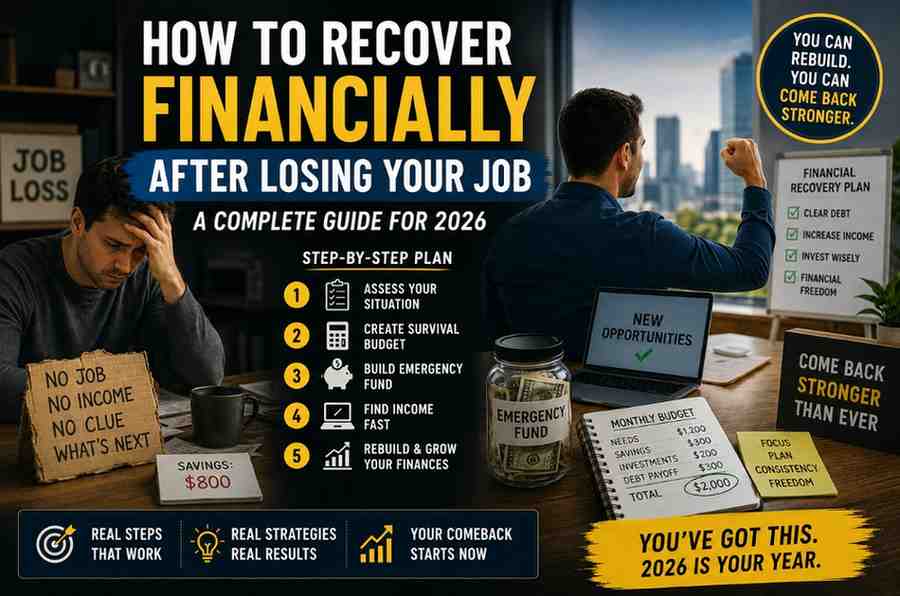
I lost my job with only $800 in savings. Here's exactly how I survived, found income, and rebuilt my finances. A complete step-by-step recovery guide for 2026.
Let me tell you about the worst morning of my adult life.
I was sitting at my desk, coffee in hand, checking emails, when a calendar invite popped up. "15-minute meeting with HR." 10:30 AM. No agenda. No explanation.
My stomach dropped. I knew what was coming. We all know that meeting.
At 10:32, I was unemployed. Four months of severance. No warning. No performance issues. Just a restructuring that had nothing to do with me and everything to do with a spreadsheet somewhere.
I felt like I'd been punched in the chest. My income was gone. My identity was gone. My sense of purpose was gone. And my bank account? About $800.
According to Bankrate's 2026 research, fewer than half of Americans have enough savings to cover even a $1,000 emergency, and more than two-thirds worry about covering a single month of living expenses if they lost their primary income tomorrow.
I was in that two-thirds. And I was terrified.
Step 1: Grieve First. Plan Second.
Here's the thing nobody tells you about job loss. Everyone says "start looking for a new job immediately." That's terrible advice.
When I lost my job, I was in shock. I was grieving. I felt like a failure. My identity as someone who works, earns, and provides was shattered. And making decisions from that state of raw panic is the worst thing you can do.
My strong opinion: Take a beat before you do anything. I took two days. I let myself feel angry. I let myself feel scared. I let myself cry. And then I got to work.
Financial therapist Lindsay Bryan-Podvin says it perfectly: "A layoff can feel so personal, but it's not a reflection of your value." Processing those emotions is the first step toward recovery.
Step 2: Build Your Survival Budget
Once I could breathe again, I sat down and looked at my finances. And I mean really looked. No more checking the balance and feeling anxious. I wrote everything down.
First, Identify Every Income Source:
- Unemployment benefits (apply immediately; approval can take weeks)
- Severance (review the terms carefully)
- Emergency savings (this is what it's for)
- Any side income or passive income
A critical mistake most people make: Don't assume unemployment benefits will replace your full income. They won't. But they provide a "critical lifeline."
Then, build a bare-minimum survival budget.
My survival budget looked different from my normal budget. I divided expenses into three categories:
Must Pay (Essentials):
- Housing (rent/mortgage)
- Utilities (electricity, water)
- Groceries
- Medications
- Transportation
- Minimum debt payments
Should Pay (Job Search Essentials):
- Internet (critical for job hunting)
- Phone
- Health insurance
Pause (Everything Else):
- Streaming services
- Gym membership
- Dining out
- Subscriptions
I was ruthless. I called my internet provider and asked for a hardship discount. I cancelled every subscription I could find. I stopped dining out completely.
Here's the key: I didn't wait until I missed payments. I reached out to creditors early. Many lenders have hardship programs, and they're more willing to work with you if you call before you fall behind.
For a deeper dive into creating a budget that works even in tough times, check out zero-based budgeting. It's the system I used to track every single dollar during my unemployment.
Step 3: Know Your Safety Nets (And Use Them Without Shame)
This is where people resist the most. We're taught that asking for help is weakness. It's not. It's survival. And it's temporary.
Federal and State Resources:
- Unemployment Insurance: Available in all states, but eligibility varies. Apply immediately, even if you think you might not qualify.
- SNAP (Food Stamps): This is exactly what it's for. Use it without shame.
- LIHEAP: Helps with energy bills.
- USA.gov Benefit Finder: Directs you to state benefits.
Local Resources:
- 211: Connects you to local assistance programs for food, housing, and utilities.
- Food Banks: Don't be too proud. I used a food bank for three months. It was the difference between eating and not eating.
- Local Nonprofits: Many offer emergency grants or temporary financial help.
Other Resources:
- COBRA: You can continue your employer's health insurance, but it's expensive.
- Marketplace Plans: Often cheaper than COBRA.
- Medicaid: If your income drops low enough, you may qualify.
Expert advice: "Getting comfortable using a food bank, or applying for SNAP benefits... is a genuinely smart financial choice. There is no shame in it."
Step 4: Rebuild the Wealth Loop
This was the hardest lesson I learned. Job loss doesn't just destroy your income. It destroys your confidence. And when you're confident, you make better decisions. It's a virtuous cycle. Or a vicious one.
This is what I've learned from interviewing self-made millionaires and recovering from my own financial disasters: The fundamentals are exactly the same, whether you're unemployed or building a wealth portfolio.
A. Protect Your Emergency Savings (What's Left of It)
If you have an emergency fund, this is the moment it was built for. Use it without guilt. But use it strategically.
- Only use it for essential expenses
- Track your burn rate (how long your money will last)
- Cut expenses to make it last longer
B. Build a Resilient System
This is the 5-step system I use and recommend to everyone:
- 1. Know Your Numbers: Exactly what's coming in and exactly what's going out. No guessing.
- 2. Build a Budget That Actually Fits Your Life: Use the survival budget. It's temporary but it works.
- 3. Plan Ahead (Forecasting): In my case, I forecasted my job search. How long would I realistically be unemployed? What's the worst-case scenario? Prepare for it.
- 4. Start Investing (Even With Small Amounts): This is the hardest step when you're unemployed. But even $10 a month keeps the habit alive. I kept investing $10 a month in an index fund. It wasn't much, but it kept my momentum going.
- 5. Increase Your Income (The Fastest Route): This becomes your primary focus. But it doesn't have to be a full-time job.
The complete 5-step system for building real, lasting wealth is covered in depth in Building Wealth From Scratch.
For more on forecasting and planning ahead, check out Budgeting vs Forecasting: The Real Difference.
Step 5: Find Income Streams (Without Compromising Your Job Search)
You need money. But you also need to search for a real job. Here's how I balanced it.
Temporary Income Ideas:
- Delivery Driving (UberEats, DoorDash): Flexible hours, immediate income.
- Tutoring: If you have any expertise, someone will pay for it.
- Freelancing: Use your primary job skills after hours.
- Substitute Teaching: Many school districts are desperate.
- Selling Unwanted Items: I made $300 selling clothes and electronics.
Take a temporary job, even if it's not your dream role. "Even if it isn't a good job and even if it is minimum wage, having a job is good for morale and good for cash flow," says Manuel Salazar, CEO of Take Charge America.
Real-World Success Stories:
Melissa Riepe, a 37-year-old in NYC, lost her $200,000 dream job. She started a decluttering business. Her rates? She Googled what organizers charged ($100-$150/hour) and cut them in half. She found clients on Reddit and now covers her rent and basic expenses alone.
Nandi Owolo, 30, lost her "dream job" in entertainment. She'd started a hobby called "junk journaling" after breaking her foot. After losing her job, she realized: "No one can lay me off from Junk Journal Club. It is mine." She now hosts ticketed events for 20-30 guests at $35-$50 each, one to three times per month. She's not taking a salary yet, but she's building a business that can't be taken away.
My rule: Any income is good income. A side hustle that brings in $400 a month gives you breathing room. It buys time. And time is what you need to find a real job.
For more side hustle ideas, check out Best AI Side Hustles for Beginners or 10 Free Ways to Start Earning Passive Income.
Step 6: The Job Search (Strategically, Not Frantically)
This was the hardest part for me. I wanted to send out 50 applications a day. I was convinced that the more applications I sent, the faster I'd get a job.
I was wrong.
A smarter approach:
- Set a realistic goal: Five applications a day. High quality, tailored submissions.
- Use your network: This is where the real opportunities are hidden. "A great many jobs are never advertised; there's a hidden job market that runs entirely on connection."
- Practice "Loud Budgeting": This is a concept that started on TikTok. Instead of hiding your financial situation, be open with people you trust. "The instinct when you lose a job is to hide it. That instinct is completely counterproductive."
- Update your resume: Make it "forward-looking." Focus on what you can contribute to future roles, not just what you did in the past.
- Structure your days: Unemployment destroys routine. I maintained a regular schedule—mealtimes, exercise, job search hours, and leisure breaks.
Step 7: Rebuild Your Emergency Fund (Once You're Employed)
This is the final step, and it's the most important for your long-term financial health.
The rule of thumb: Three to six months of essential expenses. But here's what experts are saying:
- Industry risk matters: If you're in a volatile industry, aim for 9-12 months.
- Single-income households: Aim for 6-12 months.
- High-demand fields: Three to six months might be enough.
The $1,000 first step: Don't let the math freak you out. Start with $1,000. Then aim for three months of your mortgage or rent. Then add car payments, utilities, etc.
Where to keep it: A high-yield savings account (HYSA). Separate from your checking account. "Out of sight, out of mind."
For a detailed guide on rebuilding your savings, check out The Fastest Way to Save $10,000.
Then, start investing again. Even small amounts matter. I've shown how $10 invested consistently can grow into something meaningful.
The Emotional Recovery (The Part Nobody Talks About)
I don't want to sugarcoat this. Losing your job is traumatic. It's grief. It's identity loss. It's shame.
What helped me:
- I allowed myself to grieve. I didn't try to be tough. I felt the feelings.
- I maintained a routine. Even when I didn't want to. Routine restores a sense of control.
- I leaned on my support system. I talked to friends and family. "Talking through your experience can not only help you process it but may also lead to unexpected job leads or guidance."
- I gave myself grace. I reminded myself that this was a temporary situation, not a permanent downgrade.
The Long View: My Net Worth Journey
Here's the thing I learned. Losing my job was a massive setback. But it was just that. A setback. Not the end. Not even close.
The 4-Step Wealth-Building System doesn't change because you lose your job. It adapts.
- 1. Know Your Numbers: My numbers looked different, but I still tracked them.
- 2. Build a Budget: A survival budget is still a budget.
- 3. Plan Ahead (Forecasting): I had to forecast differently. But I still had to plan.
- 4. Start Investing: I kept the habit alive.
If you want the complete roadmap from $0 to $1 million, I've written the whole system in Building Wealth From Scratch.
And if you're struggling with money habits that keep you broke, check out 25 Money Habits Keeping You Broke.
Final Thoughts: You Can Bounce Back
I got a job after 16 months. It paid less than my old one. I took a pay cut. But I recovered.
Within two years, I had rebuilt my emergency fund, restarted my investments, and was back on track to hit my financial goals.
This is the cycle of financial life. You're not always going up. Sometimes you go down. But when you have a system, you always come back.
Your system is your anchor. When the storm hits, you don't panic. You don't make emotional decisions. You follow the system. You cut expenses. You find income. You survive. You rebuild.
And eventually, you thrive again.
Recommended Reading
- Building Wealth From Scratch – The complete 5-step system.
- The 50/30/20 Rule – A simple budgeting alternative.
- Zero-Based Budgeting – Total control over every dollar.
- How to Budget With Irregular Income – For freelancers and gig workers.
- The Fastest Way to Save $10,000 – Start building your emergency fund today.
- 25 Money Habits Keeping You Broke – More traps to avoid.
- Is It Worth Buying $10 of Stock? – Yes, and here's why.
- Best AI Side Hustles for Beginners – Real ways to earn extra income.
- 10 Free Ways to Start Earning Passive Income – Build multiple income streams.
📩 Want more practical money strategies? Subscribe to my newsletter. No fluff. Just real advice from someone who's been there.
Frequently Asked Questions
What is the first thing I should do after losing my job?
Don't panic. Don't make emotional decisions. Take a day or two to process the shock and grief. Then apply for unemployment benefits immediately, review your severance terms, and build a survival budget. The key is to give yourself space to process before making major decisions.
How do I survive financially with no income?
Build a bare-minimum survival budget. Cut all non-essential expenses, negotiate with creditors early, use your emergency fund strategically, and explore unemployment benefits, SNAP, and other assistance programs. Temporary income like delivery driving or freelancing can help bridge the gap.
Should I use my 401(k) or retirement savings during unemployment?
This should be your absolute last resort. Cashing out retirement funds triggers taxes and penalties (10% early withdrawal penalty plus income tax). You'll lose a significant portion to taxes and penalties. Only consider it if you've exhausted all other options.
How do I find a temporary job during my search?
Look for flexible options like delivery driving, tutoring, freelancing, substitute teaching, or selling unwanted items. Any income is helpful. Don't be too proud to take a minimum wage job temporarily. It provides cash flow and maintains routine.
How long should my emergency fund be after I get a new job?
Aim for 3-6 months of essential expenses. But adjust based on your industry. If you're in a volatile field, aim for 9-12 months. If you're in a high-demand field, 3-6 months may be enough. Start with $1,000 and build from there.
How do I stay motivated during a long job search?
Maintain a routine, set realistic daily goals (e.g., 5 quality applications), exercise, talk to friends and family, and remember that this is temporary. Structure your days like you're still working. And don't hide your situation—sharing with your network often leads to unexpected opportunities.
Can I negotiate my severance package?
Yes, if you haven't signed it yet. You can negotiate for more severance pay, extended health insurance coverage, outplacement services, or a favorable reference. It's worth asking. The worst they can say is no.
Losing your job is one of the most financially and emotionally devastating events you can experience. But it's not the end. It's a setback. And setbacks are survivable. Build your survival budget. Use every resource available. Find temporary income. Keep the wealth loop alive, even in small ways. Rebuild your emergency fund when you get back on your feet. And remember: this is temporary. You will recover. You will rebuild. And you will be stronger for it. The system works if you work it. Start today.