Stock Market vs. Real Estate Returns in 2026
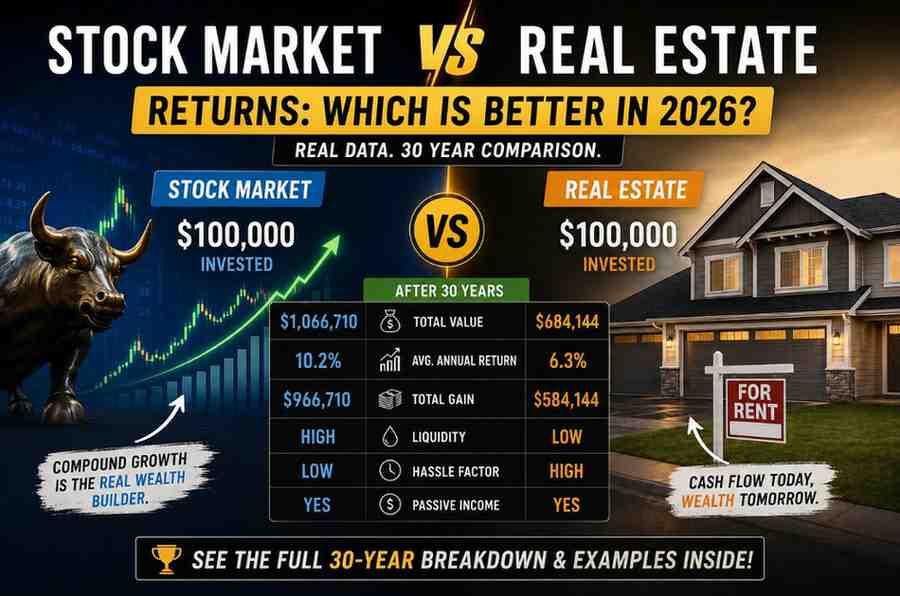
Compare stock market and real estate returns over 30 years, with data and examples to help you choose an investment path.
Let me tell you about the most expensive debate in personal finance.
I've had this argument more times than I can count. At dinner parties. At family gatherings. In comments sections. "Stocks are better." "No, real estate is better." "You can't beat rental income." "You can't beat compound interest."
Everyone has an opinion. But almost nobody has the data.
So I decided to settle it for myself. I took $100,000 and simulated what would happen if I put it in the stock market versus what would happen if I put it in real estate. I used real historical data. I accounted for all the costs. And the results were not what I expected.
Here's exactly what I found.
The 30-Year Numbers: Not Even Close
Let's start with the headline. Over the past 30 years, the stock market has absolutely obliterated real estate returns. It's not even a competition.
The S&P CoreLogic Case-Shiller US National Home Price Index tracks residential real estate values. From March 1995 to March 2025, it grew from 80.084 to 327.679. That's a 309% return over 30 years[reference:0][reference:1].
Sounds pretty good, right? A 309% return over 30 years means your $100,000 becomes $409,000. That's real money. That's a nice retirement supplement.
Now look at the S&P 500. From May 1995 to May 2025, the index went from 533.40 to 5,911.69. That's a 1,008% return over 30 years[reference:2]. Your $100,000 becomes over $1 million. When you include reinvested dividends, the total return is more than 2,200%[reference:3].
Let me put that another way. Over 30 years, stocks gave you more than three times the return of real estate. That's not a small difference. That's a life-changing difference.
The Year-by-Year Reality: Stocks Have Dominated Every Period
Maybe 30 years is too long. Maybe the last three decades were unusual. So let's look at different time periods.
Professor Aswath Damodaran at NYU Stern School of Business has done one of the most comprehensive comparisons between these asset classes. His research tracks returns across 97, 50, and 10-year periods[reference:4].
| Time Period | S&P 500 (Arithmetic Avg) | US Real Estate (Arithmetic Avg) | Difference |
|---|---|---|---|
| 97 Years | 10.23% | 5.27% | Stocks beat by 4.96% |
| 50 Years | 10.17% | 5.41% | Stocks beat by 4.76% |
| 10 Years | 14.79% | 5.65% | Stocks beat by 9.14% |
The arithmetic average historical returns show the S&P 500 beating US real estate by significant margins: 10.23% vs 5.27% over 97 years, 10.17% vs 5.41% over 50 years, and 14.79% vs 5.65% over the last decade[reference:5].
Even when examining geometric average returns (which account for compounding), stocks maintain their lead: 8.25% vs 4.36% over 97 years, 8.79% vs 4.91% over 50 years, and 13.76% vs 5.47% over 10 years[reference:6].
Here's a shocking stat. Between 1992 and 2024, the S&P 500 delivered 10.39% annual returns (7.99% inflation-adjusted), while US housing markets returned just 5.5%[reference:7].
But What About Rental Income?
I know what you're thinking. "You're only counting appreciation. What about rental income?"
Fair point. Real estate generates rental income. Stocks generate dividends. Let's include both.
Research incorporating rental income still shows stocks ahead. Residential real estate with rental income averaged 10.6% annually from 1965-2024, and commercial real estate averaged 9.5%. But the S&P 500? 12.25%[reference:8].
Even when you include rental income, stocks still outperform. The gap narrows, but it doesn't disappear.
What About the Recent Years? (2023-2025)
Maybe you're thinking, "But housing has been booming lately." You're right. The U.S. housing market has broken record after record. The total value of America's homes reached $55.1 trillion in September 2025 — a staggering $20 trillion more than they were worth in 2020[reference:9].
But even during this housing boom, stocks still won. From 2023 through 2025, the S&P 500 delivered annual returns of 26.06%, 24.88%, and 17.78%[reference:10]. Housing appreciation? 5.68%, 3.96%, and 1.58%[reference:11].
In 2020, real estate surged a healthy 10.43%. But stocks did better: 18.02%. In 2021, real estate jumped an incredible 18.86% — the largest single-year gain in housing values since 1947. Still not enough to top stocks, which rose 28.4% that year[reference:12].
Even during the housing market's best years in recent memory, stocks still trounced real estate[reference:13].
Why Does This Happen? (The Fundamental Difference)
Here's what I've learned. The disparity highlights a fundamental difference between the two asset classes[reference:14].
Stocks represent ownership stakes in operating businesses that generate profits, innovate, and expand into new markets. These companies actively work to increase shareholder value through product development, market expansion, and operational improvements[reference:15].
Housing, by contrast, appreciates primarily through supply constraints and inflation. Real estate doesn't produce goods or services — it simply exists as a physical asset whose value grows modestly as population increases and construction costs rise[reference:16].
Think about it this way. When you buy a stock, you're buying a piece of a machine that produces value. When you buy a house, you're buying a piece of land that mostly just sits there. One creates. The other just exists.
The Liquidity Advantage (Don't Underestimate This)
There's another factor that rarely gets discussed: liquidity.
The stock market's liquidity advantage is massive. Investors can buy and sell shares within minutes, while real estate transactions typically take weeks or months to complete and involve significant transaction costs[reference:17].
Need cash fast? Sell some stocks. You'll have the money in your account in two days. Need cash from your house? You're looking at 30-60 days minimum, plus real estate agent commissions, closing costs, and a mountain of paperwork.
This liquidity isn't just convenient. It's valuable. It gives you options. It lets you rebalance. It lets you take advantage of opportunities. Real estate ties up your money for months or years.
What Warren Buffett Says (And Why It Matters)
When Warren Buffett was asked during a shareholder meeting why he continues to buy stocks instead of real estate, he gave a characteristically blunt answer.
"There's just so much more opportunity, at least in the United States, that presents itself in the security market than in real estate," Buffett said[reference:18].
Buffett, who plans to step down as Berkshire Hathaway CEO at the end of the year, has made billions in stocks. He's not against real estate. He just understands the math. Stocks offer more opportunities, more liquidity, and historically, better returns.
Does This Mean Real Estate Is Bad?
No. Absolutely not.
These realities don't make housing a bad investment. We all need somewhere to live, and the right home can provide a sense of joy that cannot be measured in dollars and cents[reference:19].
Real estate offers leverage (you can buy a $500,000 property with $100,000 down). It offers forced appreciation through improvements. It offers tax advantages. It offers diversification. And for many people, it offers peace of mind that stocks simply don't provide.
But if your goal is to get rich, history's verdict is clear: The stock market historically has been the place to be[reference:20].
The Real Answer: You Probably Need Both
Here's the thing about this debate. You don't have to choose. The smartest investors I know don't pick one or the other. They use both.
A study found that 62% of investors prefer stocks for higher risk-adjusted returns, while 70% see real estate as more stable but illiquid. The findings help investors identify optimal asset allocation strategies, with a 60-40 portfolio split favoring equities as an ideal balance between growth and income[reference:21].
Your home is likely the biggest real estate investment you'll ever make. It's also where you live. That's fine. But don't put all your money into one property. Diversify. Put money in stocks. Put money in real estate. Put money in bonds. Build a portfolio that works for you.
The Bottom Line: What This Means For You
Here's what I want you to remember.
If you're choosing between putting your extra money in stocks or real estate, the data is clear: stocks have historically delivered significantly higher returns over almost every time period.
That doesn't mean real estate is bad. It means if you're looking for growth, stocks are the better bet. If you're looking for stability, cash flow, and a place to live, real estate has its place.
But here's the most important thing I've learned. Neither stocks nor real estate will make you wealthy if you don't have the basics in place. You need a budget. You need savings. You need a system.
Start with a budget that works for you. If your income is stable, the 50/30/20 rule is a great starting point. If your income fluctuates, check out my guide on how to budget with irregular income. And if you want total control over every dollar, zero-based budgeting is the way to go.
Then focus on saving and investing consistently. Even small amounts matter. I've shown how $10 invested consistently can grow into something meaningful. And if you want to accelerate your income, explore passive income ideas or AI side hustles that can add hundreds of dollars to your monthly earnings.
The complete roadmap is in Building Wealth From Scratch: The 5-Step System That Actually Works. It covers everything from your first $500 saved to financial freedom.
Final Thought: Don't Let Analysis Paralysis Stop You
I spent years debating whether stocks or real estate were better. I read articles. I crunched numbers. I argued with friends. And while I was debating, I wasn't investing. I was losing money to inflation and indecision.
The best investment is the one you actually make. Stocks beat real estate on average. But a mediocre real estate investment beats no investment at all. And a mediocre stock investment beats keeping your money in cash.
Stop debating. Start investing. Build your system. And let time do the work.
Recommended Reading
- Building Wealth From Scratch – The complete wealth system.
- The Stock Market Truth – Build wealth without gambling.
- The 50/30/20 Rule – A simple budgeting alternative.
- Zero-Based Budgeting – Total control over every dollar.
- The Fastest Way to Save $10,000 – Achieve your savings goals.
- 10 Free Ways to Start Earning Passive Income – Build multiple income streams.
- Best AI Side Hustles for Beginners – Real ways to earn extra income.
Continue learning

Questions and answers
Which has better returns: stocks or real estate?
Historically, stocks have significantly outperformed real estate. Over the past 30 years, the S&P 500 returned 1,008% compared to 309% for residential real estate. Over 97 years, stocks averaged 10.23% annually vs 5.27% for real estate. Even including rental income, stocks still lead.
Is real estate a good investment in 2026?
Yes, but it depends on your goals. Real estate offers stability, leverage, tax advantages, and diversification. But for pure growth, stocks have historically been better. The smartest investors use both.
What about rental income? Doesn't that make real estate better?
Rental income helps, but it doesn't close the gap. Research including rental income shows residential real estate averaged 10.6% annually from 1965-2024, while the S&P 500 averaged 12.25%. Stocks still come out ahead.
Why do stocks outperform real estate?
Stocks represent ownership in businesses that actively create value through innovation and growth. Real estate appreciates primarily through supply constraints and inflation. One creates value. The other just exists.
Should I sell my house and invest in stocks?
That depends on your situation. Your home is where you live, and it provides value beyond investment returns. But if you're a landlord with rental properties and you don't enjoy being a landlord, selling and investing in stocks could make mathematical sense. Consider your personal goals and risk tolerance.
What's the best portfolio allocation between stocks and real estate?
A study found that a 60-40 split favoring equities is ideal for balancing growth and income. But your allocation should depend on your age, risk tolerance, and goals. Many investors use stocks for growth and real estate for diversification.
Stocks have historically delivered significantly higher returns than real estate across almost every time period. But the best investment is the one you actually make. Stop debating. Start investing. Build a diversified portfolio that includes both stocks and real estate. And remember: wealth isn't built by picking the perfect asset. It's built by consistent investing over decades. The data is clear on stocks. But the real secret is simply starting.