How to Live on $3,000 a Month Without Feeling Broke in 2026

Can you live on $3,000 a month? See a realistic 2026 budget for housing, food, transportation, debt, savings, and everyday spending.
Let's start with the part most budgeting advice skips: $3,000 a month can be tight.
A $3,000 monthly income can disappear quickly once rent, food, transportation, insurance, and debt start taking their share. The goal isn't to live like everyone else. It's to build a system that covers the essentials, leaves you some breathing room, and still moves you forward.
That gap matters. A budget that looks reasonable on paper can fall apart once real-world housing and transportation costs enter the picture.
The trick isn't cutting every enjoyable thing from your life. It's knowing where your money is going before the month gets away from you. Give the important expenses a clear limit, leave room for a few things you enjoy, and make saving part of the plan rather than an afterthought.
Here's a practical way to make the numbers work without turning your entire life into a restriction.
The $3,000 Reality Check: What You're Actually Working With
Before getting into the tactics, let's make the numbers clear.
If $3,000 is your take-home pay, you're working with $36,000 a year after taxes. That isn't a lot of room for error, especially if you live somewhere expensive. But the number that matters most isn't how your income compares with somebody else's. It's how much of your income your own lifestyle consumes.
Household income comparisons can also be misleading. One person earning $36,000 has a very different set of obligations from a family earning the same amount. Your useful benchmark is your own monthly cash flow: what comes in, what must go out, and what you can keep.
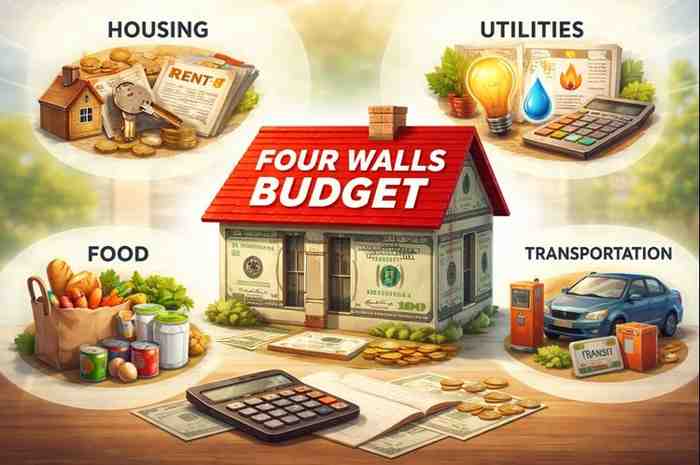
Housing is where this budget gets difficult. If rent takes $1,500 or more from a $3,000 take-home income, the rest of the budget has very little room to absorb groceries, transportation, insurance, debt, and unexpected bills.
So the first rule is simple: build around your income, not somebody else's lifestyle. On $3,000 a month, the biggest decisions matter far more than tiny spending hacks.
The 50/30/20 Framework for $3,000
The 50/30/20 rule is a useful starting point. The basic idea is 50% for needs, 30% for wants, and 20% for savings or debt repayment.
For someone earning $3,000 a month, that translates to:
- $1,500 for needs (housing, food, utilities, transportation, insurance)
- $900 for wants (entertainment, dining out, hobbies, personal care)
- $600 for savings and debt repayment
That's a useful framework, but don't treat it like a law.
For example, a $1,200 housing bill would already consume 40% of a $3,000 income. Add groceries, utilities, transportation, and insurance, and the traditional percentages can become difficult to maintain.
That can make the standard percentages unrealistic.
So adjust it. A budget is a tool, not a test you can fail. If housing is expensive, you may need to spend less on wants for a while. If your housing is cheap, you may be able to save more. For a deeper breakdown, check out the 50/30/20 rule explained.
A Realistic $3,000 Monthly Budget
Here is one workable version of a $3,000 monthly budget. Your numbers will vary, but the structure gives you a useful target.
| Category | Monthly Amount | Notes |
|---|---|---|
| Housing | $900 | Rent, including utilities if possible. This is the hardest number to hit. |
| Groceries | $350 | Cooking at home. Meal planning. Store brands. |
| Transportation | $250 | Gas, insurance, or public transit. Car payment is separate. |
| Utilities | $150 | Electricity, water, internet. |
| Phone | $40 | Prepaid or budget carrier. |
| Health Insurance | $150 | Subsidized marketplace plan or employer contribution. |
| Debt Payments | $300 | Minimum payments plus extra on highest interest. |
| Savings | $300 | Emergency fund first, then investments. |
| Discretionary | $260 | Dining out, entertainment, personal care, miscellaneous. |
| Total | $3,000 |
It is a tight budget. A large car payment or frequent restaurant meals could throw it off quickly, so the big recurring expenses have to stay under control.
The important part is that it still leaves $260 for discretionary spending. That's not a huge amount, but having some money you can spend without guilt makes a budget much easier to stick with.
The Housing Problem: How to Cut the Biggest Expense
Housing deserves special attention because it is usually the largest fixed expense. On a $3,000 income, the rent you choose can determine whether the rest of your budget feels manageable or constantly strained.
If your rent is close to $1,800, you're putting roughly 60% of a $3,000 take-home income into housing before paying for anything else. At that point, cutting coffee or subscriptions won't solve the underlying problem.
What can you do instead?
- Option 1: Get a roommate. Sharing a $1,400 apartment could bring your portion to around $700. That one decision could free up hundreds of dollars every month.
- Option 2: Consider a cheaper area. If your job is flexible or remote, compare the cost of living in nearby neighborhoods and smaller cities. A lower rent can create more breathing room than dozens of small cuts combined.
- Option 3: Keep your housing modest. If a smaller place meets your needs, don't automatically upgrade just because you qualify for a more expensive one. Lower housing costs can give you room to build savings and pay down debt.
Two people can earn the same amount and have completely different financial lives. Housing is often the reason. The lower your fixed housing cost, the more options you have with the money left over.
The Grocery Game: How to Eat Well on $350 a Month
A $350 grocery budget is realistic for some people, but it requires planning. Food costs vary by location, household size, diet, and how often you cook.
With $350 a month, you can eat reasonably well, but you need to make the grocery budget a deliberate part of your week.
A few habits make a noticeable difference:
- Meal planning. Spend a few minutes each week deciding what you will actually cook. A shopping list turns an open-ended grocery trip into a defined purchase.
- Buy store brands. For many everyday items, the cheaper version is perfectly good. Compare unit prices rather than assuming the familiar brand is the better deal.
- Shop with a plan. Fewer, more deliberate trips make it easier to avoid impulse purchases.
- Cook more often. You don't have to eliminate restaurants completely. Just make eating out an intentional expense rather than the default option.
- Use discounts when they make sense. Cashback and store-reward programs can help, but only use them for purchases you were already planning to make. A discount isn't a saving if it makes you spend more.
At $350 a month, you're working with about $11.67 a day. That requires most meals to come from groceries, not restaurants or delivery.
Transportation: The Hidden Budget Killer
Transportation can quietly become another major fixed cost. Car payments, insurance, fuel, repairs, parking, and registration all count. On a $3,000 budget, a vehicle that costs hundreds every month deserves serious scrutiny.
That is a lot of income to commit to getting around.
Look at the full cost of transportation, not just the monthly car payment:
- Reconsider an expensive car payment. A $400 payment plus insurance and fuel can quickly turn into a $700-plus monthly commitment. If the car is consuming too much of your budget, consider whether a cheaper vehicle or different transportation setup would work.
- Consider a reliable used car. Avoid assuming you need a new vehicle. A paid-off, reliable car can give your monthly cash flow much more room, although you should still budget for maintenance and repairs.
- Use public transit when practical. If buses or trains can cover your regular commute, compare the total annual cost with driving.
- Carpool, walk, or bike. Even replacing a few driving trips each week can reduce fuel and parking costs.
A reasonable target is to keep transportation around $200-$300 a month when your circumstances allow. If your actual cost is higher, look at the vehicle and commute before trying to squeeze another $20 out of groceries.
Utilities and Bills: The Small Wins That Add Up
Bills may look small individually, but several unnecessary charges can quietly consume a meaningful part of your monthly income.
- Electricity and water. Small changes to heating, cooling, lighting, and water use can reduce the bill over time. Focus on the habits that actually affect your usage rather than obsessing over every light switch.
- Internet. Check your plan every so often. If you're paying for speeds or features you don't need, downgrade or compare competing offers.
- Phone. Compare prepaid and budget carriers with your current plan. If you rarely use all the data you're paying for, a cheaper plan may be an easy win.
- Subscriptions. Review them every few months. Cancel services you barely use, and consider rotating entertainment subscriptions instead of paying for all of them at once.
Debt: The Weight That Keeps You Broke
Debt changes the math of a $3,000 budget. High-interest credit card balances can grow quickly, so paying them down should usually take priority over chasing investment returns.
- If you have credit card debt: Keep the minimum payments current, then direct extra money toward the highest-interest balance. Once one balance is gone, roll that payment into the next.
- If you have student loans: Review the repayment options available to you and choose one that fits your actual income and circumstances.
- If you have a large car payment: Calculate what the vehicle really costs each month. If it is crowding out savings and debt repayment, downsizing may be worth considering.
In this example budget, $300 goes toward debt payments. If your minimums are lower, consider sending the difference toward your highest-interest balance. The exact amount matters less than having a consistent plan.
Savings: The $300 That Changes Everything
A 20% savings target would be $600 a month on a $3,000 income. That's a good long-term target, but it may not be realistic on day one.
Once housing, food, transportation, insurance, and debt are covered, there may simply not be $600 available. That doesn't mean you should give up on saving.
In the sample budget above, the savings target is $300.
A practical order of priorities looks like this:
- 1. Build a starter emergency fund. Aim for $500-$1,000 first, then work toward a larger cash reserve. The purpose is simple: keep a surprise bill from immediately turning into new debt.
- 2. Then invest. Once your immediate financial risks are under control, start investing an amount you can maintain. Even a small recurring contribution can help you build the habit. See $10 invested consistently for the bigger picture.
- 3. Increase it over time. When your income rises or a debt disappears, redirect part of that new cash toward savings and investing instead of automatically increasing your lifestyle.
If your next goal is a larger emergency fund, see the fastest way to save $10,000 for a step-by-step approach.
The Mindset Shift: Stop Comparing, Start Strategizing
The numbers matter, but mindset matters too. A tight budget becomes harder when every purchase feels like proof that you're falling behind.
It is easy to look at social media, friends, or coworkers and assume everyone else is doing better. You see the trips, the cars, and the restaurants. You rarely see the debt, savings balance, or financial help behind them.
Don't let that comparison set your budget.
Your financial plan has to fit your numbers. Someone else's spending tells you almost nothing about their financial health.
A careful budget isn't a sign that you've failed. It means you're deciding where your money should go instead of letting every month decide for you.
Those habits become even more valuable as your income increases.
The Complete System: Building Wealth From Scratch
Living on $3,000 a month may be a temporary stage, but the habits you build during it can stay with you for years.
The bigger goal is not simply to survive on $3,000. It is to create enough margin that you can save, invest, reduce debt, and eventually increase your income.
For the bigger picture, see Building Wealth From Scratch: The 5-Step System That Actually Works, which walks through the progression from building your first savings cushion to creating long-term wealth.
If you want a budgeting method that fits your situation, you can also explore zero-based budgeting, the 50/30/20 rule, or how to budget with irregular income.
Your $3,000 income is not the end goal. It is the starting point you can build from.
Final Thoughts: You Can Do This
Living on $3,000 a month isn't always easy, but it can be manageable when your largest expenses are under control. And if you're working to increase your income, it doesn't have to be your permanent situation.
Know your numbers. Control the expenses that matter most. Automate what you can. Then look for ways to increase your income. You don't need a perfect budget; you need one you can follow consistently.
The goal is progress: a little more savings, a little less debt, and eventually a little more income. Keep repeating that process and your financial position can change significantly.
Continue learning

Questions and answers
Can you live comfortably on $3,000 a month?
It can be, but location and fixed expenses matter enormously. If your housing cost is reasonable and you keep transportation and debt under control, $3,000 can cover the basics and leave room for saving. In a high-cost area, the same income can feel much tighter.
Is $3,000 a month a good salary?
Whether it is a good salary depends on where you live and what you have to support. For one person in a lower-cost area, it can be workable. In an expensive city or with significant debt, it may require a much tighter budget.
How should I budget $3,000 a month?
Start with the 50/30/20 framework if it helps, but don't force your life into fixed percentages. A sample $3,000 budget might put about $1,500 toward needs, $900 toward wants, and $600 toward savings and debt, but high housing or debt costs may require a different split.
How much rent can I afford on $3,000 a month?
A $900 target is a useful benchmark because it leaves more room for the rest of your budget. If housing is $1,200 or more, you may need to reduce other expenses or find ways to lower the housing cost.
What's the biggest mistake people make living on $3,000 a month?
Letting housing and transportation consume too much of the budget. They are large recurring expenses, so reducing them can have a much bigger effect than cutting a handful of small purchases.
How can I save money on a $3,000 monthly budget?
Start with housing, transportation, and food. Look for the largest realistic reduction in each category, then automate whatever amount you can save. Big recurring savings are usually more powerful than dozens of tiny cuts.
Living on $3,000 a month takes planning, but it can be done. Start with the big expenses: housing, transportation, food, and debt. Give yourself a realistic amount for everyday life, build an emergency fund, and increase your savings as your income grows. You don't need a perfect budget. You need a system you can actually stick with.