Stock Market July 2026: What Investors Need to Know
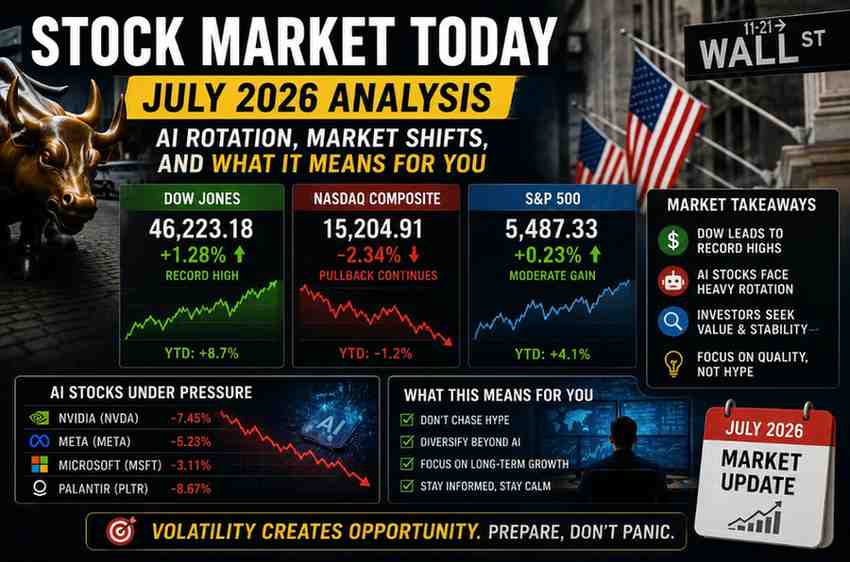
The Dow hits a record while the Nasdaq tumbles. Get an investor's take on AI stocks, market rotation, and the Fed.
Let me tell you what's happening in the stock market right now and I'm going to be brutally honest with you. It's weird, it's confusing, and it's exposing a massive divide that most investors don't fully understand.
I've been watching markets for over a decade, and I've seen rotations before. But this one feels different. It's not just a sector shuffle it's a complete repricing of what the market values. And if you're not paying attention, you could get caught on the wrong side of the trade.
Three Indexes, Three Completely Different Stories
On July 3, 2026, the Dow Jones Industrial Average hit an all-time record high of 52,900.07. That's a 1.14% gain — 594 points up. The blue-chip index is now on a four-week winning streak, its longest since October 2024. If you only owned Dow stocks, you'd be celebrating.
Meanwhile, the Nasdaq Composite dropped 207 points to 25,832.67 a 0.8% decline. If you're heavy in tech, you're probably feeling a bit sick right now.
And the S&P 500? It moved exactly 0.01 points. Flat. Unchanged. Stuck in the middle like a confused tourist at a crossroads.
| Index | Close (July 3) | Change | YTD Return |
|---|---|---|---|
| Dow Jones | 52,900.07 | +1.14% (+594 pts) | +8.7% |
| Nasdaq | 25,832.67 | -0.8% (-207 pts) | +11.0% |
| S&P 500 | ~5,600 | 0.00% (0 pts) | +9.3% |
| Equal-Weight S&P 500 | ~7,100 | +0.3% | +12.2% |
Three major indexes. Three completely different stories. And that tells you everything you need to know about the market right now: it's a tale of two markets, and they're moving in opposite directions.
The Great Rotation: What's Actually Happening Beneath the Surface
Here's what's going on that most financial headlines aren't telling you. Investors are rotating out of technology and into everything else. It's not subtle. It's not quiet. It's a full-blown stampede.
Twenty-six of the 30 Dow components finished higher on July 3. Apple surged 4.72%. McDonald's gained 4.06%. Disney rose 3.86%. Healthcare and consumer staples led the S&P 500 sectors, adding 2.70% and 2.41% respectively. These are not random moves — they're a clear signal that money is flowing to safety and value.
But technology? The Information Technology Select Sector SPDR (XLK) gained 2.8% on July 1, yet the Nasdaq still fell. Why? Because chip stocks are getting absolutely crushed. And I'm not talking about small pullbacks — I'm talking about double-digit percentage drops in a single day.
| Stock | Sector | Decline (July 1-3) | Why It's Dropping |
|---|---|---|---|
| Teradyne | Semiconductors | -13% | Profit-taking, valuation concerns |
| KLA | Semiconductors | -11.51% | Rotation out of expensive tech |
| Lam Research | Semiconductors | -10.22% | AI hype fatigue |
| Western Digital | Storage | -~10% | Chip demand fears |
| Seagate | Storage | -~10% | Broader tech selloff |
| Applied Materials | Semiconductors | -7.31% | Rising bond yields pressure |
| Intel | Semiconductors | -5.24% | Loss of AI market share |
| AMD | Semiconductors | -4.28% | Competition from Nvidia |
| Nvidia | AI Chips | -2.1% | Valuation reset |
Nvidia, the darling of the AI boom, fell 2.1%. AMD dropped 4.28%. Intel declined 5.24%. Applied Materials slid 7.31%. These are not small moves. These are major companies experiencing major selloffs that would have seemed unthinkable just six months ago.
This is a market in transition. Investors are taking profits from the AI winners that have soared over the past year and putting money into value stocks, healthcare, and consumer staples. It's the classic "rotation trade" — and it's creating a market that looks completely different depending on which index you're watching.
The AI Hangover Is Very Real — And It's Just Getting Started
Let's talk about what's really driving this volatility: AI fatigue. I've been writing about the stock market for years, and I've seen this pattern before. A new technology emerges. Everyone gets excited. Stocks skyrocket to unsustainable levels. Then reality sets in.
AI stocks have grown so massive that they've become the most influential force on Wall Street. When they sneeze, the whole market catches a cold. On July 1 alone, Nvidia dropped 3.2%, Micron fell 7.5%, and Applied Materials sank 8%. These are not small moves — they're the kind of declines that make even seasoned investors nervous.
Why is this happening? Because AI stocks have become too expensive, and investors are finally waking up to that reality. The AI euphoria has pushed valuations to unsustainable levels. Nvidia was trading at over 40x earnings. AMD at 50x. When you combine that with rising bond yields — the 10-year Treasury hit 4.48% on July 1 — suddenly those expensive tech stocks don't look as attractive.
But here's the twist that's making this market so confusing: AI spending is still driving earnings. Bloomberg Intelligence forecasts suggest Q2 earnings may increase by 23%, close to Q1's blowout 30% growth. AI infrastructure stocks are expected to contribute nearly 60% of the S&P 500's earnings-per-share growth in Q2.
The fundamentals are still strong. But the psychology is shifting. Investors are asking: "How much higher can these stocks really go?" And that question is causing whiplash.
My take: The AI bubble isn't bursting — yet. But it's definitely losing air. And if you're holding AI stocks, you need to be prepared for more volatility ahead. Don't say I didn't warn you. I've seen this movie before, and it rarely ends well for those who buy at the peak.
The Fed Factor: Rates, Jobs, and Why Nobody Knows What's Coming
If there's one thing that's keeping everyone on edge, it's the Federal Reserve. And I'm going to be honest with you — the Fed's current position is a complete mess.
In June, new Fed Chair Kevin Warsh struck a hawkish tone that surprised everyone. Nine of 18 policymakers now expect rate hikes in 2026. The consensus view is that Warsh will hike at the July 29 FOMC meeting. Investors see only a one-in-three chance of a July hike, but the threat is real — and it's causing massive uncertainty.
| Date | Probability of Rate Hike | Key Event |
|---|---|---|
| July 2026 | ~33% | Jobs data softer than expected |
| September 2026 | 55% (down from 64%) | Post-jobs report easing |
| November 2026 | ~60% | Inflation still above 3% |
| December 2026 | ~65% | Fed's preferred gauge still elevated |
Then came the jobs report. The U.S. economy added just 57,000 jobs in June — far below the 110,000 economists expected. The unemployment rate held at 4.2%. This softer-than-expected data eased rate hike fears. Expectations for a September rate hike dimmed to 55% from 64.1%.
As Adam Sarhan, chief executive at 50 Park Investments, put it: "It doesn't mean the fear of inflation is over. It just takes the pressure off the Fed to raise rates in the short term."
Here's what nobody is talking about: inflation remains stubbornly above 3%, and market expectations are that it will stay there for the remainder of 2026. Oil prices, while down from their peak, remain elevated. The Fed's preferred inflation gauge is expected to ease toward 2% over the coming quarters, but that's not guaranteed.
My opinion: The Fed is stuck between a rock and a hard place. Raise rates too quickly and you risk killing the economy. Raise them too slowly and inflation spirals out of control. This uncertainty is going to keep the market volatile for the foreseeable future. I don't envy Warsh — he's inherited a mess.
The Broader Picture: What This Means For Your Money
Let me step back and give you the big picture — because it's actually more positive than the daily headlines suggest.
The S&P 500 is up 9.3% year-to-date. The Nasdaq has gained 11% in 2026. The Dow's first-half return was 8.7%. In the first six months alone, the S&P 500 returned 9.5% — almost exactly its long-term average annual return dating back to 1950.
That's remarkable. The market has packed a year's worth of returns into six months, despite the Iran conflict almost dragging it into correction territory. If someone had told you at the beginning of the year that the market would be up almost 10% by July, you'd have taken that deal in a heartbeat.
But here's what concerns me. The S&P 500 is currently sitting 1.7% below its record close reached on June 2, 2026. The equal-weight S&P 500 is up 12.2% year-to-date — meaning the average stock is actually doing better than the market-cap-weighted index. That's healthy. That's broadening.
But it also means the easy money has been made. The AI trade that worked so well in the first half of the year is now facing a reckoning. And the rotation into value stocks, healthcare, and consumer staples suggests investors are looking for safety rather than growth.
Here's my honest assessment: The market is in a transition phase. The old leaders (AI stocks) are faltering. New leaders (value stocks, healthcare) are emerging. This creates opportunity, but it also creates risk. If you're not diversified, you're going to get hurt.
What I'm Watching Next — And What I'm Doing With My Own Money
Here's what I'm keeping my eye on in the coming weeks — and you should too.
- First, earnings season. Q2 earnings are expected to be strong — 23% growth year-over-year. But as Creative Planning put it: "When everyone expects good news, there's less room for positive surprises." The bar is high. If companies don't deliver, the market could sell off. If they beat expectations, we could see another leg up.
- Second, the Fed minutes. The minutes from last month's Fed meeting will be released on Wednesday. Investors will be looking for clues about how hawkish the new Fed chair really is, and how divided the committee is on rate hikes. This could move the market significantly.
- Third, the broadening trend. Is the rotation into value and healthcare sustainable? Or will tech stocks rebound and pull the market back to its old patterns? Joe Mazzola, head trading and derivatives strategist at Charles Schwab, said: "That's something I'll be keeping my eye on over the next couple of weeks — is whether or not that broadening continues."
As for me, I'm not panic-selling my tech positions. But I'm also not adding to them. I've been gradually shifting my new contributions toward value ETFs, healthcare, and consumer staples. I'm also keeping more cash than usual — about 15% of my portfolio — to take advantage of any dips that might come from rate hike fears.
I'll be watching the Fed minutes closely, but I'm not going to make any drastic moves based on one data point. That's the mistake most people make. They react to every headline, and they end up buying high and selling low. Don't be that person.
My Take: Don't Panic, But Don't Be Complacent
I've seen enough market cycles to know that this too shall pass. The rotation is normal. The volatility is normal. The confusion is normal. What's not normal is the complacency I'm seeing from some investors who think the AI rally will never end.
Let me share a quick story. Back in 2000, I was just starting to invest. I watched friends pour money into dot-com stocks, convinced they'd be millionaires. When the bubble burst, many of them lost everything. I wasn't smart enough to avoid the crash — I just didn't have enough money to lose. But I learned a valuable lesson: markets rotate, and the leaders of today are often the laggards of tomorrow.
That doesn't mean AI is going away. It means the easy money has been made. From here, it's going to be a stock-picker's market. The companies with real earnings growth and reasonable valuations will do well. The ones that were riding the hype wave will get crushed.
So what should you do? First, don't panic. If you're a long-term investor, this is noise. Second, rebalance. If your portfolio has become too tech-heavy, consider trimming some positions and diversifying. Third, keep investing consistently. Dollar-cost averaging works in volatile markets. And finally, ignore the doom-scrolling headlines. The market is up 9% this year — that's not a disaster.
The Inflation Elephant in the Room
I can't end this analysis without addressing the 800-pound gorilla: inflation. It's still above 3%, and it's not coming down as fast as anyone hoped. The Fed's preferred gauge — the core PCE — is expected to remain elevated throughout 2026.
This is important because inflation eats away at purchasing power. If you're holding a lot of cash, you're losing money in real terms. That's why I've been advocating for investing in assets that can outpace inflation — like stocks, real estate, and even some commodities. But I'm also cautious about overpaying for growth stocks when inflation is high, because future earnings are worth less in today's dollars.
My approach: focus on companies with pricing power — those that can pass on higher costs to customers without losing business. Think consumer staples, healthcare, and some industrials. These are the kinds of stocks that tend to hold up well during inflationary periods.
Final Thought: The Market Is Not the Economy — And That's Both Good and Bad
Here's what I want you to remember. The stock market is not the economy. It's a forward-looking mechanism that prices in expectations. Right now, it's pricing in a lot of uncertainty.
The market is up 9% this year. That's good. But it's also volatile. It's divided. It's confused about interest rates, inflation, and AI valuations. If you're a long-term investor, none of this should change your strategy. You should still be investing consistently. You should still be diversified. You should still be thinking in years, not days.
The people who get hurt in markets like this are the ones who try to time it. They buy at the top. They sell at the bottom. They chase the hot trade and panic when it reverses. Don't be that person.
If you want to build lasting wealth regardless of what the market does, start with the fundamentals. Build a budget. Save consistently. Invest regularly. And ignore the noise. Check out Building Wealth From Scratch: The 5-Step System That Actually Works for the complete roadmap.
Recommended Reading
- Building Wealth From Scratch – The complete wealth system that works in any market.
- The Stock Market Truth – Build wealth without gambling.
- Is It Worth Buying $10 of Stock? – Yes, and here's why.
- The 50/30/20 Rule – Master your budget first.
- How Regular People Get Rich in the Stock Market – The simple strategy that works.
📩 Want more honest market analysis and wealth-building strategies? Subscribe to my newsletter. No hype. Just real insights from someone who's been through it all.
Continue learning
Questions and answers
Why did the Dow hit a record high while the Nasdaq fell?
Because investors are rotating out of expensive tech stocks into value stocks, healthcare, and consumer staples. The Dow is heavily weighted toward these value stocks, while the Nasdaq is dominated by tech. This is called a 'rotation trade' and it's creating a divided market. It's a sign that investors are becoming more risk-averse and seeking safety in established, dividend-paying companies.
What's happening with AI stocks?
AI stocks are experiencing a hangover. After soaring for over a year, investors are taking profits and questioning whether valuations have become unsustainable. Nvidia, AMD, and chip stocks like KLA and Lam Research have dropped significantly. However, AI earnings are still expected to be strong, which is creating a confusing market dynamic. I think we're in the early stages of a correction, not a collapse, but volatility will persist.
Will the Federal Reserve raise interest rates in July 2026?
The market is pricing in about a one-in-three chance of a July rate hike. The new Fed Chair Kevin Warsh has been hawkish, and nine of 18 policymakers expect rate hikes in 2026. However, softer jobs data has eased some of the immediate pressure. My view is that a July hike is unlikely, but September is very much on the table. Expect more uncertainty ahead.
Should I invest in the stock market right now?
If you're a long-term investor with a diversified portfolio, yes. The market is volatile, but the long-term trend has historically been upward. Don't try to time the market. Invest consistently and think in years, not days. The market is up 9% this year despite all the uncertainty, so staying invested has paid off so far. Just make sure you're not overexposed to any single sector.
What does the market performance in 2026 tell us?
The S&P 500 is up 9.3% year-to-date, and the Nasdaq is up 11% — that's almost a full year's worth of average returns in just six months. The market has been strong, but it's also showing signs of uncertainty with the AI rotation and rate hike fears. The equal-weight index outperforming the cap-weighted index suggests the rally is broadening, which is a healthy sign. But it also means the easy money from the AI trade is likely over.
The stock market is divided, confused, and volatile. But that's normal. Markets go through cycles. The key is to stay disciplined, stay diversified, and stay focused on the long term. Don't chase the hot trade. Don't panic when things drop. Build a system, stick to it, and let time do the work. The people who get rich in the stock market are not the ones who time it perfectly. They're the ones who stay consistent. And if you need a system to build wealth regardless of market conditions, start with the fundamentals — budgeting, saving, and consistent investing. That's the real secret.