Four-Bucket Budget System for Flexible Planning

Build a flexible household budget with the Four-Bucket System for essentials, future goals, quality of life, and irregular costs.
I have reviewed literally hundreds of household budgets over the past decade, across kitchen tables, video calls, and at least one memorable session in a Waffle House booth at midnight because that was the only time my client's shift schedule allowed. And I will tell you this without hesitation: most of those budgets were completely useless.
They fall into one of two camps. Either they are so restrictive that nobody can follow them past day twelve, or so vague that they exist only to generate a low hum of guilt about your coffee habit without ever changing your bank balance. In my own informal intake data, roughly seven out of every ten new clients show up with a budgeting app already installed, a spreadsheet half-finished, or a notebook with three weeks of entries before it trails off into nothing. Neither extreme builds wealth. Neither extreme survives a flat tire, a layoff, or a sick kid. They are theater, not strategy.
Take the Johnsons, a couple I worked with in a mid-sized American city. They earn a combined $8,200 a month after taxes, which by any measure is a solid middle-class income, comfortably above the national median household income. Yet when I sat down with them, they had exactly $43 left at the end of the month. Not because they were irresponsible. Not because they were eating out every night. When we pulled ninety days of statements and traced every dollar, we found $612 a month evaporating into categories they had never named out loud: $180 spread across three overlapping streaming bundles, $140 in 'just this once' takeout that turned out to have happened eleven times, and $290 we genuinely could not reconstruct because it moved through two credit cards, a debit card, and a Venmo balance nobody was watching. They did not have a spending problem. They had a visibility problem, and visibility problems are far more expensive than they look.
The uncomfortable truth is that most households don't have an income problem. They have an allocation problem, and allocation starts with a budget that reflects how you actually live, not how a finance influencer with a different income, a different city, and frankly a different life tells you to live. A lot of the content you've scrolled past was written by someone earning sponsorship money on the side, which changes the math far more than anyone ever discloses. If you are ready to stop guessing and start controlling, this guide is for you.
Quick Takeaways
- Percentage budgets can feel rigid when essential costs change from month to month.
- The Four-Bucket System uses 50-60% Essentials, 15-20% Future Building, 15-20% Quality of Life, and a 5-10% Buffer.
- Run an income audit first. Your real spendable number is usually 3-12% lower than your salary suggests.
- Subscription slippage, convenience creep, and BNPL stacking quietly drain $350-$400+ a month in most households.
- Pay off any debt above 20% APR before building a full emergency fund; a $500 mini-fund is enough in the meantime.
The 2026 Household Budget Reality Check
Let's talk about inflation. Not the sanitized version you see in government reports, but the real-world impact on your grocery cart, your utility bill, and your rent cheque. Since 2020, the cumulative inflation rate in the United States has exceeded 20% across essential categories. But that is just the average. If you live in a major metropolitan area like Miami, Austin, or Phoenix, rent has climbed by over 30% in that same window. Groceries are up 18% nationally, with staples like eggs, milk, and cooking oil seeing even steeper spikes.
I pulled rent comparisons across a dozen metro areas while building this guide, and the spread is genuinely wild. Cities like Austin and Phoenix have absorbed 25-30% rent increases specifically because remote work pushed migration patterns that nobody priced in five years ago, while slower-growth Midwest metros are up closer to 10-12% in the same window. If a budgeting framework doesn't ask 'where do you actually live' as its very first question, it was never built for your real life. It was built for a national average that describes nobody in particular.
A percentage budget can be a useful starting point, but it can feel too rigid when housing, utilities, or family costs change. On a $5,500 monthly take-home, a household may need more room for essentials in one season and a larger buffer in another. The Four-Bucket System is designed for that flexibility: it helps you name priorities without treating one fixed percentage as a pass-or-fail test.
I am not saying this to depress you. I am saying it because the first step to fixing your finances is accepting the reality of your situation. A budget that ignores current economic conditions is not a budget; it is a fantasy. And fantasies do not pay the bills.
The Four-Bucket System: A Flexible Household Framework
After years of trial and error with my own money and working with hundreds of clients, I have developed what I call the Four-Bucket System. It is simple, flexible, and actually works for real people in 2026. Here is how it breaks down:
- Bucket 1: Fixed Essentials (50-60%) – Rent or mortgage, utilities, insurance premiums, minimum debt payments, and basic groceries. These are the bills you must pay to keep a roof over your head and the lights on.
- Bucket 2: Future Building (15-20%) – Retirement contributions, emergency fund deposits, and investment contributions. Pay yourself first, even if it is small. This is non-negotiable if you want to stop living paycheck to paycheck.
- Bucket 3: Quality of Life (15-20%) – Dining out, streaming subscriptions, hobbies, travel, and personal care. These are the things that make life worth living, and you should budget for them intentionally rather than feeling guilty about every latte.
- Bucket 4: The Buffer (5-10%) – Irregular expenses that always seem to pop up: car repairs, medical co-pays, birthday gifts, and annual subscriptions. If you don't budget for irregular expenses, they become emergencies. And emergencies destroy every budget.
Notice what I did not include. I did not tell you to track every single penny, cut out all entertainment, or subsist on rice and beans. That is not a sustainable strategy. That is a punishment. And nobody sticks to a punishment for very long.
There is one exception to this whole framework, and it is worth naming now rather than discovering it mid-crisis. If your income ever drops sharply enough that even Bucket 1 cannot be fully funded, stop trying to keep all four buckets alive. Collapse down to the Four Walls budget instead: shelter, utilities, food, and transportation, funded in that exact order, and nothing else, until your income stabilizes. The Four-Bucket System is built for a stable month. The Four Walls is built for a survival month. Knowing which mode you are actually in is half the battle.
The Income Audit: The Step Everyone Skips
Before you touch a single bucket, there is a step almost nobody takes, and it is the reason half the budgets I see fail in week one: an honest income audit. Most people budget against their salary, not their actual deposit. That sounds like the same number. It rarely is.
Here's what I mean. Run your gross pay through taxes, subtract pre-tax deductions like your 401(k) and health insurance premium, then subtract anything that hits your account but isn't really yours to spend, like a reimbursement you owe back to a side-business account, or a payment-plan installment that auto-debits before you ever see the cash. I had a client, a nurse working rotating shifts, who believed she brought home $4,800 a month. Once we accounted for mandatory union dues, a shift-differential clawback from a prior overpayment, and a 403(b) loan repayment, her real spendable number was $4,190. That $610 gap is exactly why her budget overshot by roughly the same amount every single month. She wasn't bad with money. Her budget was built on a number that didn't exist.
Do this audit once, properly, using three months of actual deposits as your evidence, and you will likely find your real number is anywhere from 3% to 12% lower than the figure in your head. Build your buckets off that real number, not the one on your offer letter, and the rest of this system actually holds together.
Real-World Example: The Martinez Family Budget
Let us make this concrete, the same way we made the Johnsons concrete, because abstractions don't change behavior, examples do. The Martinez family lives in Houston, Texas. Their combined after-tax monthly income, confirmed through the income audit above rather than guessed, is $5,500. Here is exactly how their zero-based budget looked after we applied the Four-Bucket System:
- Fixed Essentials: $3,000 (54.5%) – Mortgage $1,400, utilities $350, insurance $220, car payments $430, minimum debt payments $150, groceries $450.
- Future Building: $1,000 (18.2%) – $400 into their 401(k), $300 into an emergency fund, $300 into a taxable investment account.
- Quality of Life: $1,100 (20%) – $300 dining out, $150 subscriptions and streaming, $200 personal care and clothing, $250 fun money, $200 for weekend trips.
- The Buffer: $400 (7.3%) – Car maintenance fund, medical co-pay fund, gift fund, and a small miscellaneous fund.
Total allocated: $5,500. Zero dollars left floating. The old Martinez budget, the one they were running before we met, would have ended the month with maybe $200 unaccounted for, money that inevitably evaporated on random Amazon purchases and fast-food runs they couldn't even remember making. The new Martinez family has direction, clarity, and a growing emergency fund and investment portfolio. They have not cut out fun. They have simply given their fun money a name and a ceiling.
Six months in, something happened that I did not fully predict. Because their $150 minimum debt payment was now a fixed, visible line item instead of an afterthought, Mr. Martinez started routing his quarterly work bonus, about $900 each time, directly at the remaining balance on a $2,400 furniture loan carrying 24.9% APR. That loan, which would have taken another fourteen months to clear at minimum payments and cost them roughly $310 more in interest, was gone in five months. Nobody told him to do that. Once the budget gave him visibility, he made the obvious move on his own. That is the real value of this system: it doesn't just allocate money, it reveals decisions that were invisible before.
The Money Talk: Why Couples Budgets Fail Differently Than Solo Budgets
If you are budgeting with a partner, I need to say something most budgeting guides skip entirely: your biggest risk isn't math, it's misalignment. I have watched technically perfect budgets collapse within two months because one partner felt the system was a leash and the other felt it was the only thing standing between them and disaster. Both of them were right, which is exactly the problem.
The fix I use with couples is what I call separate 'no-questions-asked' money inside the Quality of Life bucket. Each partner gets an equal, named amount, say $150 each on the Martinez budget, that the other partner does not get to review, question, or comment on. It sounds small, but it resolves the large majority of the budget-related arguments I see in couples, because it converts 'why did you spend that' into a question that structurally cannot be asked anymore. Autonomy inside a shared system beats control inside a shared system almost every time.
Pair that with a fixed 20-minute 'money date' once a month, not weekly, monthly is enough, where you look at the four buckets together and nothing else. No phones, no scorekeeping, no relitigating last month. Couples who do this consistently stay on budget at a noticeably higher rate than couples who only talk about money when something has already gone wrong, because by then the conversation is about blame, not strategy.
The Real Enemy: Hidden Leaks That Drain Your Wallet
Let me share an original observation that has saved my clients thousands of dollars. The average household I work with wastes approximately $350 a month on what I call 'subscription slippage' and 'convenience creep.' Subscription slippage is the gym membership you use twice a month, the streaming service you forgot you had, and the app subscription that renewed quarterly without you noticing. That is typically $80 to $120 a month right there.
Convenience creep is even more dangerous. It is the daily coffee that costs $6, the lunch order that comes out to $15, and the two delivery app orders a week that run you $40 each. I worked with a client named Sarah who was spending $580 a month on takeout and delivery alone, more than her car payment. She did not realize it until we mapped it out. When she cut that to $250 a month by meal-prepping three days a week, she freed up $330 monthly. Over the course of a year, that is $3,960, a fully funded Roth IRA contribution sitting where takeout used to be.
There's a newer leak I'm watching closely in 2026, and it's more dangerous than either of the above because it hides the true cost from you on purpose: Buy Now, Pay Later installment stacking. I had a client juggling four separate BNPL plans across three different apps, none individually alarming, $38 here, $52 there, but together quietly committing $410 a month of future income before it had even arrived. The danger isn't the interest; most of these plans are interest-free if you pay on time. The danger is that each plan feels small enough to ignore, so nobody adds them up until five obligations land in the same week. If you use BNPL at all, do one thing: write every active plan, amount, and due date on a single index card. The moment you can see the total, you make different decisions.
The point here is not to shame anyone for enjoying convenience. The point is to surface these leaks so you can make an intentional choice about where your money goes. If you love delivery and it brings you joy, keep it. Just own that decision consciously instead of bleeding cash passively.
What About Irregular Income? A Strategy for Freelancers and Gig Workers
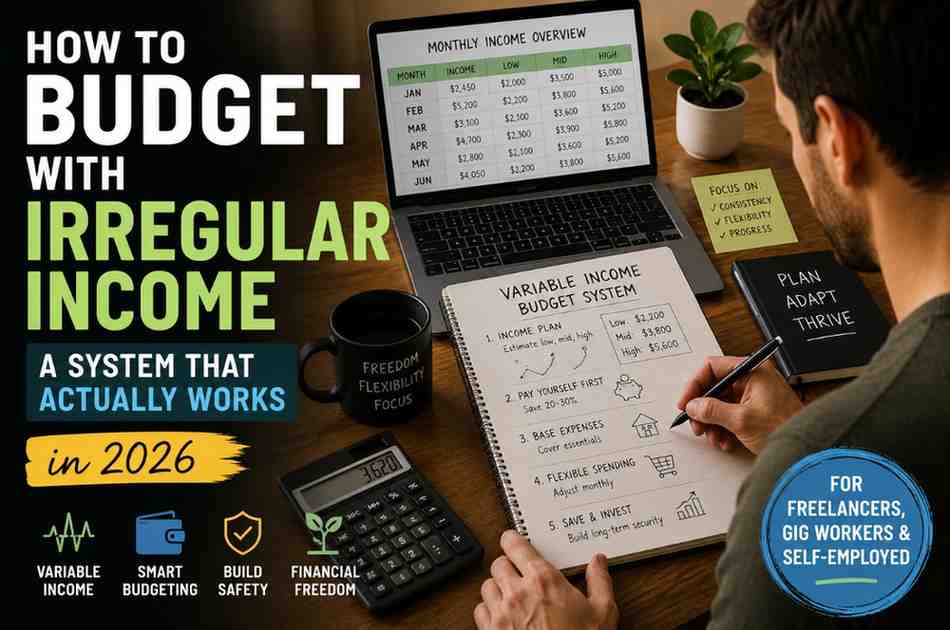
One of the most common objections I hear is, "I am a freelancer. My income fluctuates. A budget does not work for me." That is a cop-out. A budget is actually more important for you than for someone with a stable salary. The difference is that you need to budget on a multi-month average rather than a monthly fixed number.
Here is the strategy that has worked for dozens of my freelance clients. Take your total after-tax income from the past six months and divide it by six. That gives you your baseline average monthly income. Now build your budget around 80% of that average. The 20% buffer is your safety net for the lean months. In months where you earn above your average, you put the surplus directly into your buffer bucket. When a lean month hits, you pull from that buffer to cover your essentials. This smooths out the volatility and gives you the same clarity as a salaried employee.
One refinement I've made after watching this fail for a couple of clients: don't use a flat six-month average if your work is seasonal rather than simply variable. A wedding photographer earning 70% of her annual income between May and October needs a different baseline than a freelance copywriter with relatively even monthly demand. For seasonal income, calculate your average using only the corresponding months from the prior year, not a rolling six-month window that will overstate your slow season and understate your peak season. Get this wrong and you will either underspend during your best months out of unnecessary caution, or overspend during your slow months because the average lied to you.
I have seen freelance designers, consultants, and even ride-share drivers use this method to build six-month emergency funds while their peers with stable jobs are still struggling. The difference is intentionality. A fluctuating income does not excuse you from planning; it demands that you plan more carefully.
The Tracking Myth: Why Obsessive Tracking Fails
I am going to say something that will upset the personal finance app industry. Tracking every single transaction is a waste of time for most people. I am not saying you should ignore your spending. I am saying obsessing over whether you spent $4.75 or $5.25 on lunch creates friction and fatigue. And fatigue is why most people quit budgeting within 30 days.
Instead of tracking every line item, I recommend a weekly 'financial pulse check' that takes exactly 15 minutes. Sit down every Sunday evening, open your bank app, and look at only four numbers: total spent on housing, total spent on food (groceries plus dining out), total spent on transportation, and total spent on subscriptions and entertainment. That's it. Those four categories account for roughly 80% of total spending for most households. If those are on track, the smaller categories will almost always fall into place naturally. If they're off, you know exactly which lever to pull.
I've also stopped recommending most budgeting apps as a first step, which is an unpopular opinion in this industry. The apps aren't badly built; the problem is behavioral. Every added category, every push notification, every 'you're over budget in dining' alert adds friction, and friction is exactly what makes people quit in week three. I would rather a client run the four-number Sunday check-in on the back of an envelope for ninety days and build the habit, then layer in an app once the behavior is already automatic, than hand them software on day one that turns budgeting into another notification to dismiss.
This approach respects your time and your sanity. It gives you the visibility you need without turning your life into a tedious accounting exercise. I have seen compliance rates double when clients switch to this method, because a budget you can actually stick to beats a perfect budget you abandon after a month, every single time.
The 10% Test: My Rule for Big, One-Off Purchases
Buckets handle your recurring life. They don't handle the $1,800 couch, the $600 flight, or the $3,000 dental procedure that wasn't really optional. For those, I use a rule I built after watching too many otherwise-solid budgets get derailed by a single large purchase nobody planned for: the 10% Test. If a purchase costs more than 10% of your monthly take-home pay, it doesn't come out of any single bucket. It gets its own mini savings sprint before you buy it, even if you can technically afford it today.
Here's why that matters more than it sounds like it should. On the Martinez budget, 10% of $5,500 is $550. A $1,800 couch is well over three times that threshold. Buying it in one shot would gut their Future Building bucket or their Buffer for the entire month, and a budget that gets gutted once tends to get abandoned, because the next month feels impossible to recover from. Instead, I had them route an extra $300 a month from a temporarily paused 'fun money' allocation into a dedicated sinking fund for six weeks. They got the couch. Nothing else broke. The purchase felt earned instead of regretted, and regret, more than any single dollar amount, is the thing that actually destroys long-term budgeting discipline.
Emergency Funds vs. High-Interest Debt: A Contrarian View
Most financial experts will tell you to save a $1,000 emergency fund before you start aggressively paying down debt. I am going to disagree with that, at least in part. If you have credit card debt with an interest rate above 20%, that debt is an emergency. Every month you hold that balance, you are losing a massive amount of money to interest payments.
The average credit card APR in the U.S. sits well above 20% as of this year, and for store and retail cards it's frequently north of 28%. At 24% APR, a $5,000 balance carried with only minimum payments costs you roughly $1,200 a year in interest alone, money that buys you absolutely nothing. Compare that to the 4-5% you're earning on a high-yield savings account holding your starter emergency fund, and the math isn't close. You are paying a 19-20 percentage point spread for the emotional comfort of a slightly bigger savings cushion, and I do not think that comfort is worth what it costs you.
I recommend a hybrid approach: save a $500 mini-emergency fund for absolute catastrophes like a flat tire or an urgent medical co-pay. Then channel every extra dollar into paying down your highest-interest debt. Once that debt is eliminated, supercharge your full emergency fund to three to six months of expenses. This approach saved one client over $1,200 in interest fees within the first year alone, real money that stayed in his pocket instead of flowing to a credit card company.
Once your highest-rate debt is the target, you'll see advice split between the 'avalanche' method, attack the highest interest rate first, and the 'snowball' method, attack the smallest balance first regardless of rate. Mathematically, avalanche wins every time; it minimizes total interest paid, full stop. But I recommend snowball for clients who have tried and failed at debt payoff before, because the psychological win of eliminating an entire balance, any balance, in month one tends to predict whether someone sticks with the plan through month six. The 'best' method on a spreadsheet isn't always the best method for a human being who has quit twice already. Know which one you actually are before you pick.
The key is to be aggressive but not reckless. Do not leave yourself completely unprotected. But do not pay 22% interest on a $5,000 balance while letting $500 sit idle in a savings account earning 4%. That math simply does not work.
When to Break Your Own Budget, On Purpose
I want to say something that contradicts almost everything else in this guide: sometimes the right move is to blow the budget completely, deliberately, and without guilt. A close friend's wedding, a once-in-a-decade trip with your aging parents, a piece of equipment that will pay for itself in your business within sixty days, these are not failures of discipline. They are decisions, and decisions deserve to be made consciously rather than mourned after the fact.
The rule I use is simple: you are allowed to break the budget if you can name, in advance, exactly which future month is going to absorb the consequence. 'We're spending $2,200 we don't have on this trip, and Buckets 2 and 3 both get cut by 30% for the following two months to recover it' is a plan. 'We'll figure it out' is not a plan, it's a hope, and hope has never once balanced a checking account.
Final Word: Your Budget Is a Conversation, Not a Chainsaw
I will leave you with this. Your household budget is not meant to be a disciplinary tool. It is meant to be a conversation between your current self and your future self. It is a way of saying, 'This is what matters to me, and this is how I am going to fund it.'
If your budget makes you feel miserable, you will abandon it. And abandoning your budget is far worse than having a slightly imperfect budget. So give yourself grace. Adjust as you go. Celebrate the small wins. And remember that financial freedom is not about being rich. It is about having enough clarity and control that money stops being a low-grade source of constant stress running in the background of your life.
The Martinez family is now on track to save $12,000 this year, $7,000 more than the previous year, and Mr. Martinez paid off a 24.9% APR furniture loan nine months ahead of schedule simply because the budget made the decision obvious. Sarah cut her delivery spending and redirected that $330 a month into her Roth IRA, where it now has decades to compound. The freelance photographer built a seasonal buffer large enough to take a three-week unpaid vacation in her off-season without panicking. The nurse with the union dues finally has a budget built on a number that's actually true. None of them have superhuman willpower. They have a system that fits the real shape of their real lives, leaks, seasons, and all.
If you are ready to stop guessing where your money went and start telling it where to go, then the Four-Bucket System and the strategies in this guide give you everything you need. The rest is just showing up and doing the work. And the work is a lot easier when you actually have a map.
For a deeper dive into zero-based budgeting, which powers the allocation method we used here, visit our complete guide to ZBB. And if you want to accelerate your savings, check out the fastest way to save $10,000 for aggressive timelines that actually work.
Continue learning

Questions and answers
Is the 50/30/20 budget rule still valid in 2026?
No. With inflation driving essential costs to 55-65% of income for many families, the 50/30/20 rule is outdated. The Four-Bucket System better reflects current economic realities by allocating 50-60% to essentials, 15-20% to savings and investments, 15-20% to quality of life, and 5-10% to a buffer for irregular expenses.
How much should I budget for groceries for a family of four?
For a family of four in 2026, a realistic grocery budget ranges between $900 and $1,200 per month in most U.S. cities, depending on location and dietary preferences. This does not include dining out. Inflation has pushed this up by roughly 18% since 2020.
What is the fastest way to reduce household spending?
Start with subscriptions and delivery apps. These are 'low-hanging fruit' that often drain $200-$400 monthly without providing corresponding value. Review all recurring charges quarterly and cut what you don't use. Reduce takeout from five times a week to three times a week and you can save over $300 monthly.
How do I budget if I have irregular income from freelancing?
Calculate your average monthly income over the past six months, or over matching months from the prior year if your work is seasonal. Build your budget around 80% of that average and put the extra from good months into a buffer fund. In lean months, draw from that buffer to cover essentials. This smooths out income volatility and works reliably for gig workers and freelancers.
Should I save an emergency fund or pay off debt first?
Build a $500 mini emergency fund first. Then aggressively pay down any debt with an interest rate above 20%. After that, build your full 3-6 month emergency fund. This hybrid approach protects you from minor emergencies while avoiding crippling interest payments that cost you thousands over time.
Should my partner and I have a joint budget or separate budgets?
A hybrid model works best for most couples. Run shared expenses through a joint account, but keep a small, equal, no-questions-asked allowance inside your Quality of Life bucket for each partner individually. This preserves autonomy while keeping the big-picture numbers fully transparent, and resolves most money arguments that stem from feeling micromanaged.
How should I budget for a big one-time purchase like furniture or a vacation?
If the purchase costs more than roughly 10% of your monthly take-home pay, don't pull it from a single month's budget. Pause part of your Quality of Life allocation for several weeks and build a dedicated sinking fund for that specific purchase instead. This protects your other categories from getting gutted and prevents the buyer's remorse that tends to follow large unplanned purchases.
A budget isn't a punishment you survive until the next paycheck saves you. It's the one tool that turns a vague feeling of financial anxiety into a short list of specific, fixable numbers. Run the income audit, build your four buckets off the real number, leave room for the occasional deliberate splurge, and check in for fifteen minutes a week instead of obsessing daily. That's the whole system. The families in this guide aren't more disciplined than you. They just stopped guessing.