The Trading Strategy That Made Me Profitable
A real-life trading framework focused on discipline, probability, and risk management instead of hype or secret indicators.
The Trading Strategy That Finally Made Me Profitable (It’s Not What You Think)
Let’s be honest. You’ve probably binge-watched trading videos, downloaded a dozen “winning” indicators, and maybe even blown up an account or two. You’re chasing that elusive feeling of being in control of the markets, but instead, it feels like you’re just throwing darts in a hurricane. I know, because that was me for years.
If you’re serious about consistency, you should also read our detailed guide on trading as a business, which explains why structure and process matter more than motivation.
The turning point wasn’t a secret signal or a $3000 course. It was the brutal realization that I was the biggest risk to my own capital. My strategy wasn't the problem—my entire approach was.
So here’s the real-life, no-BS strategy that moved me from consistent loser to consistently profitable. It’s less about predicting the market and more about managing yourself.
The Core Philosophy: Trading is a Probability Business, Not a Crystal Ball
Let me paint a picture you know too well. You see a setup, you hesitate. "What if it goes the other way?" you think. So you wait for another candle, maybe a second indicator to flash green. By the time you convince yourself it’s "safe," the move is halfway done. You either jump in late and get chopped up, or watch in frustration as the trade you missed rockets to your target.
This was my single greatest leak of profits: the desperate, anxiety-fueled hunt for certainty. I was looking for a green light that didn’t exist.
Here’s the liberating truth I learned the hard way: No one knows what the market will do next. Not the hedge fund manager on TV, not the guru with a million followers, and definitely not you. The moment you accept that, you stop trying to be a prophet and start becoming a strategist.
Think of it like this: A professional poker player doesn’t know what the next card will be. They don’t even expect to win every hand. Their edge comes from knowing the odds, managing their chip stack meticulously, and folding relentlessly until the probabilities swing meaningfully in their favor. Trading is no different.
"Stacking probabilities" is the practical art of layering small edges to create a positive expectation over time. It means:
- Trading with the trend, because a trend in motion is probable to continue.
- Waiting for a pullback to a logical level, because buying low and selling high is probable to offer better risk/reward.
- Demanding a clear signal at that level, because momentum shifting back in the trend's direction is probable to trigger the next leg.
Each layer doesn’t guarantee the win. But together, they tilt the odds from a 50/50 coin flip to, say, a 55/45 or 60/40 scenario in your favor. That’s all you need. Because when you combine that slight edge with ironclad risk management (like the 1% rule), you create a mathematical advantage that grinds out profits over dozens of trades, not in one heroic gamble.
This mindset shift did two powerful things for me:
- It made losses peaceful. A stopped-out trade didn’t mean I was wrong or the system was broken. It just meant I was part of the 40% of times the probability didn’t play out. I could shrug, log it, and move on, knowing my rules would capitalize on the next 60%.
- It made execution mechanical. My job was no longer to predict or to be right. My job was to identify when my specific set of probabilistic conditions were met and then execute my plan without debate.
Forget finding the perfect entry. Focus instead on building a probable entry, managing an unpredictable outcome with strict rules, and repeating that process with robotic consistency. That’s where the real money is made not in the flashes of luck, but in the steady, boring accumulation of small, expected gains.
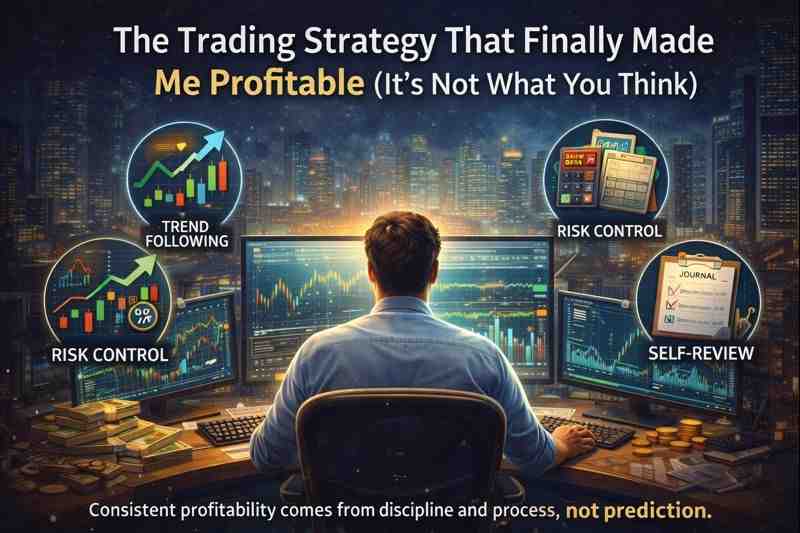
The Three-Pillar Strategy (My Actual Framework)
This isn't a get-rich-quick scheme. It's a grinding, disciplined system built on three non-negotiable pillars.
| Pillar | What It Is | Why It Works (In Real Life) |
|---|---|---|
| 1. The Edge (Your Rule) | One, single, clear condition to enter a trade. Not 5 indicators agreeing. Something like: "Price pulls back to the 20-period EMA on the 4-hour chart in a clear daily trend, and shows a rejection candle." | It removes hesitation and emotion. You’re not deciding; you’re following your rule. No rule, no trade. |
| 2. Risk First (The Holy Grail) | Every trade has a predetermined stop-loss and take-profit before you click "buy." Your position size is calculated so that loss is a small, painless percentage of your capital (I use 1%). | This makes losses boring and manageable. A bad day is a 2% dip in your account, not a 20% catastrophe. You survive to trade tomorrow. |
| 3. The Journal (Your Truth Serum) | A log of every trade: entry reason, screenshot, outcome, and most importantly—your emotional state. | This exposes your real weaknesses. Are you losing when you're tired? Overtrading after a win? The data doesn't lie. |
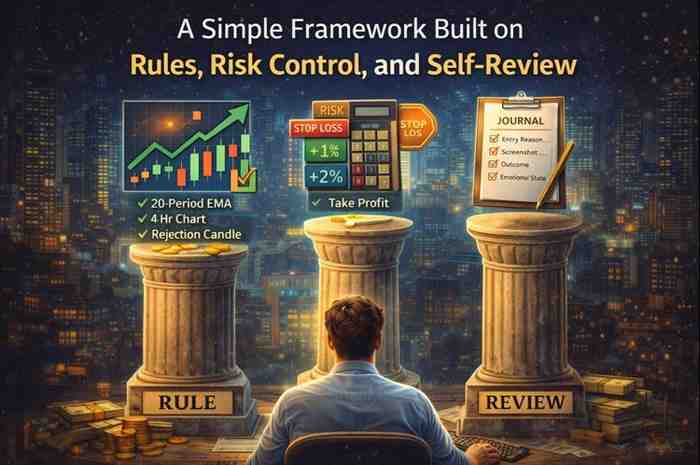
Risk management plays a major role in this framework. You may find it helpful to review our breakdown of the 3-5-7 risk rule and how professional traders protect capital.
My Simple Trade Setup (An Example)
Here’s a stripped-down version of what I actually look for. Complexity is the enemy of execution.
Instrument: Major Forex Pairs (EURUSD, GBPUSD) or Large-Cap Stocks
Timeframe Analysis:
- Daily Chart: What is the overall trend? (Up, Down, Ranging). I only take trades in the direction of the daily trend.
- 4-Hour Chart: Wait for a pullback to a key level (like a moving average or previous support/resistance).
- Entry Signal: A clear bullish or bearish price action candle (like a pin bar or engulfing candle) at that level.
- Trade Management: Stop-loss placed just beyond the signal candle. Take-profit set at a 2:1 or 3:1 Risk/Reward ratio.
Visual Comparison: The Old Me vs. The Profitable Me
| Tactic | The Old (Losing) Me | The New (Profitable) Me |
|---|---|---|
| Chart Setup | 7 indicators, screen glowing like a Christmas tree. | Clean chart. Maybe 2 moving averages and horizontal lines for key levels. |
| Entering a Trade | "This feels like it's going up!" (Emotion) | "My rule is met. Execute." (Process) |
| During the Trade | Constantly watching, moving stops, sweating. | Stop and target are set. I walk away. |
| After a Loss | Revenge trade to "get my money back." | Review journal. Respect the rule. The system worked, that trade was in the losing 40%. |
| After a Win | Feeling like a genius, doubling my next position. | Log the trade. The system worked. Onto the next setup. |
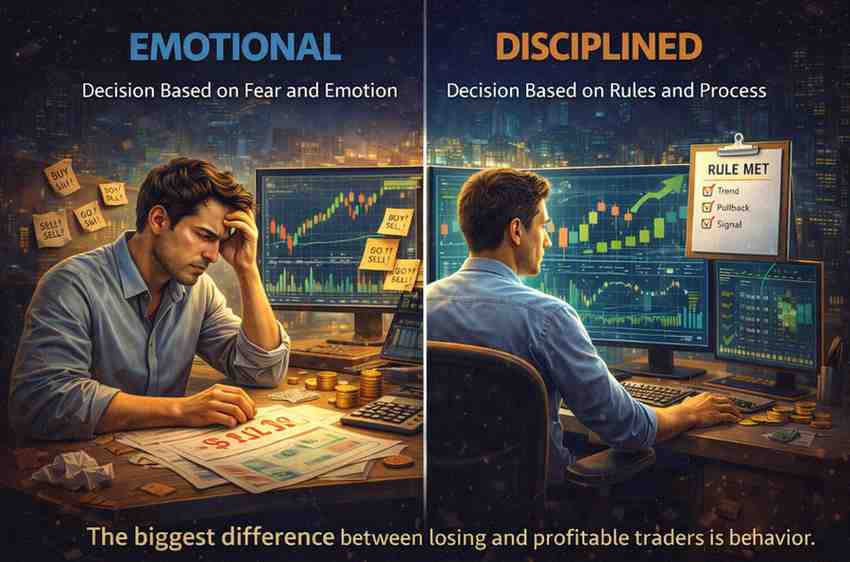
What To Realistically Expect (Spoiler: It’s Not a Lambo)
- You will still lose trades. About 40-50% of them. Winning is about letting your winners run further than your losers stop.
- It will be boring. You’ll pass on 20 setups for every 1 that meets your rule.
- Progress is measured in months and years, not days and weeks. Your goal is a steadily rising equity curve, not weekly moonshots.
If emotional control is your biggest challenge, our article on why most traders fail explains the psychological traps that cause repeated losses.
To bulding a wealth in any space not only in frelancing, you need proper scaling and investing, not only making profit is important but securing it, cutting loss and expenses is more important, you can check : building wealth from scratch to learn more about building wealth. the aim is to build wealth not just to be rich!