Is Trading Gambling? The Truth for Traders
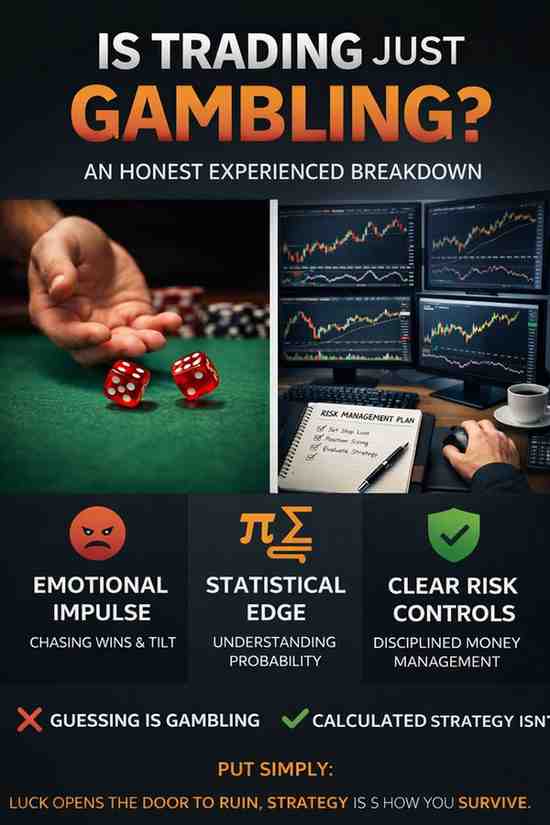
Is trading gambling? Explore the psychological, mathematical, and risk differences every trader needs to understand.
Is trading like gambling? The Truth That Every Trader Needs to Know
I remember the first time I lost a month's rent in just fifteen minutes. I kept clicking "buy" and "sell," hoping that the next trade would be the one that got me out. My hands were shaking, my throat was dry, and the screen in front of me was blurry. At that time, I wasn't a trader. I was a gambler who had a bad run, and the market was my casino.
This is an uncomfortable question that every serious trader should ask themselves: Am I gambling? The short answer is no, but there is a huge, life-changing caveat. Trading can turn into gambling in a heartbeat. The market or the asset don't draw the line; you do with your mindset, your process, and your discipline.
This isn't just a philosophical argument. It's the main difference between learning a skill that will last and giving your savings to the stock market over time. Let's stop comparing things on the surface and get to the real, psychological differences between a professional trader and a hopeful speculator.
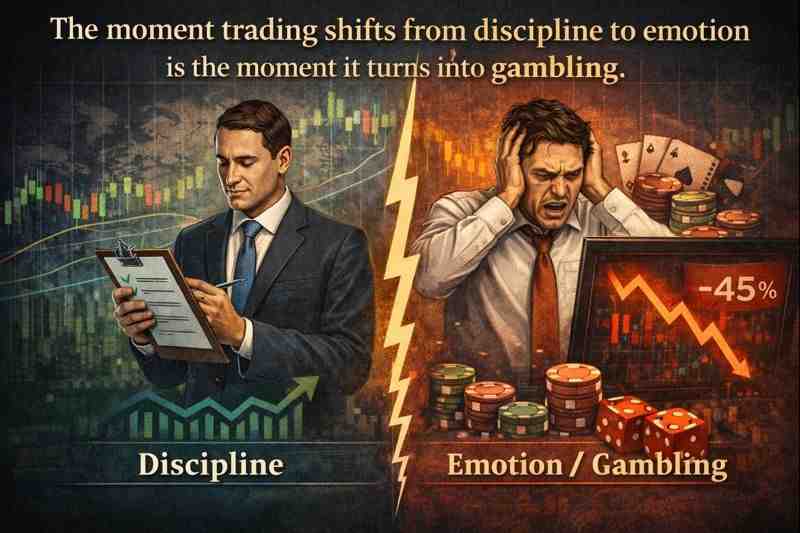
When trading goes from being a discipline to an emotion, it becomes gambling.
The Core of Gambling: A Built-In Mathematical Loss
Let's be brutally clear about what gambling truly is. Gambling is staking money on an event with an uncertain outcome, where the odds are systemically stacked against you. The house always has an edge.
Think about a roulette wheel in Las Vegas. The presence of the "0" and "00" creates a guaranteed, mathematical advantage for the casino. Over enough spins, the casino cannot lose. Your brilliant "strategy" of betting on red? It's entertainment, not investment.
Common Gambling Activities:
- Casino Games (Slots, Roulette, Keno)
- Lotteries and Scratch-Offs
- Sports Betting Based on "Gut Feel" (No Analysis)
- Card Games Purely of Chance
The Gambler's Hallmarks:
- Outcome Reliance: Most of the time, the results depend on chance.
- Negative Expectancy: The expected long-term return is mathematically negative.
- No Control: You can't change how the game ends.
- Emotional Fuel: Hope, excitement, and the need to "win it back" drive decisions.
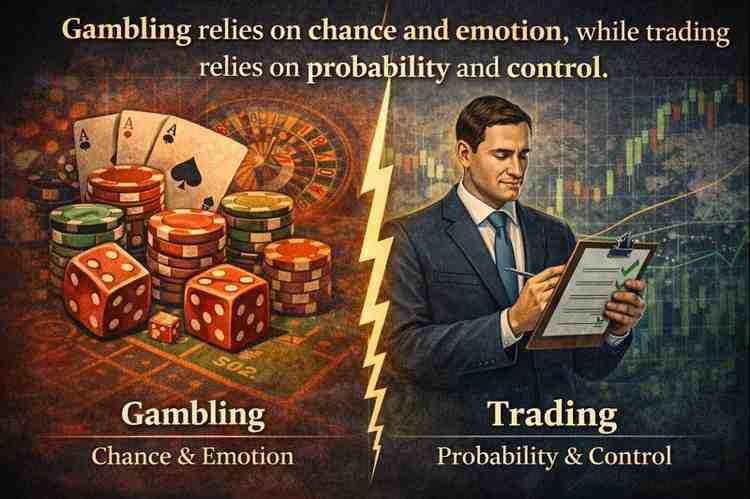
The Basics of Trading: A Skill-Based Activity
The real business of trading is to buy and sell financial instruments (stocks, forex, options) with the goal of making money from price changes, using analysis, probability, and strict risk management.
Luck doesn't give a trader an edge. It comes from a process that can be repeated:
- Analysis: Finding setups that are likely to happen by looking at technical charts, fundamental data, or quantitative models.
- Strategy: Know exactly when to enter, exit, and fail (stop-loss).
- Risk Management: Knowing ahead of time how much money you are willing to lose on a trade.
- Psychology: Staying disciplined and sticking to your plan, even when fear and greed are yelling at you.
There is risk, and it's a big risk, but it's managed risk. It is not a risk that you can't see.
The Big Difference: A Side-by-Side Breakdown
| Feature | Professional Trading | Gambling |
|---|---|---|
| Primary Driver | Skill, Analysis, & Probability | Chance & Luck |
| Decision Basis | Data, Back-tested Strategies, Rules | Emotion, Superstition, Gut Feeling |
| Risk Management | Core of the activity with strict controls | Non-existent or reckless |
| Long-Term Expectancy | Can be positive | Inherently negative |
| Control Over Outcome | Risk and execution are controlled | No control over outcome |
| Psychological Mindset | Discipline and emotional detachment | Impulsivity and thrill-seeking |
| Repeatability & Learning | Skills improve with experience | Results remain random |
Expected Value: The Math That Changes Everything
- Gambling: The expected value (EV) is always negative.
- Trading: A trader can come up with a plan that has a positive expected value.
Example of Expected Value: (0.40 × $300) + (0.60 × -$100) = +$60 for each trade.
Traders who are disciplined can still make money even if they lose more than they win. A gambler can't make this edge.
The Moment Trading Crosses the Line Into Gambling
- Trading without a plan
- Trading to get back at someone after losing
- Not paying attention to stop-losses
- Trading too much because you're bored or upset
- Using a lot of leverage without thinking
The Mindset That Makes Some People Win and Others Lose Professional trading psychology: accepts losses as a cost of doing business; personalizes losses emotionally; and focuses on process. Speculative gambling psychology: obsesses over outcome. Acts on impulse | Exercises patience Keeps emotional distance | Lives on emotional highs and lows
The Psychology That Separates Winners From Losers
| Trading Psychology (Professional) | Gambling Psychology (Speculator) |
|---|---|
| Accepts losses as a cost of business | Personalizes losses emotionally |
| Focuses on process | Obsesses over outcome |
| Exercises patience | Acts on impulse |
| Maintains emotional detachment | Lives on emotional highs and lows |
How to Ensure You're Trading, Not Gambling: A 5-Point Checklist
- Do I have a plan in writing?
- Is my risk clearly spelled out?
- Is this trade in line with my plan?
- Am I emotionally neutral?
- Do I want an edge or an adrenaline rush?
The market doesn't decide what happens to you. Your discipline does.
Final Decision: The Market Doesn't Decide for You
Trading is not gambling by nature. It is a real financial skill that takes study, practice, and mental discipline.
When you give up strategy for hope, analysis for emotion, and risk management for reckless bets, trading becomes gambling.
Think of trading as a long-term skill. The money will come after the skill.
This information is only for learning and not for financial advice. There is a high risk of losing money when you trade.
To bulding a wealth in any space not only in trading, you need proper scaling, not only making profit is important but securing it, cutting loss and expenses is more important, you can check : building wealth from scratch to learn more about building wealth. the aim is to build wealth not just to be rich!
Continue learning
Questions and answers
Is trading the same as gambling?
Trading is not the same as gambling by nature. Trading is a skill-based activity that relies on analysis, probability, and risk management, while gambling depends primarily on chance and emotion.
Can trading turn into gambling?
Yes. Trading becomes gambling when a trader abandons strategy, ignores risk management, and makes decisions based on emotion, revenge, or hope instead of probability.
What is the main difference between trading and gambling?
The main difference is control and expectancy. Trading allows for controlled risk and positive expected value, while gambling has a built-in negative expectancy over time.
Why do some traders lose money like gamblers?
Some traders lose money because they trade without a plan, overtrade emotionally, ignore stop-losses, and rely on luck rather than a repeatable strategy.
How can I make sure I am trading and not gambling?
You can ensure you are trading by having a written plan, defining risk clearly, staying emotionally neutral, following strict rules, and focusing on long-term consistency instead of short-term excitement.