Why 90% of Traders Fail

A brutally honest breakdown of why most traders fail and the disciplined roadmap required to join the consistent 10%.
Why 90% of traders fail and how to be one of the 10% who don't
You'll recognise this day, even if you've never lived it exactly. You get up before the market opens, coffee in hand, charts already glowing. You did your research and marked your levels. You tell yourself, "Today, I'll be good."
The first hour, you're patient. Then the perfect setup appears, the light turns green and your heart rate climbs. You get in. For twenty minutes it goes your way and you feel that rush of being right. Then the price turns, drifts back to your entry and slides into the red. Your brain starts negotiating: maybe the thesis is still intact, maybe adding more will lower your average.
It sinks further. Your stomach tightens and you can't bring yourself to hit "sell." You shrink the screen and promise to check after lunch. When you finally look, one trade has wiped out a week of careful gains. Anger, shame and defeat arrive together, you top up the account and swear you'll "trade your way back," and the cycle starts again.
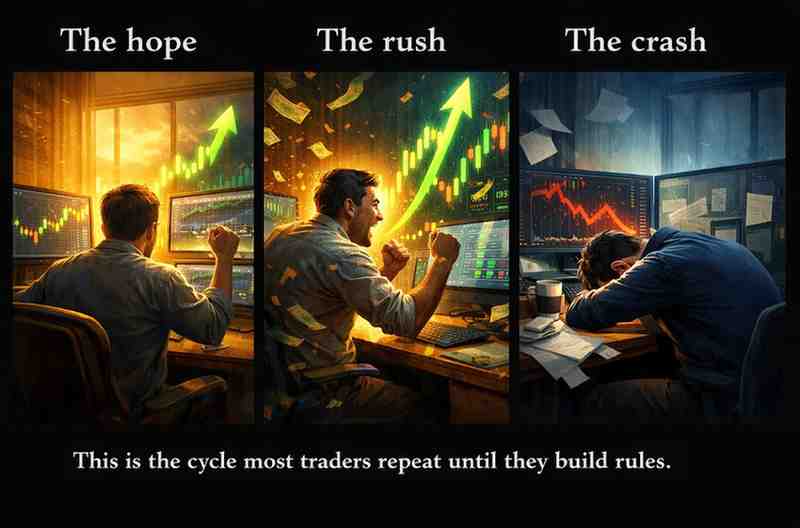
If the hope, the rush, the crash and the quiet desperation sound familiar, the explanation isn't bad luck or a missing secret indicator. It's how people think, and a market that doesn't care. Here are the four most common ways that goes wrong, and what to do about each.
First, a Word About the "90%"
The 90% figure gets repeated everywhere, but no single source defines it, and the true number depends on who you count and over what period. The better evidence points the same way, though. A study of Brazilian day traders in the equity futures market tracked people who started between 2013 and 2015 and persisted for at least 300 days: 97% of them lost money, and only about 1% earned more than the Brazilian minimum wage. That's one market and one style of trading, but the broader pattern in research on retail traders is similar. Most people who try short-term trading don't make it pay.
The Four Pillars of Failure: Why Your Brain Is Your Worst Enemy
Trading platforms are designed to be easy to use, yet they connect directly to a very old piece of wiring: your fight-or-flight response. Decisions that feel like analysis are often fear and greed in disguise. These are the four patterns that cause the most damage.
1. The Storyteller's Curse: You're Trading a Story, Not Price Action
People are built to explain things. When a stock moves, your brain insists on knowing why, so it invents a reason.
- The story: "The CEO gave a glowing interview, so this must go up. The Fed sounds dovish, so markets will rise."
- The reality: the news is usually already in the price. You're buying the headline, not the trend.
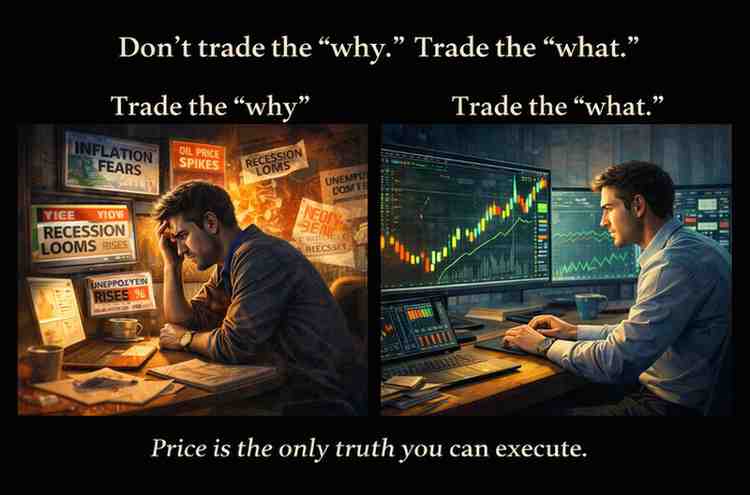
The fix: stop guessing why and focus on what's happening now and what your plan says to do about it. Don't trade the "why." Trade the "what."
2. The Illusion of Safety: Risk Management Theater
- The theater: you set a stop-loss 5% away, price approaches it, and you move it further down to "give the trade room."
- The disaster: support breaks anyway, and a planned 5% loss becomes 8% or more.
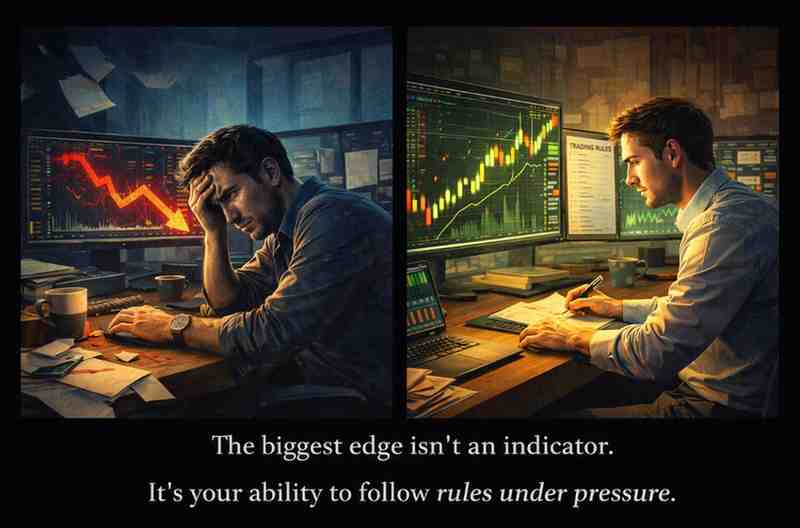
The fix: decide how much you're willing to lose before you enter, and treat the stop like a fire alarm, not a dial. A common guideline is to risk only 1% to 2% of your account on any one trade. On a $5,000 account, 1% is $50. That feels small, which is exactly the point: it lets you survive a string of losses without damage.
3. The FOMO-TOMO Cycle
Fear of missing out gets you in late: you chase a stock that's already up 10% to 20% because everyone else seems to be making money. Then comes the fear of taking out, the hesitation to sell once you're in profit in case it rips higher, which turns gains into losses. Both are the same emotion wearing different clothes.
The fix: write down what makes a setup valid and what makes an exit valid. If a trade doesn't meet your criteria, it doesn't exist, no matter how fast the price is moving.
4. The Analysis Paralysis Vortex
Too much information destroys execution. Beginners pile on indicators, scan five timeframes and follow a dozen opinions, and end up unable to act or acting on whichever signal agrees with what they already wanted to do. The fix: simplify. A clean chart with a few tools you understand beats a cluttered one every time.
The Cost of Overtrading
There's a fifth killer that hides inside the others: trading too often. Every trade costs something, in spreads, commissions and slippage, and those costs are certain while the profits aren't. A trader who needs to win a third of their trades just to cover costs is starting every day in a hole. Fewer, better trades with clear reasons almost always beat constant activity.
The Mindset Gap: Why You Do Things That Aren't Good for You
| Professional Mindset (A Cultivated Skill) | Amateur Mindset (The Default Setting) |
|---|---|
| Main goal: make money over many trades | Main goal: be right and prove a thesis |
| Self-image: risk manager working with probabilities | Self-image: market prophet who knows secrets |
| After a win: log it and move on | After a win: overconfidence and bigger bets |
| After a loss: review the plan calmly | After a loss: anger and revenge trading |
| Relationship with capital: business lifeblood | Relationship with capital: chips to bet |

The Only Roadmap That Works (The Boring, Unsexy One)
Phase 1: The Intervention (Weeks 1-2)
Stop trading. Close or reduce open positions according to your plan and step away. The goal isn't to punish yourself. It's to break the loop of loss and revenge long enough to think clearly.
Phase 2: The Blueprint (Weeks 3-4)
Write a one-page trading plan that defines what you'll trade, your entry rules, how much you'll risk, your position size and your exit rules for both profit and loss. If it doesn't fit on one page, it's too complicated.
Phase 3: The Simulation (Weeks 5-12 and beyond)
Trade the plan on a demo account until following it feels boring and automatic. Keep a journal of every trade: why you entered, what you did, how you felt. Demo trading doesn't recreate the emotions of real money, but it does show whether you can follow your own rules.
Phase 4: The Slow Return (The Forever Phase)
Return to live trading with tiny risk and scale up only after you've proved discipline over a meaningful number of trades. Success here is measured by whether you followed the plan, not by how much you made this week.
What Consistent Traders Do Differently
There's no secret, but there are habits. They risk a fixed, small fraction of their account on every trade, so no single loss matters much. They write their rules down and follow them even when it's uncomfortable. They keep a journal and learn from it. They accept being wrong quickly, without trying to prove the market mistaken. And they treat trading like a business with costs, records and a long timeline, not like a way to get rich by Friday. None of that is exciting, which may be why so many people skip it.
A Weekly Review Habit
One habit does more than most. Once a week, review every trade you took. Mark whether you followed your plan, separately from whether the trade made money. A losing trade you took by the rules is fine. A winning trade you took by breaking your rules is a warning, because it teaches the wrong lesson. Over a few weeks you'll see patterns: the time of day you overtrade, the setups you chase, the moods that lead you astray. Fix the process first, and the results tend to follow.
The Last, Unpleasant Truth
The market doesn't beat you. Most of the time, you beat yourself. Build the discipline first, and treat profits as the by-product of a process you trust. Plenty of people will still find that trading isn't for them, and that's a perfectly sensible conclusion, not a failure.
Building wealth in any space, not only in trading, takes proper scaling. Making profit is only half of it; securing it, cutting losses and controlling expenses matter more. To learn more, see building wealth from scratch. The aim is to build wealth, not just to look rich.
Keep Reading
Continue learning
Questions and answers
Do 90% of traders really fail?
The 90% figure is a popular estimate with no single source. Research on retail day traders, such as a study of Brazilian futures traders, found that the large majority lose money over time. The exact number varies with the market, the time period and how success is defined.
What is the biggest reason traders lose money?
A lack of discipline: oversized positions, moving stop-losses, revenge trading and chasing moves. Most of these are emotional decisions rather than failures of analysis.
How much should I risk per trade?
Many traders risk between 1% and 2% of their account on any one trade, so a string of losses can't do serious damage. The right figure depends on your account size and experience.
Should beginners practise on a demo account first?
Yes, to test whether you can follow a written plan. Demo trading doesn't reproduce the pressure of real money, so move to live trading with very small risk once your results are consistent.