How Regular People Build Wealth in the Stock Market
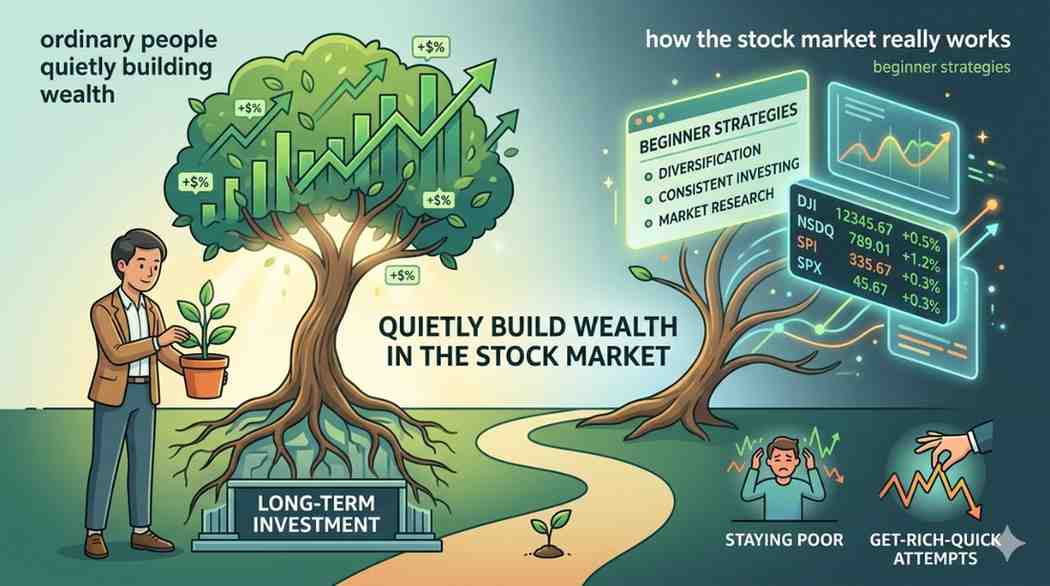
Learn how ordinary people build wealth in the stock market with beginner strategies and a long-term investing mindset.
The stock market isn't a casino, but it isn't a money machine either. It's a way of owning small pieces of real businesses, and over long stretches the owners of good businesses have tended to do well. The people who build wealth this way are rarely the cleverest. They start early, put money in regularly, don't panic when prices fall and leave it alone for years. This guide explains how the market works, how a beginner can start sensibly, and why patience tends to beat prediction.
What Is the Stock Market in Simple Terms?
The stock market is where shares of companies are bought and sold. A share is a small slice of ownership in a business, whether that's a giant like Apple, Google, Tesla or Amazon, or a smaller company you've never heard of. Companies sell shares to raise money to grow, and investors buy them hoping to share in the profits and the growth. When a business does well over time, the value of its shares has tended to follow. No magic, just ownership.
Why Many People Use Stocks to Build Wealth
There are a few reasons stocks keep turning up in long-term plans. Your money can work while you sleep, because you own businesses that keep operating whether or not you're watching the charts. Over long periods, broad stock markets have historically grown faster than inflation, which is what protects your buying power, although that's a pattern and not a promise. You don't need to be rich to start, since many brokerage apps let you begin with $10 to $50 through fractional shares. And compounding does the heavy lifting: growth builds on earlier growth, so small, regular amounts turn into large sums given enough time.
What Compounding Looks Like in Numbers
Suppose you invest $300 a month for 25 years, which means you put in $90,000 yourself. What it grows to depends heavily on the return you actually get, and nobody can know that in advance:
| Average annual return | Approximate value after 25 years | Of which your own money |
|---|---|---|
| 6% | $208,000 | $90,000 |
| 8% | $285,000 | $90,000 |
| 9% | $336,000 | $90,000 |
| 10% | $398,000 | $90,000 |
The point isn't that you'll get 9% or 10%. It's that regular contributions and time can do far more than most people expect, and that a couple of percentage points either way changes the outcome by tens of thousands. Consistency also beats timing. Someone who invests $200 a month for 20 years puts in $48,000 and, at 8%, ends up with roughly $118,000. A person who invests a one-off $50,000 can end up with more, but only if they have that lump sum to begin with. For most people, regular saving is the version that's actually available.
How the Stock Market Really Makes You Money
There are three main ways. Price appreciation is the obvious one: you buy shares, the business grows and you can sell at a higher price. Dividends are cash payments some companies make to shareholders from their profits, regardless of whether you sell. And compounding ties them together, because reinvested dividends and gains buy more shares, which then earn their own growth. Over decades, it's that third element that produces most of the result.
Stock Market vs Gambling: The Honest Difference
Investing differs from gambling in one important way: you own something productive. A broad portfolio of companies earns profits, pays dividends and tends to grow with the economy, while a roulette wheel is built to take a cut from everyone who plays. Gambling is based on chance, a short horizon and emotion. Investing, done well, is based on business performance, a long horizon and a plan.
That said, the line blurs when people behave like gamblers. Buying a single hot stock because someone online said it would double, jumping in and out every few days or borrowing to invest are all closer to betting than investing. People lose money in stocks mostly for that reason, not because the market is broken.
Why Fees Matter More Than They Look
A fee of 1% a year sounds trivial, but it compounds against you. Take the $300-a-month example from earlier. At an 8% average return, 25 years of contributions grow to roughly $285,000. If fees take 1% a year and your net return is 7%, the same contributions grow to roughly $243,000. That's a gap of about $42,000 from a charge that barely shows up on a statement, which is why low-cost index funds are so popular with long-term investors. Check a fund's expense ratio and a broker's trading fees before you commit.
Your First Month: A Simple Checklist
If you're ready to start, the first month doesn't have to be complicated. Decide how much you can invest every month without touching your emergency fund. Choose a regulated broker or app and read its fee schedule. Pick one broad, low-cost fund to begin with, rather than a handful of stocks. Set up an automatic monthly contribution so investing happens without a decision each time. Then leave it alone and review once or twice a year, not every day.
Where Beginners Go Wrong
The mistakes are remarkably consistent. Beginners chase whatever's been rising, sell in a panic when prices fall, invest money they'll need within a year or two, copy influencers without checking their record, and start with no plan at all. Most of those come down to emotion. Investors who do better tend to do the opposite: they buy broad, sensible holdings, think in years, ignore daily noise and keep contributing regardless of the headlines.
A Sensible Beginner Strategy
- Sort the basics first: an emergency fund and no high-interest debt, so you never have to sell investments in a bad month.
- Start with broad index funds or established, financially solid companies. A fund that holds hundreds of companies protects you from any single one failing.
- Invest a fixed amount every month rather than waiting for the perfect moment. This is often called dollar-cost averaging, and it removes the pressure of timing.
- Watch costs. Fund fees and trading commissions compound against you just as returns compound for you.
- Reinvest dividends, hold for years rather than weeks, and decide in advance what you'll do when the market falls.
What the Bad Years Look Like
Stock markets do fall, sometimes sharply. The US S&P 500 dropped by roughly a third in a matter of weeks in early 2020 and by more than half between 2007 and 2009, and both falls were later recovered. An investor who could sit tight came through. One who needed the money in the middle of the drop, or sold out of fear, locked in the loss. That's why your time horizon matters more than almost anything else, and why money you'll need soon belongs somewhere safer.
Can You Lose Money in the Stock Market?
Yes. Individual companies can fall a long way or fail altogether, and even broad markets can stay down for years. Diversification, a long horizon and steady contributions improve your odds considerably, but they don't remove the risk. Anyone who tells you the market is certain to reward you has something to sell.
How Much Can You Realistically Make?
Broad US stock markets have averaged returns in the region of 7% to 10% a year over very long periods, with the lower end closer to what's left after inflation. That's an average across good and terrible years, not a yearly expectation, and returns elsewhere in the world have differed. Plan with cautious assumptions, such as the 6% and 8% rows in the table above, so a good outcome is a bonus instead of a requirement.
Investing From Nigeria or Elsewhere Outside the US
If you're investing from outside the US, you generally have two routes: local exchanges such as the Nigerian Exchange, or licensed brokers and apps that give access to foreign markets. Check that any platform is regulated where you live, look carefully at fees and withdrawal rules, and remember currency risk. If you earn in naira and invest in dollars, exchange-rate moves can work for you or against you, and they can be large.
Stock Market Myths Worth Ignoring
You don't have to be rich to invest, since small regular amounts matter. You don't need inside information, and acting on it is illegal anyway. It isn't too risky for beginners if you start with diversified funds and a long horizon. And you don't need to watch charts every day; for long-term investors, watching too closely usually makes things worse. The simpler your approach, the easier it is to stick with.
Final Thoughts
The stock market is a tool, not a shortcut. It won't make you rich overnight, but it can build real wealth over time for people who stay consistent and keep their emotions in check.
Building wealth in any market, not only stocks, takes more than good returns. Protecting what you've made and keeping losses and expenses under control matters at least as much. For the bigger picture, see building wealth from scratch.
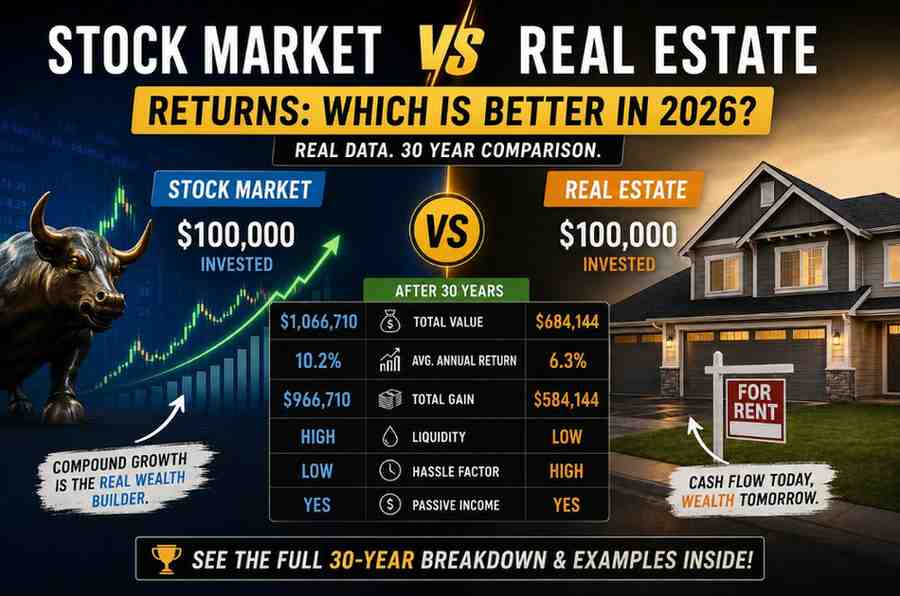
You may also find stock market vs. real estate returns useful.
Continue learning
Questions and answers
How much money do I need to start investing in stocks?
Many platforms let you start with $10 to $50 through fractional shares. What matters more than the starting amount is contributing regularly and keeping fees low.
Are index funds a good choice for beginners?
They're a popular starting point because one fund holds many companies, which spreads risk and keeps costs low. They still fall when the market falls, so they suit money you can leave invested for years.
What is a realistic return from the stock market?
Broad US markets have averaged roughly 7% to 10% a year over very long periods, with the lower end closer to after-inflation returns. Individual years vary enormously, and returns aren't guaranteed.
Can I invest in the stock market from Nigeria?
Yes, through local exchanges or through regulated brokers and apps that offer foreign markets. Check the platform's regulation, fees and withdrawal rules, and consider currency risk.